





Single-Use Technology vs Stainless Steel: why is this decision getting harder?
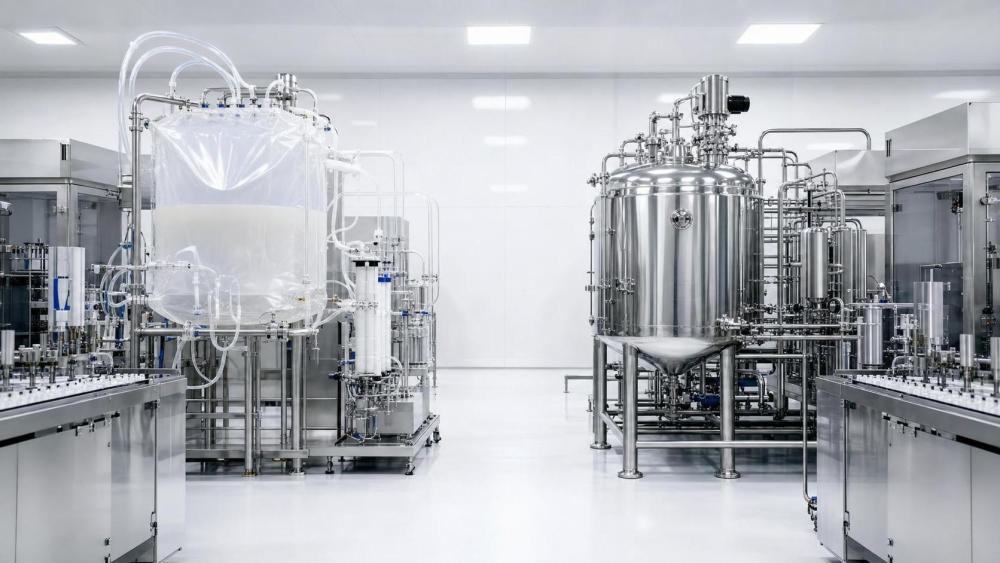
In biopharma operations, equipment choice now shapes cost structure, speed, and compliance effort at the same time.
That is why the debate around single-use technology versus stainless steel keeps returning in sourcing discussions.
On paper, the comparison looks simple.
Single-use technology reduces cleaning and shortens changeover.
Stainless steel spreads cost across years and supports large, stable production.
In practice, the answer depends on batch profile, facility utilization, validation burden, and supply continuity.
This matters across the broader BLES landscape, from bioreactors and downstream separation to liquid handling and GMP-facing workflows.
When process flexibility becomes a competitive need, single-use technology often gains attention first.
When long campaigns and predictable demand dominate, stainless steel still remains difficult to replace.
The more useful question is not which platform is better overall.
It is which platform creates the best cost and changeover outcome for the actual production model.
What does single-use technology really change beyond disposable components?
Many people reduce single-use technology to bags, tubing, filters, and presterilized flow paths.
That description is correct, but incomplete.
The bigger shift is operational.
A single-use setup changes how quickly lines switch between molecules, how often cleaning validation is required, and how shutdown time is planned.
In facilities handling monoclonal antibodies, vaccines, or CGT programs, that flexibility can be worth more than a narrow unit-cost comparison.
BLES analysis often frames this as a link between microscopic process control and commercial responsiveness.
If a site must move rapidly from development batches to pilot runs, single-use technology supports that rhythm well.
It also reduces dependence on clean-in-place and steam-in-place infrastructure.
That lowers utilities demand and simplifies some facility design decisions.
Still, disposable does not mean effortless.
Extractables and leachables review, supplier qualification, waste handling, and film compatibility remain serious evaluation points.
Where do the real cost differences show up?
The most common mistake is comparing purchase price alone.
A better comparison separates capital expense, operating expense, and hidden compliance labor.
Single-use technology usually lowers initial capital because tanks, piping, cleaning skids, and utility systems can be smaller or fewer.
Stainless steel usually wins on consumable cost when volumes are high and campaigns are long.
The break-even point moves with scale, campaign frequency, and the number of product changeovers per year.
For facilities under uncertain demand, idle stainless assets become expensive very quickly.
For heavily utilized plants, repeated single-use assemblies can create significant annual spend.
The table below helps organize the comparison in a more practical way.
A realistic sourcing review should price all five areas together, not in isolation.
Is changeover speed the strongest argument for single-use technology?
Very often, yes.
But only when the facility truly benefits from frequent product switches.
Single-use technology removes much of the cleaning, drying, and revalidation time between campaigns.
That can shorten nonproductive hours and open more slots for development or clinical batches.
In multi-product environments, faster changeover also lowers scheduling friction across upstream and downstream operations.
This becomes especially important when bioreactors, centrifuges, filtration skids, and liquid handling workflows must stay synchronized.
However, speed gains should be tested against preparation reality.
Assemblies must be available, operators trained, and documentation released on time.
If supply lead times are unstable, the promised agility of single-use technology can narrow quickly.
More common than many expect is a hybrid model.
Core high-volume steps remain stainless steel, while flexible buffer prep, seed train, sampling, or small-scale transfer paths shift to single-use technology.
When does stainless steel still make better economic sense?
Stainless steel still performs well in mature production with stable forecasts and long manufacturing campaigns.
If a line runs similar products for extended periods, changeover savings matter less.
In those cases, reusable systems can spread investment over many years and many batches.
Large-scale commercial biologics often fit this profile, especially where utility systems already exist.
There is also a process familiarity advantage.
Engineering teams usually know how stainless systems behave under stress, maintenance, and scale-up conditions.
That experience reduces uncertainty in some projects.
The tradeoff is slower responsiveness.
Any change to cleaning cycles, validation protocols, or line allocation can ripple through production calendars.
So stainless steel is not automatically cheaper.
It is cheaper when the plant stays busy enough to justify its fixed cost and slower transitions.
What risks are often missed during sourcing and vendor comparison?
The first blind spot is assuming single-use technology always reduces risk.
It reduces cross-contamination risk, but it can introduce supplier dependence and material-change exposure.
A bag film revision, connector change, or sterilization update may trigger fresh review.
The second blind spot is underestimating documentation alignment.
GMP readiness depends on extractables data, lot traceability, change notification, and compatible validation packages.
This is where the BLES perspective becomes useful.
The decision is not only mechanical.
It connects process scale-up, audit resilience, and data integrity across the production chain.
A short checklist helps keep evaluation grounded.
- Confirm annual batch count and expected product change frequency.
- Quantify cleaning validation hours and utility consumption today.
- Review supply security for bags, manifolds, filters, and connectors.
- Check change notification policy and material traceability depth.
- Model waste handling, storage, and disposal cost.
- Test whether the platform supports future scale-up or tech transfer plans.
These points usually reveal whether single-use technology is a strategic fit or just an attractive short-term option.
How should the final decision be made when both options look reasonable?
When the comparison is close, the best decision usually comes from scenario modeling rather than preference.
Start with three demand cases: conservative, expected, and high-growth.
Then calculate how single-use technology and stainless steel behave in each case.
Include changeover hours, validation labor, facility modifications, consumables, utilities, and lost capacity during transitions.
This often makes the answer clearer than debating general advantages.
If demand uncertainty is high, single-use technology often protects flexibility better.
If product mix is stable and throughput is consistently high, stainless steel may deliver stronger lifetime economics.
A blended architecture is also worth serious consideration.
That approach fits the current direction of many life science facilities tracked by BLES.
They need absolute process control, but also faster commercial response.
If the next step is evaluation, build a side-by-side decision sheet around cost per batch, changeover time, validation burden, and supply resilience.
That turns the single-use technology discussion from opinion into an operational decision with measurable tradeoffs.
Related News
- TÜV Rheinland Sets 2,000-Cycle SUT Fatigue Test RuleJun 23, 2026Bioprocess Scientist
- TÜV Rheinland Sets New SUT Fatigue Test RuleJun 22, 2026Bioprocess Scientist
- Single-Use vs Stainless Bioreactors: Which Fits Scale-Up Better?Jun 21, 2026Bioprocess Scientist
- TÜV Rheinland Tightens SUT Testing for CE FilingsJun 21, 2026Bioprocess Scientist
Related News
- 00
0000-00
Pharmaceutical Scale-Up: When Process Gains No Longer Justify the Cost - 00
0000-00
Innovative Drug Development Trends Shaping Partner Selection in 2026 - 00
0000-00
High-Throughput Screening Bottlenecks and How to Improve Assay Throughput - 00
0000-00
GMP Compliance Checklist: Common Data Integrity Risks in Regulated Labs - 00
0000-00
Liquid Chromatography Mass Spectrometry: How to Choose the Right Setup for Trace Analysis
Bioprocess Scientist
Weekly Insights
Stay ahead with our curated technology reports delivered every Monday.