





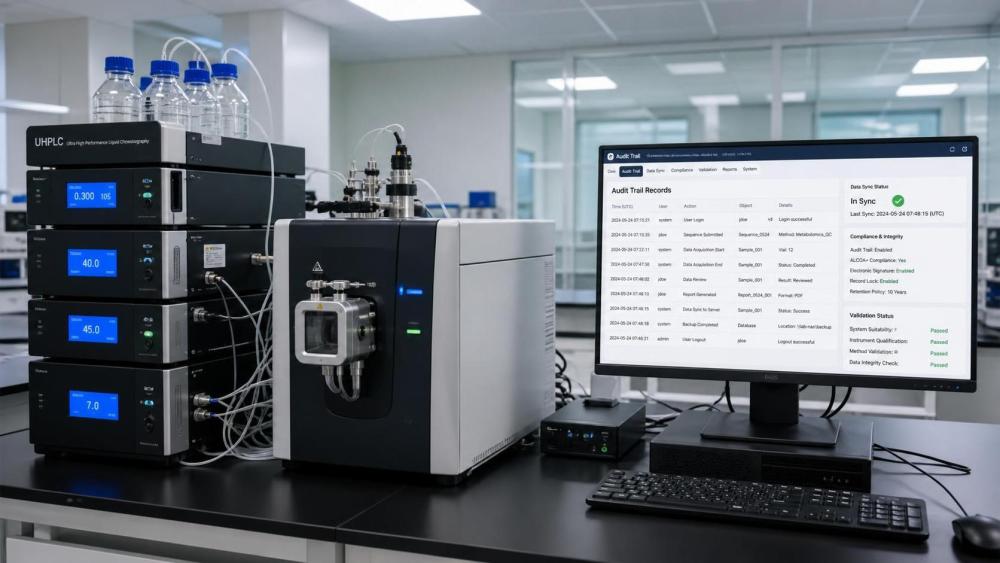
On August 9, 2026, the European Medicines Agency (EMA) issued the final revised version of GMP Annex 11, clarifying that computerized systems supplied with laboratory equipment marketed in the EU must support bidirectional, tamper-evident audit trail integration between LIMS and CSV platforms, while also enabling real-time remote GMP compliance checks. For exporters, equipment makers, validation teams, and EU-facing laboratory supply chains, this matters because the requirement reaches beyond instrument performance and into how digital records, validation packages, and delivery readiness are presented to customers.
What the revised Annex 11 explicitly requires
According to the information provided, the EMA released the final revised Annex 11 on August 9, 2026. The update states that all computerized systems associated with laboratory equipment placed on the EU market must achieve bidirectional integration of audit trails between LIMS and CSV platforms, and those audit trails must be tamper-evident. The requirement applies to equipment categories including UHPLC systems, Q-TOF mass spectrometers, and NGS library preparation workstations. The same update also requires support for real-time remote GMP compliance inspection. The information provided further states that this change directly affects the completeness of validation packages and delivery timelines for Chinese exporters supplying equipment to EU customers.
Where the impact is likely to be felt first
Equipment exporters and OEM delivery teams
From an industry perspective, exporters and original equipment suppliers are likely to feel the impact most directly because their deliverables to EU customers extend beyond hardware and into computerized system readiness. The business effect is likely to show up in validation documentation, system integration evidence, and customer acceptance timing. What deserves closer attention is whether existing delivery packages clearly demonstrate the required audit trail linkage between LIMS and CSV environments.
Validation and compliance service providers
Service teams responsible for computerized system validation may face tighter expectations around how integration, traceability, and record integrity are documented. The practical pressure point is not only whether systems operate, but whether audit trails can be presented as bidirectional and tamper-evident in a form suitable for GMP review, including remote review scenarios.
EU buyers and laboratory operators
Purchasers and end users in the EU may pay closer attention to the completeness of supplier documentation before acceptance or deployment. Analysis shows that, where procurement involves regulated laboratory workflows, review of computerized system interfaces and remote inspection readiness could become a more visible part of supplier evaluation and handover discussions.
Supply chain coordination and project delivery functions
For teams handling project scheduling, cross-border delivery, and implementation planning, the likely impact is on sequencing and coordination. Observably, when compliance expectations move into integrated digital records, handover may depend more heavily on the alignment of software, validation materials, and customer-side review processes rather than on equipment shipment alone.
What companies should watch now
Separate confirmed rules from implementation assumptions
The confirmed point in the provided information is the EMA's requirement for bidirectional, tamper-evident audit trail integration between LIMS and CSV systems, together with support for real-time remote GMP checks. Companies should avoid assuming broader obligations that are not stated in the provided information and instead anchor internal reviews to the exact compliance language available to them.
Review validation package completeness early
Because the update is described as directly affecting validation package completeness, exporters and project teams should pay close attention to whether their current handover materials adequately cover computerized system integration, audit trail behavior, and evidence suitable for customer review. In practice, this is likely to become a timing issue as much as a documentation issue.
Check delivery schedules against compliance handover steps
What deserves closer attention is the connection between regulatory expectations and delivery timing. Even where equipment configuration is technically ready, acceptance milestones may be delayed if supporting compliance records are incomplete or if integration evidence is not prepared in a reviewable format for EU customers.
Prepare for more detailed customer communication
For account teams, regulatory liaisons, and implementation managers, the immediate focus should be on communication readiness. Questions from EU customers are likely to center on how LIMS and CSV audit trails interact, how tamper resistance is demonstrated, and how remote GMP review can be supported within the delivered system environment.
Why this reads as more than a narrow software change
Analysis shows that this update should not be understood only as a technical software interface matter. It points to a compliance expectation in which laboratory equipment, computerized systems, and validation evidence are assessed together. It is more appropriate to understand this as a near-term operational requirement for EU-facing suppliers, and at the same time as a longer-term signal that digital traceability and remote reviewability are becoming more central to regulated equipment delivery.
How the industry may best interpret this stage
At this stage, the information supports a measured conclusion. The rule change is already concrete in its stated requirement, but the full business effect will depend on how suppliers, service providers, and buyers translate that requirement into validation workflows, delivery documents, and acceptance procedures. It is more appropriate to understand this development as both an immediate compliance checkpoint and an ongoing industry signal that still warrants close observation in practice.
Basis of this article and follow-up verification
This article is based on the user-provided news title, event date, and event summary. For this category of development, relevant source types typically include official regulatory announcements, company notices, industry association updates, authoritative media coverage, and standard-setting documents. A specific official source link was not provided in the input, so the exact source document and any subsequent clarifications still need continuous verification. Further monitoring should focus on whether additional official wording, implementation interpretation, or related compliance guidance emerges after the final Annex 11 revision.
Related News
- What drives laboratory system validation cost in GMP environments?Sep 23, 2026Dr. Elara Sterling
- How analytical metrology systems support data integrity in QC labsSep 22, 2026Dr. Elara Sterling
- How to evaluate a process technology equipment manufacturer for GMP readinessSep 21, 2026Dr. Elara Sterling
- When digital laboratory workflow solutions reduce GMP data integrity riskSep 19, 2026Dr. Elara Sterling
Related News
- 00
0000-00
What drives laboratory system validation cost in GMP environments? - 00
0000-00
How analytical metrology systems support data integrity in QC labs - 00
0000-00
How to evaluate a process technology equipment manufacturer for GMP readiness - 00
0000-00
When does a single use manufacturing platform reduce scale-up risk? - 00
0000-00
When digital laboratory workflow solutions reduce GMP data integrity risk
Dr. Elara Sterling
Weekly Insights
Stay ahead with our curated technology reports delivered every Monday.