





How GMP Shapes Risk Management in Innovative Drug Development
In innovative drug development, GMP is often discussed as a requirement that becomes relevant when a program approaches clinical manufacturing or commercial launch. That view is too narrow. GMP is the operating discipline that forces a development team to ask the difficult questions early: What could change the product? Which measurements can be trusted? What happens if an automated system fails silently? Can a process be transferred without changing the quality attributes that matter to patients?
For quality and safety teams, GMP innovative drug development is not simply about creating documentation. It is about turning uncertainty into a managed set of risks, controls, decisions, and evidence. This becomes especially important for biologics, cell and gene therapies, high-potency products, and complex analytical workflows, where the product may be sensitive to small changes in raw materials, environmental conditions, equipment configuration, operator handling, or data processing rules.
A promising molecule can fail long before its clinical value is fully understood if the process cannot generate consistent material, the analytical method cannot distinguish a real signal from an artifact, or the batch record cannot explain what actually happened. GMP does not remove scientific uncertainty. It makes uncertainty visible, traceable, and easier to control.
Risk management begins when the science is still moving
Early development is often fast, exploratory, and deliberately flexible. Teams may adjust culture media, purification conditions, formulations, or analytical methods as they learn more about the molecule. That flexibility is necessary. The mistake is assuming that GMP discipline must wait until the process is “final.” By the time a method or manufacturing platform is locked, undocumented changes and weak comparability evidence can become expensive to unravel.
A practical GMP risk framework asks four connected questions: what can go wrong, how likely is it, how serious would the consequence be, and how would the organization detect or prevent it? The approach is consistent with quality risk management principles described in ICH Q9, but its value depends on how honestly it is applied. A risk assessment that merely scores every item “medium” gives little direction. A useful assessment identifies the few variables that can genuinely alter product quality, patient safety, operator safety, or data reliability.
For example, an early-stage CHO cell culture process may be robust enough to tolerate modest changes in agitation, but highly sensitive to shifts in dissolved oxygen control, inoculum condition, or feed timing. In that case, the key risk is not “bioreactor operation” in general. It is the specific combination of sensor performance, control strategy, sampling practice, and operator response when a process parameter drifts. That distinction matters because it determines what should be monitored, calibrated, investigated, and eventually validated.
The same principle applies to CGT workflows. A short hold-time deviation, a mix-up in chain-of-identity information, or a contamination event may carry far greater significance than a minor deviation in a more conventional small-molecule process. GMP risk management should therefore be proportionate to the product and process, not copied from a generic checklist.
Equipment risk is really process risk
In biopharmaceutical production, equipment is never just hardware. A bioreactor, centrifuge, filtration skid, biosafety cabinet, liquid handler, or LC-MS platform becomes part of the control strategy once it affects material quality or the evidence used to release material. Quality personnel should resist the habit of treating qualification as a one-time engineering exercise. The real question is whether the equipment continues to perform as intended in the actual process, with actual users, materials, cleaning practices, and data flows.
Consider downstream purification. Industrial centrifuges and separation systems must remove cell debris and reduce the burden on subsequent purification steps, but their risk profile extends beyond mechanical performance. Feed variability, bowl handling, hold times, cleaning effectiveness, filter integrity, and sample traceability can all affect the final outcome. If a centrifugation step is followed by ultrafiltration or diafiltration, the team must understand whether a process excursion changes impurity clearance, product concentration, aggregation behavior, or recovery. It is not enough to state that the system “ran normally.”
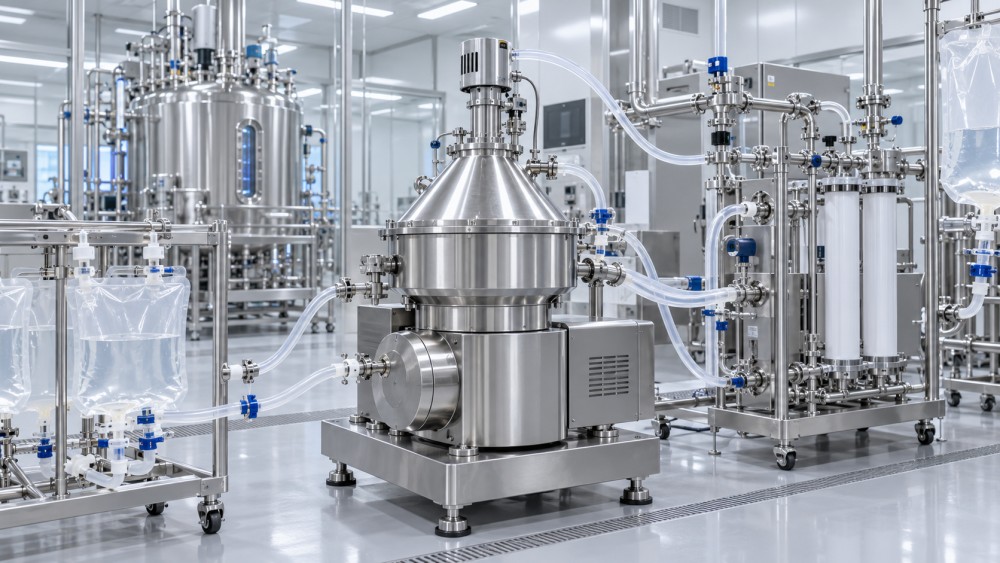
This is why equipment selection and process development should not be separated too aggressively. A platform may offer attractive throughput but provide limited access to audit trails, calibration history, alarm review, or user-level controls. Another system may be more appropriate for a regulated workflow even if it requires more upfront implementation effort. In practice, the lowest purchase price can become the highest lifecycle risk when the equipment cannot support investigations, change control, maintenance, or compliant data retention.
For organizations evaluating single-use technology, the risk discussion also needs to go beyond speed of changeover. Single-use assemblies can reduce cleaning validation burden and increase operational flexibility, but they introduce their own controls: supplier qualification, component traceability, incoming inspection, installation checks, integrity testing where applicable, and assessment of extractables and leachables according to the intended use. A single-use system is not inherently lower risk; it changes where the risk sits.
Data integrity is a patient-safety control, not an IT detail
Innovative drug programs generate a large amount of electronic information: chromatograms, instrument method files, environmental monitoring results, cell culture trends, plate maps, audit trails, images, and automated calculations. When those records are fragmented across standalone instruments, spreadsheets, laboratory information systems, and cloud platforms, the main risk is not merely lost efficiency. It is the loss of confidence in the decision-making chain.
Data integrity expectations are commonly framed through ALCOA+ principles: records should be attributable, legible, contemporaneous, original, accurate, and supported by additional expectations such as completeness, consistency, endurance, and availability. These concepts are straightforward on paper. Their difficult part is implementation. An LC-MS analyst may generate a technically valid run, for example, but the result becomes hard to defend if reprocessing is uncontrolled, integration changes are undocumented, failed injections are excluded without justification, or the audit trail is not reviewed according to procedure.
High-molecular analytical metrology makes this especially sensitive. Products with closely related variants, aggregates, charge differences, or structurally similar impurities can require careful analytical interpretation. The instrument is capable of detecting a signal; that does not automatically mean the laboratory has demonstrated that the signal is meaningful, reproducible, and correctly processed. Method lifecycle management, reference standards, system suitability, analyst training, and predefined review criteria all contribute to risk reduction.
Computerized system validation should be approached with the same practical mindset. Not every software function has equal impact. A configuration that controls a critical calculation, records a batch decision, or preserves raw analytical data deserves deeper scrutiny than a convenience feature with no quality impact. Risk-based validation does not mean reduced rigor. It means focusing effort where failure could compromise product quality, patient safety, or the integrity of regulated records.
Automation reduces some errors and creates different ones
Automated liquid handling has transformed high-throughput screening, NGS library preparation, assay development, and repetitive sample preparation. A workstation can dispense microliter volumes into dense microplate formats far more consistently than an operator performing hundreds of repetitive manual transfers. Yet automation should not be treated as automatic compliance.
The typical failure modes are different. A manual workflow may be vulnerable to fatigue, transcription mistakes, and pipetting variability. An automated workflow may be vulnerable to a wrong deck layout, an unapproved script revision, a mislabeled source plate, incorrect liquid-class settings, unrecognized carryover, or a failed calibration that remains undetected. Because automation can process many samples quickly, a configuration mistake can propagate before anyone sees the pattern.
The appropriate control is not to surround every robot with excessive paperwork. It is to define the intended use clearly and test the conditions that matter. If the workstation supports a potency assay, then volume accuracy, precision, mix performance, plate mapping, barcode controls, software access, and exception handling may all be relevant. If it only prepares exploratory research samples, the control burden may be different. The boundary between research use and GMP use needs to be explicit; ambiguity is where weak practices tend to survive.
Contamination control is both a quality and occupational safety issue
Biosafety cabinets and clean benches are often discussed in terms of airflow performance, but they sit at the intersection of operator protection, sample protection, and environmental protection. These goals are not interchangeable. A clean bench intended to protect a product is not automatically suitable for work involving hazardous materials. Likewise, a biosafety cabinet may provide a defined containment function, but only when it is correctly selected, installed, maintained, and used within its operational limits.
For teams handling viral vectors, pathogenic agents, or cytotoxic compounds, GMP risk management needs coordination between quality, biosafety, engineering, and operations. The risk assessment should address workflow design, material movement, decontamination, waste handling, spill response, maintenance access, and training—not simply the cabinet specification. A well-qualified unit can still be undermined by blocked grilles, overloaded work zones, poor cleaning technique, or unplanned interventions during critical operations.
This is an area where procedural reality matters more than elegant documentation. If an instruction cannot be followed during a busy shift, it is not an effective control. Quality teams should observe the work, ask operators where they improvise, and use those findings to improve the process before a deviation exposes the gap.
Scale-up reveals whether risk knowledge is transferable
A process that performs well in a small development vessel may not behave the same way in a pilot or manufacturing-scale bioreactor. Mixing time, gas-liquid mass transfer, heat removal, sparger design, shear environment, and sensor placement can change the conditions experienced by cells. Matching a single setpoint across scales is not necessarily the same as matching process performance.
This is where GMP turns development knowledge into a defensible scale-up strategy. Teams need to identify which parameters are scale-dependent, which quality attributes need comparability evidence, and what ranges remain acceptable. A 2,000 L system may require a different operational approach than a bench-scale unit even when both use the same nominal temperature and pH targets. The question is not whether the process has been copied. It is whether the process-relevant conditions have been understood well enough to manage change.
BLES follows this intersection of bioprocessing, downstream purification, analytical control, automated liquid handling, and GMP compliance because these disciplines are often treated as separate conversations. In actual development programs, they are tightly connected. A change in upstream performance can alter downstream impurity burden; a revised purification step can change the analytical profile; a software update can affect the traceability of all resulting data.
The useful GMP question is: can we explain and control this?
The strongest quality systems do not try to eliminate every deviation or uncertainty. Drug development is too complex for that. They make sure that deviations are detected promptly, investigated with appropriate technical depth, and translated into better controls when needed. They distinguish between a documentation lapse and a product-impacting event without minimizing either. They also avoid the opposite mistake: treating every minor inconsistency as a crisis and exhausting the organization with low-value investigations.
For innovative therapies, GMP risk management works best when it is introduced as a development partner rather than an approval gate. Bring quality into equipment selection, analytical method design, automation planning, and scale-up discussions early enough for controls to be built in. Ask whether the team can reconstruct a critical decision months later from complete records. Ask whether a process change has a scientific rationale and a proportionate comparability plan. Ask whether the controls still work on a difficult day, not only during a planned audit.
Those questions are demanding, but they are also practical. They are how scientific promise becomes material that can be trusted, reviewed, transferred, and ultimately used to treat patients.
- high-molecular analytical metrology
- automated liquid handling
- industrial centrifuges
- separation systems
- biosafety cabinets
- clean benches
- GMP compliance
- high-throughput screening
- single-use technology
- innovative drug development
- GMP innovative drug development
- data integrity
- computerized system validation
Related News
- How to assess audit trails in analytical data integrity solutionsOct 16, 2026Dr. Elara Sterling
- How user licensing affects laboratory validation system pricingOct 14, 2026Dr. Elara Sterling
- How secure data integrity systems support GMP audit readinessOct 12, 2026Dr. Elara Sterling
- How laboratory validation systems support GMP data integrityOct 10, 2026Dr. Elara Sterling
Related News
- 00
0000-00
How to assess audit trails in analytical data integrity solutions - 00
0000-00
How to assess an automated liquid handling platform's throughput - 00
0000-00
How user licensing affects laboratory validation system pricing - 00
0000-00
When does pathogen sample processing require a Class III cabinet? - 00
0000-00
How secure data integrity systems support GMP audit readiness
Dr. Elara Sterling
Weekly Insights
Stay ahead with our curated technology reports delivered every Monday.