





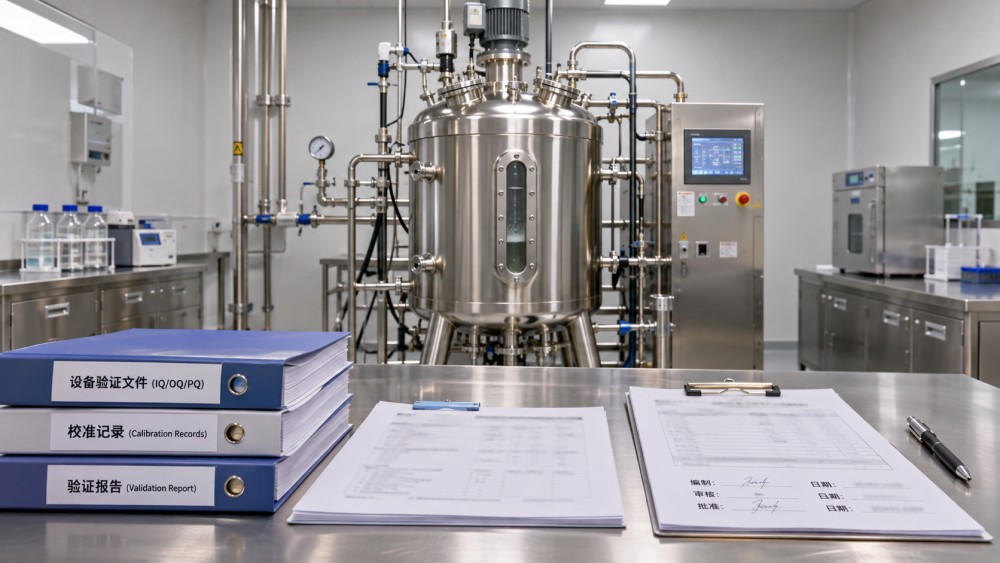
What does it take to demonstrate that GMP equipment is fit for its intended use? For quality control and safety teams, the answer lies in a risk-based, traceable documentation package. Validation documentation for GMP equipment typically includes user requirements, risk assessments, qualification protocols and reports, calibration records, and evidence that deviations have been resolved. Depending on the equipment and its intended use, computerized system validation and ongoing maintenance records may also be needed.
There is no single universal binder that satisfies every inspection or every instrument. A bioreactor controlling a critical culture parameter presents different risks from a laboratory workstation used for exploratory research. The documentation should explain those differences and show why the chosen controls and tests are appropriate.
What is the core documentation package?
For equipment used in a GMP process or quality control activity, the package normally connects the intended use to the evidence generated before release and throughout operation. The following documents are commonly expected, although their depth and format should be proportionate to risk.
Some organizations combine documents; others maintain separate plans, protocols and reports. The important point is not the number of files, but whether an independent reviewer can follow the evidence from requirement to test result and understand any remaining limitations.
Start with intended use, not a supplier’s template
The URS is the foundation of equipment qualification. It describes what the user needs the system to do in its actual operating environment—not merely what appears on a product brochure. A useful URS identifies the equipment, its intended GMP application, relevant process interfaces and requirements that could affect quality or reliable operation.
For a bioreactor, requirements might address temperature and pH control ranges, alarm behavior, access to electronic records and connections to utility systems. For an LC-MS system used in GMP testing, they might include instrument control, analytical data handling, audit trail functionality and interfaces with a laboratory information management system.
The accompanying risk assessment determines which requirements need the strongest verification. It should consider what could go wrong, the potential impact and the controls that reduce the risk. For example, an incorrect temperature reading could affect a cell culture, while an uncontrolled administrator account could compromise electronic records. Safety risks should also be assessed under applicable site and occupational safety procedures; equipment qualification does not replace those obligations.
Keep requirements traceable
A traceability matrix is not always a standalone regulatory requirement, but it is a practical way to link each relevant requirement to a test, supplier assessment or other verification. It should also identify requirements that are met through procedures rather than equipment features. If a requirement is not tested, document the rationale instead of leaving an unexplained gap.
Qualification protocols and reports: the evidence behind release
Qualification is often organized into design qualification, installation qualification, operational qualification and performance qualification. Terminology and sequencing vary, and some activities may be combined. The underlying questions remain the same: was the design suitable, was the equipment installed correctly, does it operate as intended, and can it perform reliably in its intended setting?
Design qualification (DQ)
DQ documents the assessment of the proposed design against intended use and relevant requirements. Depending on the project, the evidence may include design reviews, specification comparisons, drawings and assessments of materials or interfaces. It is especially useful for complex or custom-built systems, where design decisions can affect cleaning, access, containment or data flows long before installation.
Installation qualification (IQ)
IQ records that the equipment and associated components have been installed as specified. Typical checks cover identification and configuration, location, utilities, major components, instrument calibration status, software versions and availability of manuals. For a separation system, the record might also identify connected vessels, piping and relevant product-contact components.
Installation records should reference the configuration actually accepted at the site. A supplier’s drawing is helpful, but an outdated drawing alone does not establish what is installed.
Operational qualification (OQ)
OQ challenges relevant functions across defined operating ranges or conditions. Tests may cover controls, alarms, interlocks, set points, access permissions and responses to foreseeable faults. Each test needs predetermined acceptance criteria and a way to capture the actual result.
For example, a temperature alarm test should record the setup, the observed alarm response and whether it met the approved criterion. If the equipment is computerized, appropriate functional and data-related checks may be integrated into OQ or documented in a separate system validation package.
Performance qualification (PQ)
PQ demonstrates performance in the intended operating environment, using representative conditions and, where appropriate, routine users, materials and procedures. The protocol should explain why the selected conditions are representative and how acceptance will be determined.
PQ does not automatically prove that an entire manufacturing process or analytical method is validated. Those activities have their own scopes and evidence requirements. A dispensing workstation, for instance, may be qualified as equipment while the specific dispensing method and its suitability for a GMP assay are addressed separately.
What should an executed protocol and final report contain?
An approved protocol sets expectations before testing begins. The executed record then shows what actually happened. At a minimum, reviewers should be able to identify the equipment and configuration tested, test dates, personnel, results, supporting raw data and any departures from the approved procedure. Corrections must remain traceable under the site’s documentation practices.
The final report should summarize results against acceptance criteria and provide a clear conclusion about suitability for use. It should reference open or closed deviations, assess their impact and state any restrictions or required follow-up actions. Approval by the appropriate functions, including quality where required by site procedures, provides a documented basis for release.
A passed test is not enough if its evidence cannot be reconstructed. Screenshots, instrument printouts, electronic files and calculations should be retained or referenced in a controlled way. The record should make it possible to find the original data and understand how the conclusion was reached.
Computerized equipment: document the data lifecycle
Many GMP instruments are also computerized systems. A liquid handling workstation may store methods and run results; an LC-MS platform may acquire, process and report analytical data. Where electronic functions affect GMP decisions or records, the validation scope should address both equipment operation and the reliability of the computerized functions.
Depending on risk and system design, the documentation may include:
- System description, intended use, interfaces and configuration records.
- Requirements and testing for user roles, access controls and security settings.
- Audit trail functionality, review arrangements and tests where applicable.
- Data retention, retrieval, backup and restoration requirements and evidence.
- Controls for electronic signatures, if used, and for changes to software or configuration.
- Supplier assessment and documented use of supplier testing, where justified.
In the United States, FDA 21 CFR Part 11 may apply to electronic records and signatures within its scope; its applicability depends on how records are created, maintained and used. EU GMP Annex 11 addresses computerized systems used as part of GMP-regulated activities. Neither framework is satisfied simply by enabling an audit trail: procedures, access management and review practices also matter.
Supporting records that are easy to overlook
Qualification reports are only part of the inspection story. A reviewer may follow an instrument from its initial acceptance to its current use and ask whether it remained suitable along the way. Keep these supporting records accessible and linked to the equipment identity:
- Calibration: calibration status, certificates or results, defined intervals and assessments of out-of-tolerance findings.
- Maintenance: preventive maintenance schedules, completed work, repairs and assessments of effects on qualified status.
- Procedures and training: approved operating, cleaning and maintenance procedures, plus evidence that relevant personnel are trained.
- Change control: assessment and approval of changes to hardware, software, settings, location, utilities or intended use, including any necessary testing.
- Periodic review: documented review, as applicable, of performance, deviations, changes and continued suitability.
- Retirement: records for decommissioning and, where relevant, secure retention or migration of GMP data.
Cleaning and sterilization documentation may also be important, particularly for product-contact equipment. Whether a separate cleaning validation or sterilization validation is needed depends on the process and applicable requirements; an equipment qualification report should not be assumed to cover it.
How much supplier documentation can be used?
Supplier documents can reduce duplication and provide valuable technical evidence. Examples include material certificates, calibration certificates, factory acceptance test results, software documentation and drawings. However, receiving a package is not the same as accepting it without review.
The regulated user should assess whether supplier evidence is relevant, reliable and applicable to the installed configuration and intended use. Factory testing may support qualification when its scope, execution and results are suitable, but site-specific installation, interfaces and operating conditions still need appropriate assessment. Any decision to leverage supplier testing should be documented, including gaps to be addressed at the user site.
Which regulations and guidance should teams consult?
Requirements depend on the product, jurisdiction and activity. Teams should map their documentation approach to the rules applicable to their operations rather than treating a guidance document as a universal checklist. Common reference points include:
- EU GMP Annex 15: qualification and validation principles for facilities, equipment, utilities and processes.
- EU GMP Annex 11: expectations for computerized systems used in GMP activities.
- US 21 CFR Parts 210 and 211: current good manufacturing practice requirements for drugs, including relevant equipment and recordkeeping provisions.
- FDA guidance on process validation: a lifecycle approach relevant to understanding the relationship between equipment qualification and process validation.
Other requirements may apply to laboratories, medical devices, biologics or specific markets. Current versions and local regulatory expectations should be checked before defining a project’s compliance strategy.
An inspection-ready check for quality and safety teams
Before releasing equipment, follow one critical requirement through the package. Can you find its risk assessment, the verification method, the raw result and the approval that supports the conclusion? Then check an ongoing control: is the instrument still within calibration, are changes assessed, and can current users access the right procedure?
If those links are clear, the documentation is doing more than filling a folder. It is helping the team explain why the equipment was accepted, how it is controlled today and what would trigger another assessment. That traceable lifecycle view is the practical foundation of validation documentation for GMP equipment.
Related News
- What validation documentation is required for GMP equipment?Nov 03, 2026Dr. Elara Sterling
- FDA Issues Final Guidance on Cell and Gene Therapy Development and QualityNov 03, 2026Dr. Elara Sterling
- China's Revised Medical Device GMP Takes Effect, With Official Guidance on Data IntegrityNov 02, 2026Dr. Elara Sterling
- ASME BPE-2026 Bioprocessing Equipment Standard Takes Effect November 1Nov 01, 2026Dr. Elara Sterling
Related News
- 00
0000-00
What validation documentation is required for GMP equipment? - 00
0000-00
FDA Issues Final Guidance on Cell and Gene Therapy Development and Quality - 00
0000-00
How to size a stainless steel fermentation system for yeast production - 00
0000-00
China's Revised Medical Device GMP Takes Effect, With Official Guidance on Data Integrity - 00
0000-00
Can a biopharma separation equipment supplier support process scale-up?
Dr. Elara Sterling
Weekly Insights
Stay ahead with our curated technology reports delivered every Monday.