





As biologics pipelines expand and batch complexity rises, pharmaceutical downstream purification has become a decisive factor in product quality, yield, and speed to market. The hardest part is rarely one unit operation alone. Risk usually appears at the interfaces between harvest, clarification, chromatography, viral clearance, concentration, and final formulation. When those interfaces are poorly characterized, scale-up delays, resin overloading, membrane fouling, and deviation-driven rework quickly follow.
A checklist approach helps convert a complex purification train into a sequence of observable control points. It also supports better technical discussions around capacity limits, data integrity, cleaning validation, and process economics. In modern biopharma, that structure is essential because product quality and GMP compliance are now inseparable from throughput and cost.
Why a checklist is essential for pharmaceutical downstream purification
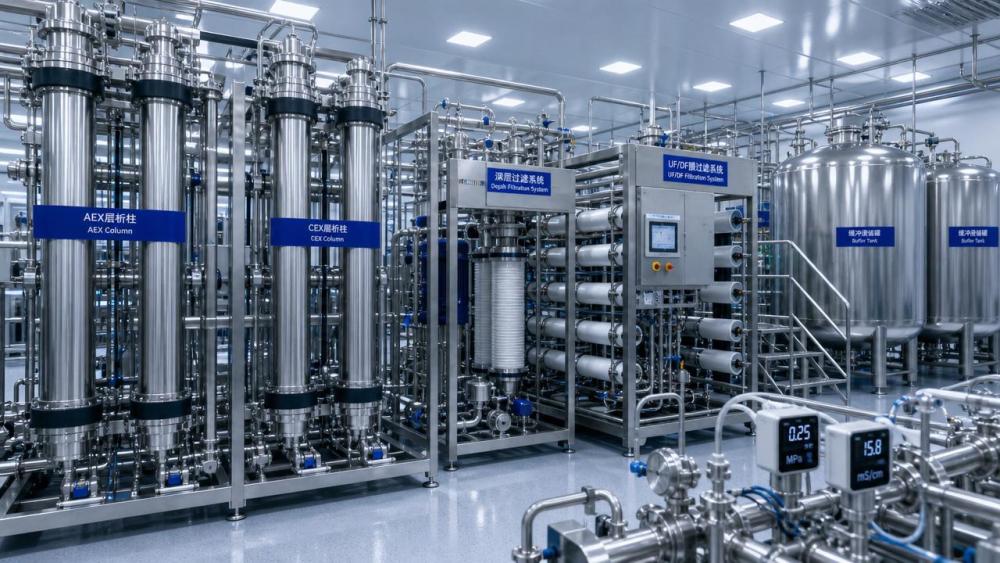
Downstream platforms once relied on stable monoclonal antibody processes with predictable impurity profiles. Today, mixed modalities, higher titers, and Cell & Gene Therapy workflows create very different purification demands. The same facility may handle proteins, viral vectors, plasmids, or sensitive intermediates with sharply different shear tolerance and hold-time limits.
That change makes informal decision-making dangerous. A structured review of pharmaceutical downstream purification helps identify hidden bottlenecks before they become batch failures, OOS events, or commercial launch constraints.
Core checklist: how to identify the main downstream purification bottlenecks
- Map feed variability early and quantify solids, viscosity, host cell protein load, DNA burden, and aggregate levels before locking harvest and clarification assumptions.
- Verify clarification capacity under worst-case broth conditions, not average runs, because centrifuge efficiency and depth filter loading often collapse during scale-up peaks.
- Test resin dynamic binding capacity with realistic residence times, conductivity, and impurity backgrounds rather than relying on vendor data from simplified model feeds.
- Check buffer preparation and storage logistics, since buffer shortages, transfer delays, and wrong hold temperatures can quietly throttle chromatography productivity.
- Measure pressure rise across membranes and columns continuously to catch fouling trends before they trigger premature filter changes or unplanned process interruptions.
- Challenge viral inactivation and viral filtration steps with realistic upstream carryover because residual lipids, DNA, and aggregates can reduce robustness dramatically.
- Review ultrafiltration and diafiltration for concentration polarization, shear stress, and extended recirculation that may damage sensitive biologics or reduce final recovery.
- Confirm cleaning validation, leachables, extractables, and resin lifetime assumptions to avoid hidden GMP and lifecycle cost issues in routine manufacturing.
- Audit PAT signals, historian integrity, and electronic records because poor data traceability weakens batch release decisions and comparability evidence.
- Model process timing across all unit operations, since a single hold step, CIP turnaround, or buffer transfer lag can become the real purification bottleneck.
Where bottlenecks usually appear in modern biopharma trains
Harvest and clarification
The first major bottleneck in pharmaceutical downstream purification often starts before chromatography. Higher cell density cultures increase solids loading, reduce filter throughput, and make shear-sensitive targets harder to recover. Centrifuges may remove bulk solids, but depth filters still face rapid fouling when particle size distribution shifts between lots.
This stage should be evaluated as a system, not as separate equipment blocks. Centrifuge cut efficiency, hold tank mixing, and filter train sizing must align with true broth behavior at production scale.
Chromatography and capture productivity
Chromatography remains the cost and capacity center of most pharmaceutical downstream purification schemes. Capture columns may underperform when feed conductivity drifts or when aggregate burden consumes useful binding sites. Elution pool dilution can then create another bottleneck downstream by enlarging UF/DF loads.
In intensified plants, the issue is not only resin price. It is also cycle time, skid availability, buffer exchange speed, and the ability to reproduce column packing performance over repeated campaigns.
Viral clearance and polishing
Viral inactivation and nanofiltration steps are frequently underestimated. Minor upstream carryover can shorten filter life, force conservative loading, and compress manufacturing windows. Polishing steps may also become overburdened when charge variants or clipped species rise during upstream stress.
A robust purification strategy should link impurity control trends back to upstream process changes. Otherwise, downstream teams are left compensating for biological instability with expensive unit operations.
UF/DF and final concentration
UF/DF looks simple on paper, yet it often defines the true end-of-line bottleneck. High protein concentrations raise viscosity, increase membrane resistance, and extend diafiltration time. Sensitive molecules may also experience interfacial stress, aggregation, or adsorption losses.
For this reason, pharmaceutical downstream purification reviews should include mixing studies, membrane screening, and final formulation compatibility rather than treating concentration as a routine finishing step.
Scenario-based considerations across different product types
Monoclonal antibodies
For antibodies, the classic bottlenecks are Protein A economics, aggregate control, and buffer-heavy polishing trains. Rising upstream titers increase capture productivity, but they also intensify clarification stress and polishing selectivity demands.
Recombinant proteins
Recombinant proteins often present broader impurity diversity and tighter stability windows. Here, pharmaceutical downstream purification must focus on proteolysis control, conductivity transitions, and product-specific adsorption behavior across membranes and resins.
Viral vectors and CGT intermediates
Viral vectors and CGT materials are less forgiving. Shear, hold times, and low overall yields dominate process risk. Small deviations in clarification or concentration can remove a large fraction of active product, making platform assumptions especially risky.
Commonly overlooked risks in pharmaceutical downstream purification
Underestimating buffer infrastructure. Many facilities focus on columns and filters while ignoring tank turnover, inline dilution accuracy, and transfer path cleaning. The result is idle skids and missed production windows.
Separating process science from compliance. Weak electronic batch records, incomplete audit trails, or poor CSV discipline can invalidate otherwise strong process performance under inspection.
Using average-case data. Bottlenecks emerge during worst-case biomass, longest campaigns, dirtiest feeds, and shortest turnaround windows. Mean values rarely protect commercial operations.
Ignoring scale transition effects. Residence time distribution, pressure behavior, and mixing patterns can shift sharply from development skids to production trains, especially in single-use systems.
Practical execution steps that improve purification performance
- Run integrated mass-balance reviews after every engineering batch and track cumulative yield loss across each handoff point.
- Stress-test clarification and chromatography with deliberately challenging feeds to define real operating windows.
- Add inline analytics where pressure, conductivity, UV, and turbidity reveal developing bottlenecks earlier than end-point testing.
- Align process development, automation, and quality records so scale-up decisions are supported by defensible GMP data.
Organizations building stronger purification capability increasingly combine process equipment knowledge with compliance intelligence. That means understanding centrifugation physics, chromatography loading, LC-MS confirmation, biosafety controls, and automated liquid handling as one connected operational system.
Conclusion and next action
The main lesson is clear: pharmaceutical downstream purification bottlenecks are rarely isolated equipment failures. They are system-level constraints shaped by feed variability, separation physics, facility logistics, and GMP execution. A practical checklist reveals where capacity is theoretical, where quality margins are narrow, and where scale-up assumptions need proof.
The most effective next step is to audit one active purification train end to end. Review clarification loads, chromatography cycle efficiency, viral clearance robustness, UF/DF timing, and electronic record completeness together. That single exercise usually exposes the highest-value improvement path faster than another isolated optimization study.
Related News
- What to compare when sourcing protein purification equipment in the USAOct 01, 2026Downstream Purification Fellow
- How to size downstream purification systems for batch capacitySep 13, 2026Downstream Purification Fellow
- How to Evaluate GMP Protein Purification Systems for Scale and ComplianceJul 19, 2026Downstream Purification Fellow
- Protein Polishing Systems: How to Compare Yield, Purity, and ThroughputJul 13, 2026Downstream Purification Fellow
Related News
- 00
0000-00
What CSV documentation should a laboratory systems supplier provide? - 00
0000-00
SCIEX Begins Construction of High-End Mass Spectrometer Plant in Beijing - 00
0000-00
Which design features make cleanroom benches easier to clean? - 00
0000-00
IndexBox Forecasts 12% CAGR for Global Microbioreactor Market Through 2035 - 00
0000-00
When do hazardous compound labs need isolators for containment?
Downstream Purification Fellow
Weekly Insights
Stay ahead with our curated technology reports delivered every Monday.