





Pharmaceutical Downstream Purification: Choosing Between TFF and Chromatography
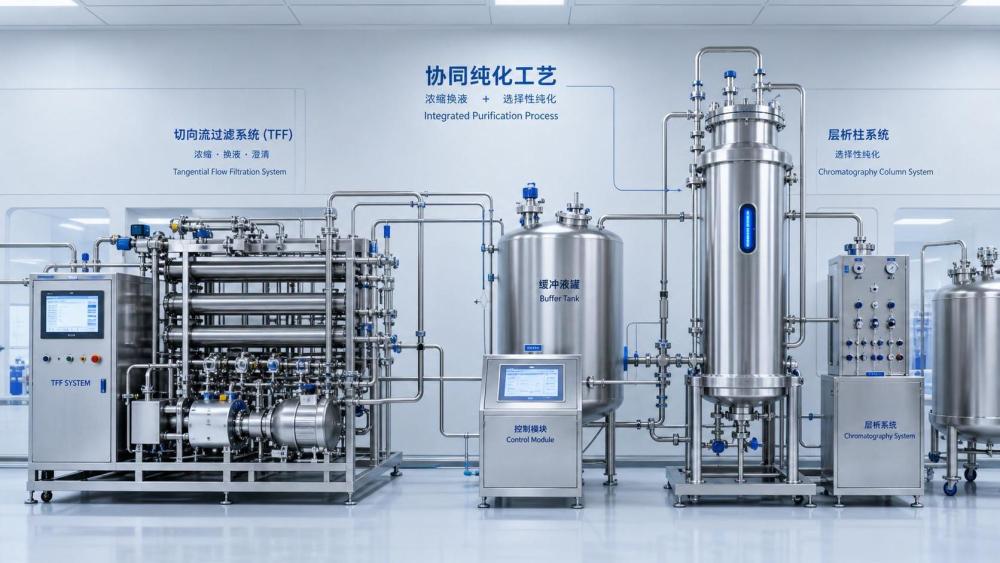
In pharmaceutical downstream purification, the choice between TFF and chromatography shapes yield, purity, speed, and cost.
That decision also affects cleaning validation, buffer use, operator workload, and scale-up confidence.
In real production, these two methods rarely compete in a simple winner-takes-all way.
More often, they solve different bottlenecks inside the same pharmaceutical downstream purification workflow.
TFF is usually selected for concentration and buffer exchange.
Chromatography is usually chosen for selective impurity removal and final polishing.
The practical question is not which technology sounds better.
The better question is which step needs volume reduction, which needs selectivity, and which needs tighter GMP control.
For process teams, that difference matters every day on the floor.
It influences hold time, membrane fouling, resin lifetime, batch release pressure, and troubleshooting complexity.
What TFF Really Does in Pharmaceutical Downstream Purification
Tangential flow filtration moves liquid across a membrane surface while part of the fluid passes through it.
Because the flow runs parallel to the membrane, solids build up more slowly than in dead-end filtration.
In pharmaceutical downstream purification, TFF is valued for bulk handling.
It can concentrate proteins, exchange buffers, and remove small molecules without relying on target-specific binding.
That makes it especially useful after harvest and before chromatography loading.
It is also common in viral vector and plasma fractionation workflows.
A strong TFF setup performs well when the process goal is physical separation by size.
It becomes less effective when impurities look too similar to the product.
Best-fit use cases for TFF
- Concentrating monoclonal antibodies before capture or formulation.
- Diafiltration for buffer exchange before ion exchange steps.
- Removing salts, solvents, or low-molecular impurities.
- Handling larger feed volumes with relatively straightforward automation.
The main operational watchpoints are membrane selection, transmembrane pressure, shear exposure, and fouling behavior.
If these are poorly controlled, pharmaceutical downstream purification can lose both throughput and product quality.
What Chromatography Does Better
Chromatography separates molecules by affinity, charge, hydrophobicity, or size.
That selective behavior is why it remains central in pharmaceutical downstream purification.
When the target must be separated from host cell proteins, DNA, aggregates, or closely related variants, chromatography usually leads.
Protein A capture is a classic example for antibodies.
Ion exchange and mixed-mode steps often follow for intermediate purification or polishing.
This gives operators much finer control over purity targets.
The trade-off is complexity.
Chromatography needs tighter loading windows, more method development, more buffer management, and stronger resin care.
Best-fit use cases for chromatography
- High-selectivity capture of target biomolecules.
- Removal of process-related and product-related impurities.
- Polishing for aggregate control and charge variant reduction.
- Processes where release specs demand tight purity margins.
From a decision standpoint, chromatography is less about volume management and more about separation precision.
TFF vs Chromatography: The Practical Decision Points
When comparing options in pharmaceutical downstream purification, daily operating reality matters more than theory.
A process may look elegant on paper but fail under high-volume manufacturing pressure.
This comparison shows why pharmaceutical downstream purification often uses both tools in sequence.
TFF prepares the stream.
Chromatography sharpens the separation.
How to Choose Based on Process Goals
A useful selection approach starts with the exact job the step must do.
That sounds obvious, but many pharmaceutical downstream purification delays come from unclear step definitions.
Choose TFF first when
- You need to reduce volume before a costly column step.
- You need fast diafiltration into a new process buffer.
- The impurity profile is mostly low-molecular material.
- The process demands flexible scaling with single-use flow paths.
Choose chromatography first when
- You need target-specific capture with strong purity gain.
- You must remove closely related contaminants or variants.
- Product quality attributes depend on a precise polishing step.
- Regulatory expectations require highly reproducible impurity clearance.
In practice, many teams ask a simple screening question.
Is the problem mainly about volume and buffer, or mainly about selective impurity separation?
That answer quickly points the pharmaceutical downstream purification strategy in the right direction.
Operational Risks That Influence the Final Choice
Selection is not only about scientific fit.
It is also about what stays stable during long campaigns and scale-up.
For TFF, the recurring risks are often visible early.
Flux drops, rising pressure, foaming, and product adsorption can erode performance fast.
For chromatography, the problems may build more quietly.
Small packing defects, resin aging, or shifting conductivity can gradually reduce resolution.
In pharmaceutical downstream purification, these hidden drifts can become release issues later.
Helpful checks before locking the process
- Confirm whether the product tolerates shear and recirculation time.
- Map impurity types, not just total impurity levels.
- Compare buffer consumption and storage burden.
- Review cleaning validation or single-use replacement strategy.
- Check scale-up data, not only lab-scale recovery numbers.
These checks make pharmaceutical downstream purification decisions more practical and less reactive.
A Smarter Workflow Often Uses Both
The most efficient answer is often not TFF or chromatography.
It is TFF plus chromatography, arranged in the right order.
For example, TFF can concentrate harvest material and place it into the ideal loading buffer.
That reduces column size pressure and improves downstream consistency.
After that, chromatography can remove the harder impurities that membranes cannot separate well.
This combined pharmaceutical downstream purification logic is now common in biologics manufacturing.
It also supports GMP readiness by assigning each unit operation a clear and measurable purpose.
If a process is struggling, start by defining the step objective in one sentence.
If the objective is concentration or buffer exchange, TFF usually deserves the first look.
If the objective is selective purification, chromatography usually carries the load.
And if both needs exist, build a sequence that lets each technology do what it does best.
That is usually the most reliable path to stronger pharmaceutical downstream purification performance, easier scale-up, and steadier batch quality.
Related News
- How to size downstream purification systems for batch capacitySep 13, 2026Downstream Purification Fellow
- How to Evaluate GMP Protein Purification Systems for Scale and ComplianceJul 19, 2026Downstream Purification Fellow
- Protein Polishing Systems: How to Compare Yield, Purity, and ThroughputJul 13, 2026Downstream Purification Fellow
- Protein A Purification Systems: Key Factors That Drive Yield and Resin CostJul 12, 2026Downstream Purification Fellow
Related News
- 00
0000-00
When does a single use manufacturing platform reduce scale-up risk? - 00
0000-00
When digital laboratory workflow solutions reduce GMP data integrity risk - 00
0000-00
How biopharma teams can prepare audit trails for GMP inspections - 00
0000-00
How electronic analytical data integrity supports GMP audit readiness - 00
0000-00
How to build a system lifecycle validation strategy for GMP compliance
Downstream Purification Fellow
Weekly Insights
Stay ahead with our curated technology reports delivered every Monday.