





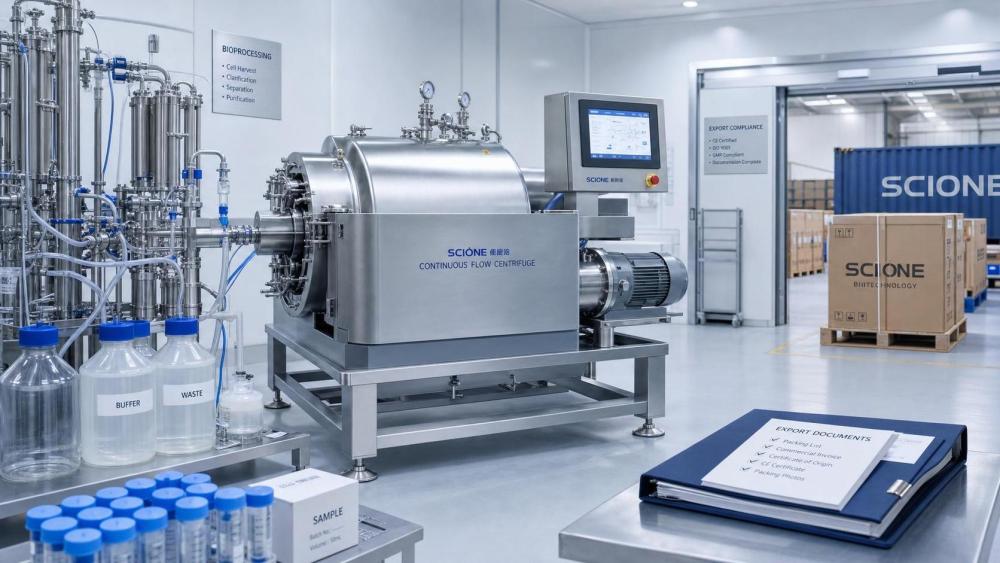
On June 21, 2026, the U.S. Bureau of Industry and Security (BIS) updated EAR Section 744 to add continuous flow centrifuges used in bioprocessing applications to a supplementary licensing requirement for exports to Russia and Belarus. Because the scope explicitly covers uses such as cell harvesting and virus purification, the change deserves attention from exporters, procurement teams, compliance staff, logistics providers, and end users involved in bioprocessing equipment transactions tied to these two markets.
What the rule change confirms
The confirmed fact is that BIS issued an amendment under EAR Section 744 on June 21, 2026. Under this amendment, “Continuous Flow Centrifuges for bioprocessing applications” were added to Supplement No. 4 as a category subject to an additional licensing requirement.
The stated application scope includes bioprocessing uses such as cell harvesting and virus purification. For exports of these items to Russia or Belarus, a separate BIS license is now required, and the requirement took effect immediately on the date announced.
Where the immediate pressure is likely to appear
Export-facing equipment transactions
From an industry perspective, direct exporters and trading companies are the first group likely to feel the effect, because the rule changes the approval path for covered shipments to Russia and Belarus. The main impact is not simply on sales intent, but on whether a transaction can proceed without a separate BIS license.
Procurement and order management workflows
Procurement teams and order management functions may also be affected when equipment specifications or stated end uses involve bioprocessing applications. What deserves closer attention is whether internal screening, document review, and customer communications are aligned with the updated licensing trigger.
Logistics and delivery coordination
Supply chain service providers, including teams responsible for shipment planning and export documentation, may face added execution risk if a covered product is scheduled for Russia or Belarus without the required licensing review. In practice, the pressure point is likely to be timing, document completeness, and shipment release decisions.
End users and project-side planning
For buyers and end users connected to bioprocessing equipment projects in the affected markets, the change may alter procurement timing and delivery certainty. Analysis shows that the business issue is not only product availability, but also whether project schedules need to account for a separate licensing step from the outset.
What companies should watch next
How product scope is interpreted in practice
Companies should closely review whether a product falls within the stated category of continuous flow centrifuges for bioprocessing applications, especially where equipment may be marketed or documented for uses including cell harvesting or virus purification. The difference between technical configuration and stated application may become important in internal review.
Whether business documents match the regulated use case
Contracts, quotations, technical descriptions, end-use statements, and shipping documents should be checked for consistency. Observably, the practical compliance risk often appears when commercial paperwork and product-use descriptions do not align clearly with licensing requirements.
How licensing affects delivery timelines
Because the measure is effective immediately, businesses should pay attention to whether current orders, pending deliveries, or near-term export plans to Russia or Belarus require revised timelines. The policy signal and actual shipment execution are not the same issue, and companies should distinguish between the announcement itself and the operational steps needed to move goods lawfully.
How to prepare customer and supplier communication
Relevant teams may need to prepare for questions on lead times, licensing status, document requests, and fulfillment expectations. What deserves closer attention is whether suppliers, distributors, and customers are using the same description of the product and intended application when assessing next steps.
Why this looks like a targeted control signal
This section is analysis rather than confirmed fact. It is more appropriate to understand this update as a targeted regulatory signal affecting a defined equipment-and-application combination, rather than as a general statement about all centrifuges or all bioprocessing trade. The wording matters: the rule change is tied to continuous flow centrifuges for bioprocessing applications and to exports to Russia and Belarus.
Analysis shows that the development is already operationally relevant because it is effective immediately, but its broader commercial effect still depends on how often affected transactions arise, how companies classify relevant equipment, and how licensing reviews shape delivery decisions. For that reason, the industry still needs continued observation rather than broad conclusions.
How the market may need to read this update
The immediate significance of this development is clear: a separate BIS license is now required for covered exports to Russia and Belarus. At the same time, a measured reading is more appropriate than an exaggerated one. The update should currently be understood as a concrete compliance change with direct implications for transaction screening, documentation, and delivery planning in affected business flows.
For industry participants, the key takeaway is not to overgeneralize, but also not to treat the change as a routine notice. It sits at the intersection of product scope, stated application, and destination market, which means compliance and commercial teams need to evaluate the practical exposure of each relevant transaction carefully.
Basis of this article and follow-up verification
This article is based on the user-provided news title, event date, and event summary concerning the BIS update issued on June 21, 2026. For this type of development, commonly relevant source categories may include official government notices, company disclosures, industry association updates, authoritative media reporting, and standards or regulatory documentation.
No specific official source link was provided in the input, so the exact official publication link still needs to be verified on an ongoing basis. Continued monitoring should focus on any further official wording, interpretive updates, or implementation details related to the EAR Section 744 amendment and Supplement No. 4 treatment for the affected product category.
Related News
- When Does Centrifugal Separation for Cell Harvest Outperform TFF?Aug 12, 2026Downstream Purification Fellow
- Industrial Centrifuges for Continuous Operation: What Impacts Uptime MostJul 13, 2026Downstream Purification Fellow
- TUV Rheinland Updates BSL-3 Rules for Flow CentrifugesJul 07, 2026Downstream Purification Fellow
- CBP Reclassifies Continuous Flow Centrifuges, Adds 25% DutyJul 03, 2026Downstream Purification Fellow
Related News
- 00
0000-00
When does a single use manufacturing platform reduce scale-up risk? - 00
0000-00
When digital laboratory workflow solutions reduce GMP data integrity risk - 00
0000-00
How biopharma teams can prepare audit trails for GMP inspections - 00
0000-00
How electronic analytical data integrity supports GMP audit readiness - 00
0000-00
How to build a system lifecycle validation strategy for GMP compliance
Downstream Purification Fellow
Weekly Insights
Stay ahead with our curated technology reports delivered every Monday.