





An industrial centrifugal separation system costs more than the centrifuge on the equipment list. A usable project budget must also cover feed handling, controls, installation, commissioning, and any cleaning or qualification work required by the process. A standalone separator and an integrated biopharmaceutical separation skid represent different purchases, even when their stated throughput looks similar.
There is no single industrial separation systems price that meaningfully covers these configurations. The practical starting point is a budgetary quotation tied to a defined feed, separation target, and supply boundary. Without those details, a low equipment price can leave substantial work outside the contract.
To establish a defensible budget, separate the purchase into three amounts: the supplied equipment package, the cost of bringing it into operation, and the ongoing cost of running it. Compare suppliers against the same process requirements before deciding which proposal offers better value.
What should the quoted price actually include?
The word “system” deserves close attention. One proposal may cover a centrifuge with local controls. Another may include pumps, valves, instruments, piping, a control cabinet, and factory testing. Both may be described as complete systems, while leaving different responsibilities to the buyer.
Ask each supplier to identify inclusions, exclusions, and connection points. The following breakdown makes proposals easier to compare.
A useful comparison shows the quoted amount alongside the estimated cost of completing excluded work. Otherwise, the proposal with the smallest initial figure may simply transfer more engineering and installation responsibility to the site.
Choose the separation duty before comparing machine prices
Different centrifuge designs solve different problems. Comparing their prices without checking suitability can produce an attractive budget for equipment that cannot deliver the required result.
Disc-stack centrifuges are commonly considered for liquid clarification and certain liquid-liquid separations. In bioprocessing, they can separate cells or cell debris from a liquid containing the target product. Feed characteristics, solids discharge behavior, and product sensitivity influence the configuration.
Decanter centrifuges are often considered when the process requires continuous handling of a substantial solids load. Their suitability depends on settling behavior, solids transport, and the required liquid clarity or solids dryness. They should not be treated as interchangeable with disc-stack separators simply because both operate continuously.
Filtering centrifuges, including basket and peeler designs, may suit crystalline or other filterable solids where cake washing and liquid removal matter. They address a different separation duty from clarification of a cell culture harvest.
For biopharmaceutical applications, also establish where the product resides. If the target protein is in the liquid, product lost with discharged solids affects recovery. If the cells themselves are the product, cell recovery and viability may govern equipment selection. The same nominal feed rate does not make these duties equivalent.
Centrifugation also has limits. A clarification step that removes cells does not automatically remove dissolved contaminants or replace downstream chromatography and membrane processing. Budgeting for the complete purification train prevents unrealistic expectations about what the centrifuge alone will achieve.
The specifications that change the investment
Throughput must be linked to separation performance
A flow-rate figure is incomplete unless it identifies the feed and the required output quality. A separator may handle a liquid at a high flow rate while needing a lower rate to achieve the required clarity with a more difficult feed.
Define the required processing window, feed variability, solids concentration, viscosity, temperature, and relevant particle characteristics. Then ask the supplier to state the operating conditions behind its proposed capacity. Where uncertainty could change machine selection, representative material testing can provide more useful evidence than a catalogue comparison.
Oversizing carries costs beyond the machine purchase. It can increase utility demand, cleaning requirements, and installation needs. Insufficient capacity can extend processing time or create a bottleneck. Capacity margin should address identified variability and expansion plans, with acceptable operation at the lower end of expected demand.
Product sensitivity changes the equipment package
For a robust industrial slurry, the main priorities may be solids removal and reliable discharge. A sensitive biological feed can introduce requirements for gentle feed acceleration, temperature control, closed transfer, or reduced air contact.
These features need a process justification. Excessive cell disruption, for example, can release intracellular material and increase the burden on later purification steps. A cheaper separator can therefore create costs elsewhere even if its immediate clarification result appears acceptable.
Materials, cleaning, and containment require separate decisions
Corrosive feeds, abrasive solids, cleaning chemicals, and operating temperatures influence material and seal selection. Specify compatibility with both production and cleaning conditions rather than choosing materials by industry convention alone.
Hygienic design, sterilization capability, and containment are distinct requirements. Equipment suitable for cleaning in place is not automatically suitable for sterilization in place. A closed process connection does not, by itself, establish containment performance for a hazardous material.
Each requirement can affect valves, seals, piping, instruments, and testing. Defining them early reduces the chance of discovering expensive modifications after the base equipment has been selected.
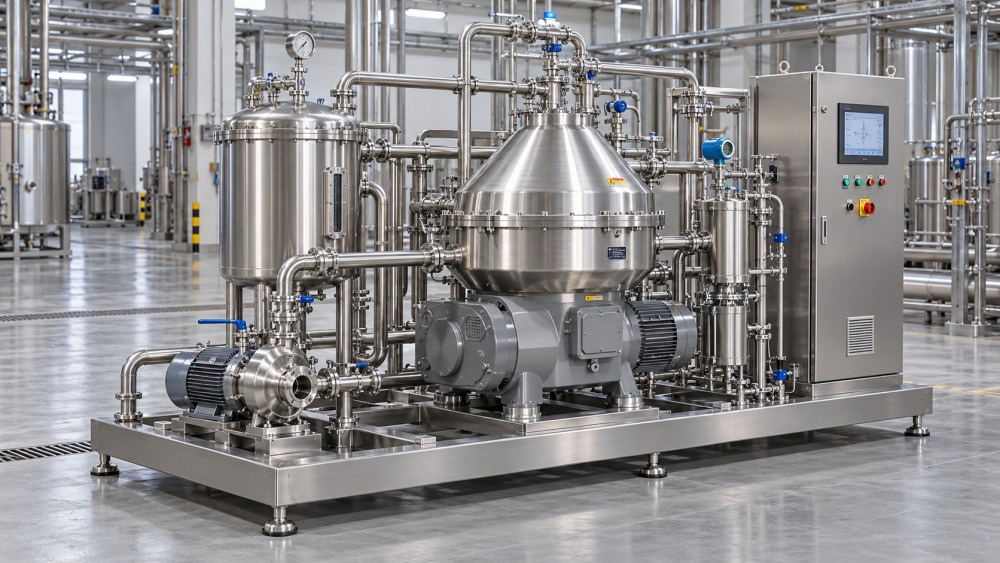
Why biopharmaceutical systems need a different budget
In a GMP environment, the cost extends to demonstrating that the installed system is suitable for its intended use. That affects documentation, testing, software configuration, and responsibilities throughout the project.
A supplier’s description of equipment as “GMP compliant” does not establish that it meets a particular facility’s requirements. The purchase specification should identify the required product-contact material records, calibration documentation, cleaning provisions, software functions, and qualification deliverables.
Automation should be assessed against the way the system will operate. User permissions, recipe management, alarm handling, electronic records, and interfaces with site systems may need defined controls. Buying every available software option can add complexity; omitting a necessary function can create manual work or later modification.
Qualification support also needs a clear scope. Document templates, supplier-executed tests, and support during site qualification are different deliverables. Clarify who writes, reviews, executes, and approves each activity, including how exceptions will be resolved.
For facilities considering single-use separation technology, compare recurring assembly costs, supply availability, waste handling, and process suitability against reusable equipment and its cleaning requirements. The financial advantage depends on campaign frequency, changeover needs, and production volume.
Build the installed budget around the actual site
A machine can fit the process and still require substantial work before it can operate in the building. Confirm floor loading, maintenance access, delivery routes, lifting arrangements, drainage, noise constraints, and utility capacity before finalizing the investment request.
Maintenance space is particularly easy to underestimate. Equipment may fit within its operating footprint while lacking the clearance needed to remove major components safely. That can affect room layout, lifting equipment, and future service costs.
Utilities should be evaluated at the system boundary. Feed pumps, cooling, compressed air, cleaning supply, and waste handling can add requirements beyond those listed for the centrifuge itself. Existing utility connections are only useful if their capacity and operating conditions match the proposed package.
Keep installation allowances separate from allowances for unresolved process questions. A site survey can reduce installation uncertainty; representative feed testing can reduce selection uncertainty. A general contingency should not replace either activity when the issue could materially change the project.
Compare operating costs per acceptable output
The most useful ownership comparison connects spending to the quantity of acceptable product or clarified liquid delivered. Purchase price alone does not capture differences in recovery, cleaning time, maintenance, or process availability.
Include energy, water, cleaning chemicals, consumables, scheduled service, replacement parts, labor, waste disposal, and qualification maintenance where applicable. Use the expected production schedule rather than assuming continuous operation throughout the year.
Product loss deserves particular attention in high-value processes. Liquid retained in discharged solids, residual hold-up, and material discarded during start-up or shutdown can affect recovery. Those losses need to be evaluated under the proposed operating conditions.
A practical calculation is:
Evaluated lifecycle cost = installed project cost + operating and maintenance costs over a defined period + expected costs of downtime and product loss.
Keep the evaluation period and production assumptions consistent across proposals. Where recovery or service-life assumptions remain uncertain, compare several plausible scenarios. This shows whether a purchasing decision depends heavily on an optimistic forecast.
After-sales support belongs in this calculation. Establish who can service the equipment, which parts require specialist work, what site staff can maintain, and whether critical spares should be held locally. An inexpensive purchase can become costly if a repair interrupts a production campaign.
Turn supplier quotations into a purchasing decision
Before requesting a firm proposal, prepare a short user requirement specification that captures the conditions suppliers must price:
- The feed composition, variability, temperature, and relevant solids characteristics.
- The required separation result, including clarity, recovery, solids dryness, or cell viability as applicable.
- The batch volume or continuous flow requirement and available processing time.
- The cleaning, sterilization, containment, and product-contact material requirements.
- The automation, documentation, testing, and qualification scope.
- The site utilities, physical constraints, delivery boundary, and installation responsibilities.
Request a priced base scope, clearly separated options, and an explicit exclusions list. Ask suppliers to identify the evidence supporting their proposed process performance and the conditions under which that performance applies.
Acceptance criteria should describe a successful separation outcome as well as successful machine operation. Where a factory test uses water or another substitute feed, distinguish mechanical and control-system checks from performance evidence for the production material.
If a proposal is cheaper, locate the reason: different capacity assumptions, fewer auxiliary components, a smaller documentation package, different materials, or more work assigned to the site. If it is more expensive, determine whether the added scope addresses a requirement that matters to the process.
The budget to approve is the cost of achieving the required separation reliably at the intended site. A clearly defined duty, matched quotation boundaries, and measurable acceptance criteria make that figure far more useful than an isolated equipment price.
Related News
- How much do industrial centrifugal separation systems cost?Oct 29, 2026Downstream Purification Fellow
- How Can You Prevent Recombinant Protein Loss During Centrifugation?Oct 04, 2026Downstream Purification Fellow
- When Does Centrifugal Separation for Cell Harvest Outperform TFF?Aug 12, 2026Downstream Purification Fellow
- Industrial Centrifuges for Continuous Operation: What Impacts Uptime MostJul 13, 2026Downstream Purification Fellow
Related News
- 00
0000-00
How much do industrial centrifugal separation systems cost? - 00
0000-00
Global Rocking Bioreactor Bag Market Forecast to Reach $1.23 Billion by 2032 - 00
0000-00
How to evaluate an automated liquid handling robot’s pipetting accuracy - 00
0000-00
68th National Pharmaceutical Machinery Expo Opens in Xiamen at Record Scale - 00
0000-00
How to choose cell culture systems for adherent cell scale-up
Downstream Purification Fellow
Weekly Insights
Stay ahead with our curated technology reports delivered every Monday.