





Image Placement Plan
Use one image near the opening of the article to visualize the supply pressure on medical TFF ultrafiltration membrane materials, focusing on PVDF base membrane rolls, allocation-based supply, and longer procurement lead times.
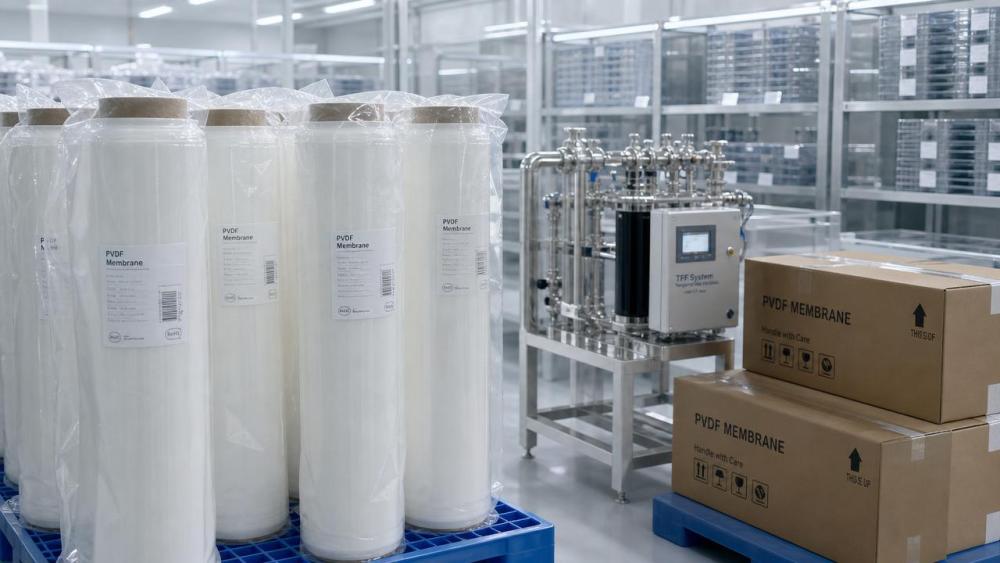
On June 2, 2026, Sumitomo Bakelite of Japan and SK IE Technology of Korea jointly announced a supply rule change for medical TFF ultrafiltration membrane PVDF base films, introducing allocation-based supply, a 40% price increase, and an extended delivery lead time of 18 weeks as semiconductor-grade PVDF feedstock capacity shifts toward chip packaging applications.
Confirmed Change in PVDF Base Film Supply
According to the event summary provided, the announcement was made on June 2, 2026 by Japan's Sumitomo Bakelite and Korea's SK IE Technology.
The confirmed change concerns PVDF base films used in medical TFF ultrafiltration membranes. From the announcement date, these materials are subject to allocation-based supply. The stated price increase is 40%, and the delivery lead time has been extended to 18 weeks.
The stated reason is that semiconductor-grade PVDF raw material capacity is being redirected toward chip packaging. The material is described as a core consumable for TFF Ultrafiltration Systems, with limited global alternatives.
How the Allocation Rule May Affect Market Participants
Direct trading companies
Direct trading companies may be affected because allocation-based supply changes the way orders are confirmed and fulfilled. Instead of relying only on purchase orders and pricing negotiation, trading desks may need to manage supplier allocation limits, customer priority, shipment sequencing, and contract adjustment discussions.
Business processes likely to receive closer attention include quotation validity, back-to-back procurement terms, inventory reservation, delivery commitment wording, and customer notification procedures. Companies may need to monitor whether the 18-week lead time becomes a baseline planning assumption for new orders.
Raw material procurement teams
Raw material procurement teams are directly exposed because PVDF base films are a core consumable for TFF Ultrafiltration Systems and the event summary indicates that global alternatives are scarce. This increases the importance of allocation visibility, supplier qualification status, and purchase forecast discipline.
Procurement teams may need to pay closer attention to confirmed supplier capacity, allocation documentation, price adjustment clauses, and whether existing supply agreements allow immediate price pass-through after a 40% increase.
Processing and manufacturing companies
Processing and manufacturing companies using medical TFF ultrafiltration membranes may face pressure in production scheduling, order acceptance, and technical specification continuity. Because the affected PVDF base film is tied to a specific medical filtration application, switching materials may not be a simple commercial substitution.
Key operational links include bill-of-material control, validated material lists, incoming inspection, process planning, finished product delivery commitments, and customer technical approval. Manufacturers may need to review whether any material change would require additional verification before being used in existing systems.
Supply chain service providers
Supply chain service providers may be affected through longer planning windows and higher coordination requirements. Allocation-based supply can create more frequent changes in shipment schedules, booking priorities, and customer delivery expectations.
Relevant business links include order consolidation, inventory visibility, logistics timing, customs documentation coordination where applicable, and after-sales traceability. Providers should watch for changes in customer demand patterns caused by extended lead times and limited replacement options.
Priority Actions for Companies Using TFF Systems
Recheck qualification records before any substitution
Because the affected material is used in medical TFF ultrafiltration membranes, companies should not treat alternative sourcing as a routine purchasing change. Any potential substitute should be reviewed against existing qualification files, compliance documentation, validation records, and customer-approved specifications.
Convert the 18-week lead time into procurement planning
The announced delivery period of 18 weeks should be reflected in rolling purchase plans, safety stock discussions, and customer delivery commitments. Companies with ongoing demand for TFF Ultrafiltration Systems should review open orders, forecast accuracy, and internal approval timelines for advance purchasing.
Update technical specifications and tender language
Where TFF ultrafiltration components are included in technical bids, procurement files, or customer specifications, companies may need to clarify whether PVDF base film brand, grade, validation status, and delivery schedule are mandatory requirements. Technical tender alignment is especially important if allocation affects the ability to deliver within existing project timelines.
Strengthen supplier allocation and traceability controls
Supplier qualification management should include confirmation of allocation status, delivery priority, price adjustment terms, and batch traceability. For downstream users, clear documentation may help reduce disputes related to delayed delivery, changed cost structures, or restricted material availability.
Industry Observation: Scarce Substitutes Raise the Compliance Burden
From an industry perspective, this event is more than a price adjustment. It represents a supply rule change for a specialized membrane material used in medical TFF ultrafiltration applications. Allocation-based supply can shift purchasing from price-led negotiation toward qualification-led access management.
Analysis shows that the limited availability of global alternatives may increase the practical importance of validated materials, supplier approval records, and technical documentation. However, this should be understood as an analytical judgment based on the provided event summary, not as a confirmed market-wide outcome.
What deserves closer attention is the interaction between semiconductor material demand and medical filtration supply. If semiconductor-grade PVDF capacity continues to be prioritized for chip packaging, users of medical TFF ultrafiltration membranes may need longer preparation cycles for procurement, compliance review, and customer communication.
Measured Conclusion for the TFF Membrane Supply Chain
The June 2, 2026 announcement highlights a material supply constraint with direct relevance to TFF Ultrafiltration Systems. The confirmed elements are clear: allocation-based supply, a 40% price increase, and an 18-week delivery lead time for medical TFF ultrafiltration membrane PVDF base films.
A reasonable industry conclusion is that companies should treat this as a procurement, compliance, and delivery planning issue rather than only a cost increase. The full impact will depend on allocation execution, customer approval requirements, and the availability of qualified alternatives.
Source Note and Items to Monitor
This article is based on the user-provided news title, event date, and event summary. Specific official source links were not provided in the input and should be verified continuously.
For events of this type, companies typically monitor supplier announcements, product compliance documentation, certification and validation requirements, tender documents, customer technical specifications, and industry feedback. Further observation is needed on implementation details, certification execution practices, changes in bidding documents, and responses from downstream users of TFF Ultrafiltration Systems.
Related News
- How polymeric membrane systems affect protein recovery in TFFSep 03, 2026Downstream Purification Fellow
- EU Starts Green Tariff Relief Pilot for TFF SystemsJul 15, 2026Downstream Purification Fellow
- China Launches RCEP Smart Origin Checks for TFF SystemsJul 14, 2026Downstream Purification Fellow
- EU Sets Tier-2 Ecolabel Rule for TFF SystemsJul 13, 2026Downstream Purification Fellow
Related News
- 00
0000-00
What CSV documentation should a laboratory systems supplier provide? - 00
0000-00
SCIEX Begins Construction of High-End Mass Spectrometer Plant in Beijing - 00
0000-00
Which design features make cleanroom benches easier to clean? - 00
0000-00
IndexBox Forecasts 12% CAGR for Global Microbioreactor Market Through 2035 - 00
0000-00
When do hazardous compound labs need isolators for containment?
Downstream Purification Fellow
Weekly Insights
Stay ahead with our curated technology reports delivered every Monday.