





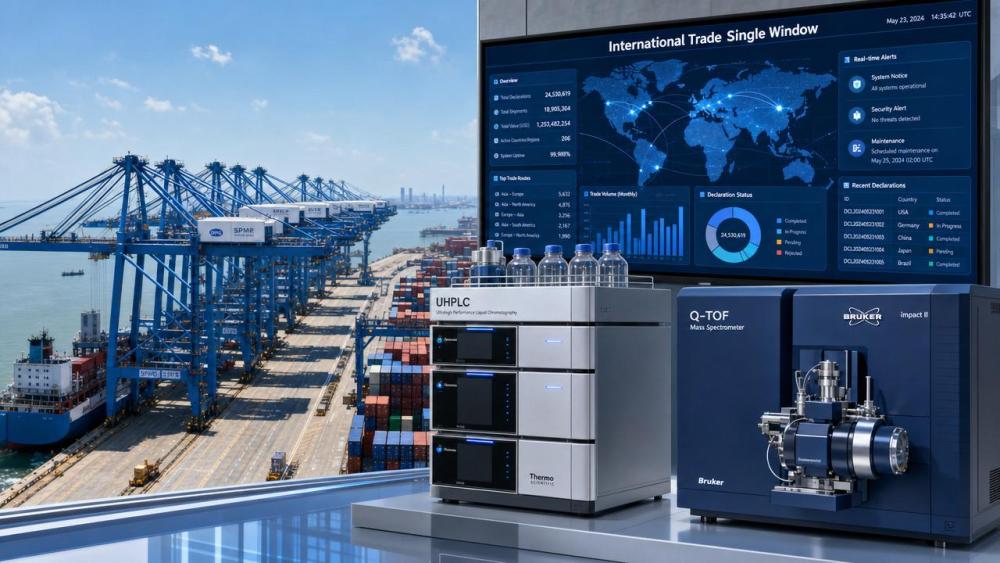
On April 23, 2026, China launched the 2026 Cross-Border Trade Facilitation Initiative, enabling self-service printing of key pharmaceutical import documents—including the Import Drug Clearance Certificate and MED Device Filing Certificate—via the International Trade Single Window. The measure specifically covers high-end analytical equipment imports such as UHPLC systems and Q-TOF mass spectrometers. Early results from Shanghai and Shenzhen ports show a 30% reduction in average clearance time and a 42% drop in inspection anomaly rates—making this development highly relevant for life sciences, diagnostics, pharmaceutical manufacturing, and precision instrument trading sectors.
Event Overview
The 2026 Cross-Border Trade Facilitation Initiative was officially launched on April 23, 2026. It mandates integration of pharmaceutical and medical device import documentation—including the Import Drug Clearance Certificate and MED Device Filing Certificate—into the national International Trade Single Window platform, enabling automated, self-service printing. The initiative explicitly applies to imports of ultra-high-performance liquid chromatography (UHPLC) systems and quadrupole time-of-flight (Q-TOF) mass spectrometers. Verified outcomes from pilot operations at Shanghai and Shenzhen ports indicate an average 30% reduction in customs clearance time and a 42% decline in inspection-related anomalies.
Impact on Specific Industry Segments
Direct Importers and Trading Enterprises
These entities handle end-to-end import declarations for regulated health products and lab equipment. They are directly affected because document issuance—previously requiring manual submission, inter-agency coordination, and physical collection—is now fully digitalized and integrated into the Single Window. Impact manifests as reduced administrative lead time, lower risk of document rejection, and tighter alignment between customs and drug regulatory timelines.
Raw Material and Reagent Procurement Units
While not importing finished devices or drugs, procurement teams sourcing critical components (e.g., Q-TOF detector modules, UHPLC column hardware) under dual-use or controlled classification may face upstream verification requirements. As customs processing becomes faster and more standardized, delays previously absorbed in documentation now shift toward technical compliance checks—making pre-submission classification accuracy more consequential.
Contract Manufacturing and Analytical Service Providers
Organizations operating GLP/GMP-compliant labs rely on timely receipt of calibrated UHPLC/Q-TOF systems for method validation and batch release testing. A 30% reduction in equipment clearance time shortens facility commissioning cycles—particularly relevant for new CDMO facilities scaling up in China. However, this benefit assumes consistent application across all ports; current data is limited to Shanghai and Shenzhen.
Distribution and Channel Operators
Medical device distributors managing parallel import portfolios—including refurbished or demo units—must ensure each shipment carries valid, digitally verifiable credentials. Self-printed certificates carry the same legal standing as manually issued ones, but require updated internal SOPs for digital archive retention, audit trail generation, and cross-border certificate authenticity verification.
Key Considerations and Practical Responses for Affected Entities
Monitor official rollout scope and port-level implementation
Current performance metrics (30% faster clearance, 42% fewer anomalies) are confirmed only for Shanghai and Shenzhen. Entities importing through other ports—including Tianjin, Guangzhou, or Chengdu—should verify local Single Window integration status and document eligibility before adjusting lead-time assumptions.
Validate document eligibility for specific equipment configurations
Not all UHPLC or Q-TOF models automatically qualify. Eligibility depends on tariff classification, intended use (e.g., R&D vs. clinical diagnostics), and whether the item falls under the Import Drug Clearance Certificate or MED Device Filing Certificate regime. Companies should cross-check HS codes and NMPA registration status prior to filing.
Distinguish policy enablement from operational readiness
The Single Window functionality is live, but internal ERP, customs brokerage interfaces, and quality management systems may not yet support auto-pull of digitally signed certificates. Firms should assess API compatibility, digital signature acceptance protocols, and internal training needs—not just regulatory eligibility.
Update import planning and contingency buffers
With verified clearance acceleration in key ports, procurement teams may revise safety stock levels and shipping frequency for time-sensitive spares (e.g., Q-TOF ion sources). However, given that inspection anomaly reduction reflects past performance—not guaranteed future outcomes—maintaining partial buffer capacity remains prudent pending broader port validation.
Editorial Perspective / Industry Observation
Observably, this initiative represents a procedural upgrade—not a regulatory relaxation. It streamlines execution within existing legal frameworks rather than altering classification rules, safety standards, or NMPA oversight authority. Analysis shows the primary value lies in predictability: shorter and more consistent clearance windows reduce scheduling uncertainty for lab instrument deployment and clinical trial material logistics. That said, it functions more as an operational signal than an immediate, universal outcome—its real-world impact remains contingent on consistent technical implementation across regional customs nodes and alignment with parallel NMPA electronic certification systems. The sector should therefore treat it as a step toward system interoperability, not a de facto simplification of compliance.
Conclusion: This initiative marks a measurable improvement in customs process efficiency for select high-value, regulated life science imports—but its practical benefit is currently constrained by geographic and product-specific scope. It is best understood not as a broad deregulatory shift, but as a targeted digitization milestone with tangible time savings where fully deployed. Stakeholders should prioritize verification over assumption, and adapt internal workflows incrementally—aligning changes with confirmed local implementation, not national announcements alone.
Source: Official announcement of the 2026 Cross-Border Trade Facilitation Initiative (April 23, 2026); publicly reported clearance performance data from Shanghai and Shenzhen Customs authorities. Note: Implementation status beyond Shanghai and Shenzhen ports remains under observation and has not been formally confirmed.
Related News
- How to prevent carryover errors in UHPLC proceduresOct 08, 2026Analytical Metrology Expert
- How to choose triple quadrupole LC-MS systems for routine quantitationSep 01, 2026Analytical Metrology Expert
- EMA CSV Update Tightens Records for Imported UHPLC SystemsAug 02, 2026Analytical Metrology Expert
- FDA Tightens Data Integrity Checks for Imported UHPLCJul 22, 2026Analytical Metrology Expert
Related News
- 00
0000-00
What CSV documentation should a laboratory systems supplier provide? - 00
0000-00
SCIEX Begins Construction of High-End Mass Spectrometer Plant in Beijing - 00
0000-00
Which design features make cleanroom benches easier to clean? - 00
0000-00
IndexBox Forecasts 12% CAGR for Global Microbioreactor Market Through 2035 - 00
0000-00
When do hazardous compound labs need isolators for containment?
Analytical Metrology Expert
Weekly Insights
Stay ahead with our curated technology reports delivered every Monday.