





Starting on 25 May 2026, Shanghai Customs and the National Medical Products Administration jointly launched a pilot program at Yangshan Special Comprehensive Bonded Zone to accelerate customs clearance for high-value bioprocessing equipment—directly impacting biopharmaceutical manufacturers, especially those developing monoclonal antibody production lines.
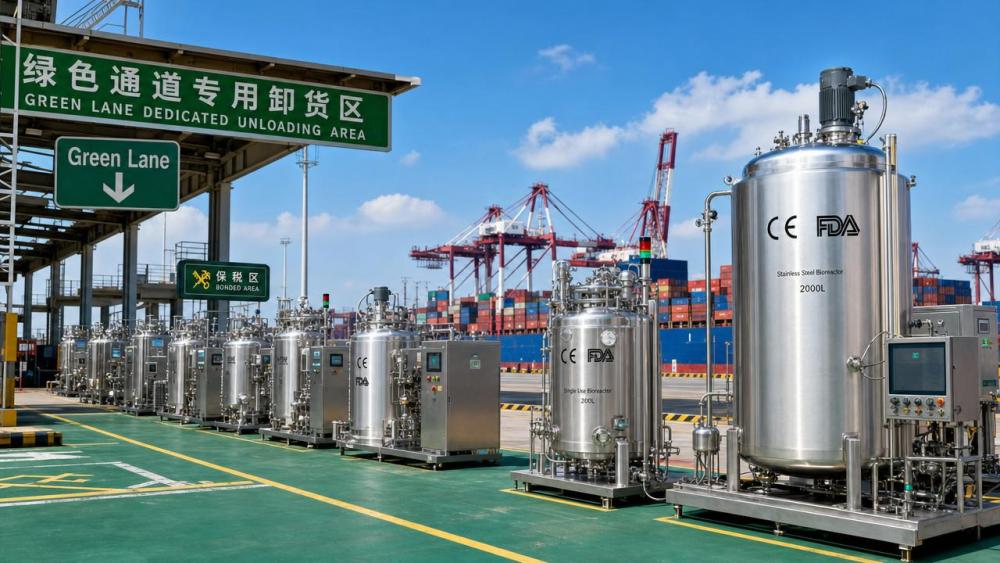
Launch of the High-Value Bioprocessing Equipment Fast Clearance Pilot
On 25 May 2026, the pilot ‘High-Value Bioprocessing Equipment Fast Clearance Program’ commenced at Yangshan Special Comprehensive Bonded Zone in Shanghai. The initiative covers 12 equipment categories, including Single-use Bioreactors, Stainless Steel Fermenters, and Continuous Flow Centrifuges. Eligible enterprises may clear goods upon submission of a GMP compliance statement together with CE or FDA certification. Under this arrangement, customs inspection is completed within four hours—40% faster than standard procedures.
Impact Across the Biomanufacturing Value Chain
Direct Trading Enterprises
Importers and exporters handling bioprocess equipment face reduced dwell time at port, lowering demurrage costs and improving cash flow predictability. However, they must now ensure documentation—including GMP declarations and international certifications—is fully aligned prior to shipment.
Raw Material and Component Procurement Firms
Suppliers of critical subsystems (e.g., sensors, single-use bags, control modules) may experience upstream demand shifts as end-users prioritize full-system compliance over modular procurement. Pre-qualification against GMP and CE/FDA-aligned specifications becomes increasingly decisive.
Equipment Manufacturing Companies
OEMs must verify that their product documentation explicitly supports GMP compliance claims—not just functional performance—and confirm CE or FDA status applies to the exact configuration being imported. Post-market technical files may be subject to increased scrutiny during customs verification.
Supply Chain Service Providers
Logistics integrators, regulatory consultants, and customs brokers need updated protocols for pre-clearance validation, including document triage, certificate authenticity checks, and cross-referencing of GMP statements with equipment design history files.
Key Operational Considerations for Enterprises
Pre-submission Verification of Regulatory Documentation
Enterprises must validate that CE or FDA certificates are current, scope-appropriate, and issued by accredited bodies. GMP compliance statements must be signed by authorized quality personnel and reference specific process parameters relevant to the imported equipment.
Alignment of Technical Specifications with Certification Scope
Technical bids, purchase orders, and delivery notes must explicitly reflect the certified configuration (e.g., material grade, software version, sterilization method), avoiding generic descriptions that could trigger re-evaluation during customs review.
Procurement Timeline Adjustment for Documentation Readiness
Given the shortened 4-hour inspection window, procurement planning must now allocate buffer time for internal documentation preparation—especially for multi-vendor systems where GMP declarations require coordination across suppliers.
Supplier Qualification and Traceability Management
Buyers should update vendor assessment criteria to include documented evidence of CE/FDA certification maintenance and GMP-aligned quality system implementation—not only for final equipment but also for key subassemblies affecting process sterility or data integrity.
Industry Perspective: Beyond Speed—A Shift Toward Integrated Compliance
Analysis shows this pilot signals a broader regulatory evolution: from isolated certification acceptance toward integrated verification of technical, quality, and regulatory coherence. Observably, it incentivizes early-stage alignment between equipment design, quality system documentation, and import logistics—reducing post-import remediation risks. It is more appropriate to understand this as a step toward harmonizing manufacturing readiness with trade facilitation, rather than merely a procedural efficiency gain. What deserves closer attention is how this model may extend to other high-regulation sectors—such as advanced diagnostics or cell therapy manufacturing—where equipment qualification timelines often constrain clinical supply.
Strategic Implications for Bioprocess Infrastructure Development
This initiative does not eliminate compliance requirements but compresses their execution timeline—shifting emphasis from reactive correction to proactive documentation governance. For global equipment suppliers, consistent certification maintenance and transparent technical file architecture become competitive differentiators. For domestic biomanufacturers, faster access to critical infrastructure supports accelerated process development and tech transfer—but only if internal quality systems are mature enough to generate auditable GMP declarations on demand.
Source Attribution and Monitoring Guidance
This article was generated exclusively from the user-provided title, event date (25 May 2026), and summary. Specific official source links were not provided in the input and should be verified continuously. Stakeholders are advised to monitor forthcoming implementation guidelines from Shanghai Customs and the NMPA, particularly regarding acceptable formats for GMP declarations, scope interpretation of CE/FDA certificates for modular equipment, and potential expansion of the 12-category list. Industry feedback on pilot execution—especially regarding documentation rejection rates and inter-agency coordination—will shape future scalability.
Related News
- What CSV documentation should a laboratory systems supplier provide?Oct 26, 2026Dr. Elara Sterling
- SCIEX Begins Construction of High-End Mass Spectrometer Plant in BeijingOct 26, 2026Analytical Metrology Expert
- Which design features make cleanroom benches easier to clean?Oct 25, 2026Bio-containment Strategist
- IndexBox Forecasts 12% CAGR for Global Microbioreactor Market Through 2035Oct 25, 2026Bioprocess Scientist
Related News
- 00
0000-00
What CSV documentation should a laboratory systems supplier provide? - 00
0000-00
SCIEX Begins Construction of High-End Mass Spectrometer Plant in Beijing - 00
0000-00
Which design features make cleanroom benches easier to clean? - 00
0000-00
IndexBox Forecasts 12% CAGR for Global Microbioreactor Market Through 2035 - 00
0000-00
When do hazardous compound labs need isolators for containment?
Industry Global
Weekly Insights
Stay ahead with our curated technology reports delivered every Monday.