





Biopharma manufacturing is moving into a more selective scale-up phase in 2026. Capacity expansion still matters, but the stronger signal is quality of expansion. Decisions now sit at the intersection of process robustness, regulatory readiness, automation depth, and capital discipline.
That shift matters because the market no longer rewards volume alone. It rewards flexible facilities, stable yields, traceable data, and the ability to support biologics, advanced therapies, and faster product changeovers without losing control.
For organizations tracking equipment strategy and operational maturity, biopharma manufacturing in 2026 is less about isolated machines and more about connected process systems. The most relevant trends are shaping how scale-up risk is measured before a line is ever expanded.
Why scale-up looks different in 2026
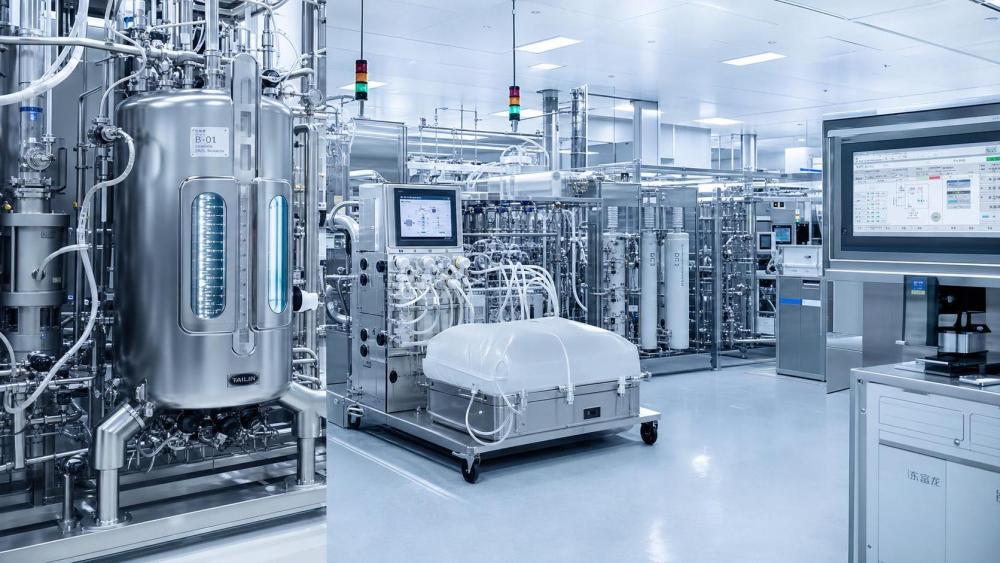
The next scale-up cycle is not being driven by a single product class. Monoclonal antibodies, recombinant proteins, CGT pipelines, and regional supply requirements are all pushing biopharma manufacturing toward mixed operating models.
In practical terms, facilities must support both throughput and adaptability. A plant designed only for steady blockbuster demand may struggle when smaller batches, faster validation, and multi-product scheduling become routine.
This is where the broader equipment ecosystem becomes important. BLES frames the market through five pillars: upstream culture systems, downstream separation, molecular analysis, biosafety infrastructure, and automated liquid handling.
That lens is useful because scale-up rarely fails at a single point. It usually breaks where process assumptions, equipment capability, and compliance evidence stop matching each other.
The core trends redefining biopharma manufacturing
Several trends are already changing how biopharma manufacturing projects are evaluated. They affect technology selection, operating cost, validation burden, and long-term site resilience.
Single-use moves from convenience to strategic flexibility
Single-use technology is no longer viewed only as a startup shortcut. In 2026, it is increasingly a portfolio management tool for rapid line turnover, lower cleaning validation load, and phased capacity expansion.
The business case becomes stronger when demand is uneven or products have shorter commercial visibility. Still, the value depends on supply chain reliability, bag integrity, extractables data, and change control discipline.
Upstream scale-up is becoming more data-sensitive
Bioreactors and fermenters remain central to biopharma manufacturing, but volume alone tells very little. Oxygen transfer, mixing behavior, shear profile, and pH stability increasingly determine whether development performance survives commercial scaling.
This is especially important for mammalian systems and sensitive cell lines. A technically successful pilot run can still create future losses if gas-liquid transfer assumptions collapse at larger working volumes.
Downstream intensification is under stronger scrutiny
Many scale-up bottlenecks now appear after the bioreactor. Industrial centrifuges, filtration systems, and polishing steps are being reassessed because higher upstream titers can expose weak downstream capacity.
In other words, biopharma manufacturing efficiency depends on end-to-end balance. A strong harvest profile means little if clarification losses, membrane fouling, or low recovery rates erase the gain.
Automation is expanding from labor savings to control logic
Automated liquid handling used to be discussed mainly in high-throughput screening. Now it supports method consistency, tech transfer accuracy, and reproducible sample preparation across development and QC workflows.
That matters because scale-up decisions depend on trusted data. When liquid handling variability falls, process comparisons become more credible, especially in NGS workflows, analytical prep, and release-support environments.
Why data integrity is now a capacity issue
One of the clearest changes in biopharma manufacturing is that compliance can no longer be treated as a late-stage review. Data integrity, CSV alignment, and audit traceability now influence whether expansion plans are truly usable.
A facility may install advanced bioprocess hardware, but weak digital governance can delay release, complicate inspections, and reduce cross-site comparability. Capacity on paper is not the same as compliant capacity.
This is where intelligence-led evaluation becomes valuable. BLES emphasizes not only equipment categories, but also the relationship between microscopic process behavior and GMP evidence structures.
LC-MS systems, for example, are not just analytical accessories. In scale-up settings, they support comparability, impurity profiling, and molecular consistency, all of which affect process confidence and commercial readiness.
Where the main business value is being created
The strongest biopharma manufacturing investments in 2026 are likely to create value in four connected ways rather than one isolated metric.
- Shorter time to validated production through modular and easier-to-qualify systems.
- Higher process resilience through better fit between upstream output and downstream recovery.
- Lower deviation risk through automation, standardized handling, and stronger traceability.
- Improved capital efficiency by scaling only where technical constraints actually justify expansion.
This is also why biosafety cabinets and clean benches should not be overlooked. In high-risk workflows and cytotoxic handling, safe containment protects not only staff and samples, but also continuity of operations.
A practical view of scale-up priorities
When reviewing biopharma manufacturing readiness, it helps to compare trends against their operational impact rather than their popularity.
This kind of review helps separate true scale-up enablers from expensive upgrades that add complexity without solving the primary bottleneck.
How to read the market signals behind equipment choices
In 2026, the most informative equipment signals are usually indirect. They show up in validation timelines, batch release predictability, consumables dependence, and cross-functional data confidence.
Biopharma manufacturing strategies should therefore be tested against scenario questions, not only technical brochures. Can the system support both current molecules and probable next molecules? Can it scale without rewriting every control assumption?
It is also worth checking whether an equipment platform improves decision quality across the full workflow. A good system should support process development, transfer, QC visibility, and audit defensibility at the same time.
That integrated view reflects the value of specialist intelligence platforms such as BLES. The advantage is not promotion of a single device, but a stitched understanding of how biopharma manufacturing performance emerges across linked process steps.
What deserves closer attention next
The best next step is usually a structured review of scale-up assumptions. Focus on where process variability, compliance friction, and capital exposure meet.
- Map the real bottleneck across upstream, downstream, analytics, and handling workflows.
- Check whether automation improves traceability, not only labor efficiency.
- Compare flexible capacity options against projected product mix volatility.
- Review data integrity readiness before treating added equipment as usable output.
- Track whether each investment improves both process science and GMP confidence.
Biopharma manufacturing in 2026 will favor organizations that scale with discipline. The important question is no longer how fast capacity can be added, but how reliably it can deliver quality, evidence, and commercial flexibility together.
Related News
- How to evaluate a bioprocessing intelligence platform for scale-upSep 07, 2026Prof. Alistair Thorne
- How can a cell therapy bioprocessing manufacturer support GMP scale-up?Sep 07, 2026Prof. Alistair Thorne
- What drives CGT bioprocessing cost at commercial scale?Aug 31, 2026Prof. Alistair Thorne
- When do automated bioprocess scale-up solutions reduce tech-transfer risk?Aug 30, 2026Prof. Alistair Thorne
Related News
- 00
0000-00
How to build a system lifecycle validation strategy for GMP compliance - 00
0000-00
How to assess supplier support when buying biotech equipment in Europe - 00
0000-00
How to assess GMP audit readiness in Europe before an inspection - 00
0000-00
How to size downstream purification systems for batch capacity - 00
0000-00
When does a Class II biosafety cabinet provide adequate protection?
Prof. Alistair Thorne
Weekly Insights
Stay ahead with our curated technology reports delivered every Monday.