





Cell & Gene Therapies are moving from breakthrough science toward commercial reality.
Yet progress depends on more than vectors, edited cells, or promising clinical data.
The harder question is whether manufacturing systems can scale without breaking quality, timelines, or budgets.
For the broader life sciences equipment market, this is where investment risk and operational readiness meet.
Cell & Gene Therapies need better scale-up tools because process variability remains high, batch sizes differ, and GMP expectations are unforgiving.
From bioreactors to LC-MS systems, from separation platforms to liquid handling, infrastructure now shapes development speed and launch confidence.
What scale-up means in Cell & Gene Therapies
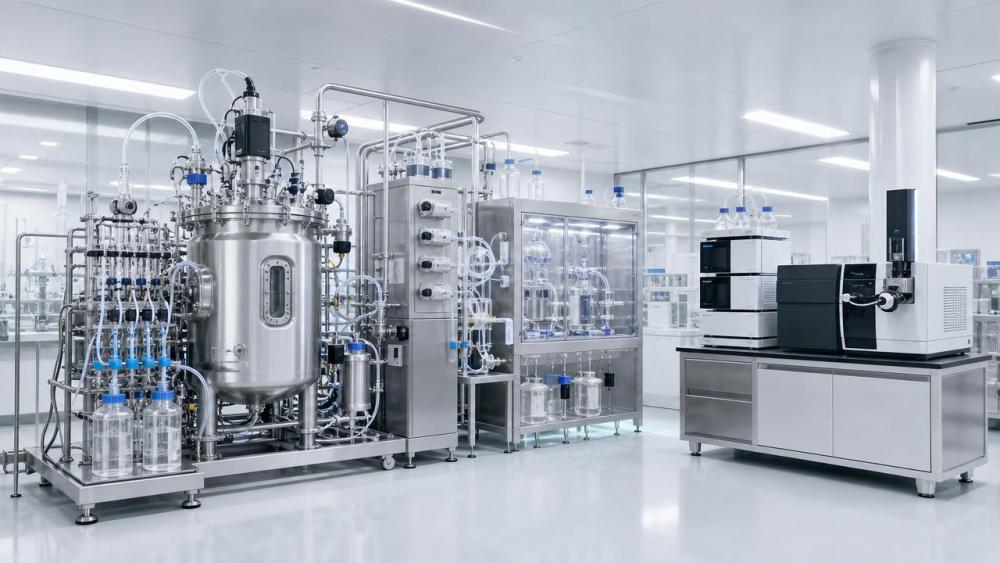
Scale-up in Cell & Gene Therapies is not a simple matter of making a larger batch.
It involves preserving critical quality attributes while moving from research conditions to clinical and commercial manufacturing.
That challenge is amplified by living materials, narrow process windows, and product-specific workflows.
Autologous therapies often need precise small-batch orchestration.
Allogeneic therapies require consistent large-scale expansion and purification.
Both models demand better scale-up tools, but for different operational reasons.
In practice, Cell & Gene Therapies rely on tightly linked unit operations.
Cell culture, vector production, harvest, concentration, analytical release, and aseptic handling must remain synchronized.
If one platform lacks flexibility or traceability, the entire manufacturing chain becomes fragile.
Industry signals driving demand for better scale-up tools
Several market signals explain why Cell & Gene Therapies are reshaping equipment priorities across the industry.
- Clinical pipelines are expanding faster than many facilities can adapt.
- Process economics are under pressure from high failure costs and complex logistics.
- Regulators expect strong data integrity, traceability, and validated digital control.
- Technology transfer remains difficult across sites, partners, and manufacturing scales.
- Investors increasingly evaluate platform robustness, not only scientific novelty.
These pressures are visible across bioprocessing, analytical metrology, and laboratory automation.
They also align with the intelligence priorities followed by BLES.
The market now values systems that connect microscopic process behavior with GMP-ready operational control.
Why process infrastructure now influences business outcomes
In Cell & Gene Therapies, infrastructure is no longer a background function.
It directly affects comparability, batch release timing, tech transfer success, and long-term manufacturing economics.
A therapy with weak scale-up design may look promising in early development.
However, poor tool compatibility can delay validation, increase deviations, and reduce commercial viability.
Better scale-up tools improve business performance in several ways.
- They reduce process drift between development and manufacturing environments.
- They support data continuity for GMP inspections and quality reviews.
- They improve asset utilization through modular or single-use configurations.
- They shorten troubleshooting cycles with stronger analytical visibility.
- They lower the risk of expensive batch loss and rework.
For this reason, Cell & Gene Therapies are increasingly evaluated through an operational lens.
Scientific excellence still matters, but scalable execution determines whether value can be realized.
Core equipment categories shaping Cell & Gene Therapies
The most effective scale-up strategies usually combine five equipment domains.
Bioreactors and fermenters
These systems define the physical environment for cell expansion and viral vector production.
Precise control of temperature, dissolved oxygen, pH, and shear is essential.
Small changes in gas-liquid transfer can alter viability and productivity.
Industrial centrifuges and separation systems
Downstream processing in Cell & Gene Therapies often handles delicate materials and low margins for error.
Clarification, concentration, and impurity removal must protect yield while maintaining consistency.
LC-MS systems
Analytical depth matters because release, comparability, and characterization standards keep rising.
LC-MS provides confidence in identity, impurity profiles, and process understanding.
Biosafety cabinets and clean benches
Aseptic handling remains fundamental across viral, cellular, and gene editing workflows.
Containment design supports sample protection, operator safety, and environmental control.
Liquid handling workstations
Automation reduces manual variance in assay setup, library preparation, and screening workflows.
For Cell & Gene Therapies, that precision improves reproducibility and readiness for scale.
Typical scale-up scenarios across the CGT workflow
Not every program faces the same bottlenecks.
Different Cell & Gene Therapies emphasize different tool requirements.
This variation explains why generic biomanufacturing tools are often insufficient.
Cell & Gene Therapies need better scale-up tools that reflect product biology and workflow complexity.
Practical considerations for selecting scale-up infrastructure
A useful evaluation framework should move beyond equipment specifications alone.
The key issue is how each tool supports reproducibility, compliance, and future capacity changes.
- Check whether process parameters remain comparable from bench to pilot to GMP scale.
- Confirm data integrity features, audit trails, and readiness for CSV expectations.
- Assess compatibility with single-use technology and rapid changeover needs.
- Review analytical methods for sensitivity, speed, and transferability across sites.
- Measure automation value by error reduction, not only labor reduction.
- Consider service support, calibration demands, and spare parts continuity.
These points are especially relevant in a funding environment that rewards disciplined capital deployment.
Cell & Gene Therapies require infrastructure that can defend both science and economics.
Operational direction for the next stage of market readiness
The future of Cell & Gene Therapies will depend on stronger integration across equipment, data, and process intelligence.
Facilities need systems that can connect cell culture behavior with downstream recovery and analytical proof.
That is why BLES tracks the full equipment ecosystem rather than isolated instruments.
Bioreactor physics, GMP compliance, separation efficiency, and automation design now belong to one strategic conversation.
For organizations building in Cell & Gene Therapies, the next step is practical.
Map current process bottlenecks, identify where variability enters the workflow, and compare toolsets against future GMP scale targets.
Prioritize platforms that strengthen data integrity, simplify transfer, and support flexible expansion.
Cell & Gene Therapies will keep advancing scientifically.
Commercial success, however, will belong to programs supported by better scale-up tools from the start.
Related News
- Zylidac Bio and Prolific Machines Partner to Scale Optogenetics for GMP ProductionOct 23, 2026Prof. Alistair Thorne
- How to prevent oxygen limitation in process scale-up for biologicsOct 18, 2026Prof. Alistair Thorne
- How to maintain product quality when scaling up a bioprocessOct 09, 2026Prof. Alistair Thorne
- What should you verify before choosing a bioprocessing equipment exporter?Oct 08, 2026Prof. Alistair Thorne
Related News
- 00
0000-00
What CSV documentation should a laboratory systems supplier provide? - 00
0000-00
SCIEX Begins Construction of High-End Mass Spectrometer Plant in Beijing - 00
0000-00
Which design features make cleanroom benches easier to clean? - 00
0000-00
IndexBox Forecasts 12% CAGR for Global Microbioreactor Market Through 2035 - 00
0000-00
When do hazardous compound labs need isolators for containment?
Prof. Alistair Thorne
Weekly Insights
Stay ahead with our curated technology reports delivered every Monday.