





Following the conclusion of the American Society of Clinical Oncology (ASCO) Annual Meeting 2026 on May 31, a marked acceleration in demand for automated NGS library preparation systems has been observed globally—driven by rapid expansion in liquid biopsy assay (LBA) research and heightened regulatory emphasis on sample integrity standards.
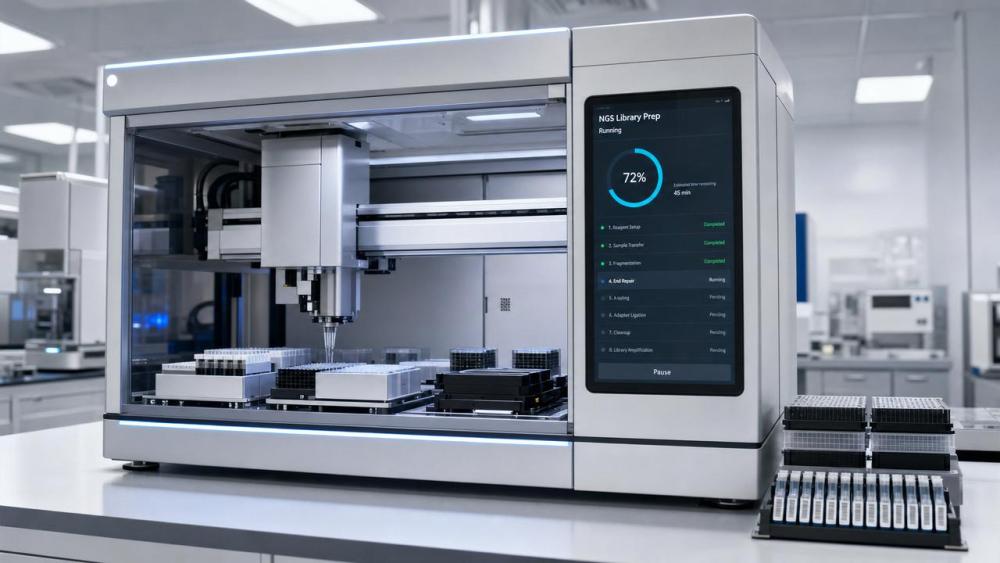
Confirmed Market Impact Data from ASCO 2026
According to on-site data monitoring at the ASCO 2026 conference (concluded May 31), the number of global Liquid Biopsy Assay (LBA) research projects increased by 37% year-on-year. This growth directly catalyzed surging procurement of NGS Library Prep Stations: Q2 2026 global order volume reached 2.1 times that of Q2 2025. Primary buyers were concentrated in Germany, Singapore, Brazil, and emerging life science hubs across the Middle East. End users consistently specified requirements for fully automated dual workflows covering both FFPE and cfDNA sample types, as well as compliance with ISO 20387:2018 for biobanking and sample integrity assurance.
Implications Across the Life Science Supply Chain
Direct Trade Enterprises
Export-oriented distributors and equipment traders face intensified demand validation cycles. The geographic shift toward non-traditional markets—including Brazil and select Middle Eastern jurisdictions—requires updated regulatory pre-clearance checks, especially for ISO 20387:2018 conformance documentation and bilingual technical manuals aligned with local biobank governance expectations.
Raw Material & Component Suppliers
Suppliers of precision fluidic modules, barcode-compatible consumables, and certified reagent kits are experiencing revised forecast timelines. Demand signals now emphasize compatibility with dual FFPE/cfDNA protocols—prompting recalibration of inventory planning and lot traceability protocols to support audit-ready chain-of-custody reporting.
Manufacturers & System Integrators
OEMs and system builders must verify functional validation of automated dual-sample-type workflows under real-world lab conditions—not just nominal specifications. ISO 20387:2018 alignment necessitates documented evidence of sample identity preservation, temperature-controlled processing logs, and failure-mode response testing across full run cycles.
Supply Chain Service Providers
Logistics and installation service partners are adapting to tighter delivery windows and expanded commissioning scopes. Deployments increasingly require on-site verification of ISO 20387:2018-aligned operational procedures—including cold-chain handover records, calibration certificate archiving, and operator competency attestations.
Strategic Priorities for Equipment Providers
Accelerate ISO 20387:2018 Compliance Documentation
Manufacturers must prioritize third-party attestation of sample integrity safeguards—not only hardware performance. This includes traceable calibration histories, environmental monitoring integration, and software-based audit trails for every sample-handling step.
Validate Dual-Workflow Automation Under Regulatory-Ready Conditions
FFPE and cfDNA workflow certifications should be conducted using reference materials accepted by major accreditation bodies (e.g., CAP, UK NEQAS), not internal benchmarks alone. Validation reports must explicitly address cross-contamination controls and nucleic acid degradation thresholds.
Align Technical Specifications with Emerging Procurement Criteria
Bid documents from institutions in Germany, Singapore, and Brazil now routinely include mandatory clauses referencing ISO 20387:2018 Annex A (sample integrity requirements) and IEC 62304 (medical device software lifecycle). Technical proposals must map features directly to these clauses—not generic ‘compliance statements’.
Strengthen Post-Sale Traceability Infrastructure
With growing emphasis on sample provenance, manufacturers should embed secure digital log capabilities—including tamper-evident timestamps, geolocated service event recording, and encrypted export of raw instrument logs—to support long-term quality audits and regulatory inspections.
Industry Observation: Beyond the Order Spike
Analysis shows this is not merely a cyclical procurement uptick but reflects structural shifts in translational research infrastructure planning. Observably, funders and national biobank initiatives—particularly in Singapore and Brazil—are embedding ISO 20387:2018 conformance as a prerequisite for LBA project funding eligibility. What deserves closer attention is how rapidly automation vendors are being evaluated less on throughput alone and more on their ability to deliver auditable, end-to-end sample integrity assurance. It is more appropriate to understand this as an inflection point where instrumentation certification converges with biobanking governance maturity.
Broader Significance for Diagnostic Infrastructure Development
This ASCO 2026–driven demand surge signals growing institutional recognition that robust, standardized library preparation is foundational—not ancillary—to clinical-grade liquid biopsy development. While short-term pressure centers on delivery capacity and compliance readiness, the longer-term implication lies in accelerated convergence between molecular diagnostics, biobanking standards, and automated laboratory infrastructure. Stakeholders should anticipate continued tightening of technical and procedural harmonization—not relaxation—as global LBA adoption scales.
Source Attribution & Verification Notes
This article was generated exclusively from the user-provided input: title, event date (2026-05-31), and summary text. Specific official source links were not provided in the input and should be verified continuously. Readers are advised to monitor upcoming updates to national biobanking guidelines, tender specifications issued by academic medical centers in target regions, and evolving interpretations of ISO 20387:2018 implementation by accreditation bodies such as CAP and DIN CERTCO.
Related News
- What CSV documentation should a laboratory systems supplier provide?Oct 26, 2026Dr. Elara Sterling
- SCIEX Begins Construction of High-End Mass Spectrometer Plant in BeijingOct 26, 2026Analytical Metrology Expert
- Which design features make cleanroom benches easier to clean?Oct 25, 2026Bio-containment Strategist
- IndexBox Forecasts 12% CAGR for Global Microbioreactor Market Through 2035Oct 25, 2026Bioprocess Scientist
Related News
- 00
0000-00
What CSV documentation should a laboratory systems supplier provide? - 00
0000-00
SCIEX Begins Construction of High-End Mass Spectrometer Plant in Beijing - 00
0000-00
Which design features make cleanroom benches easier to clean? - 00
0000-00
IndexBox Forecasts 12% CAGR for Global Microbioreactor Market Through 2035 - 00
0000-00
When do hazardous compound labs need isolators for containment?
Industry Global
Weekly Insights
Stay ahead with our curated technology reports delivered every Monday.