





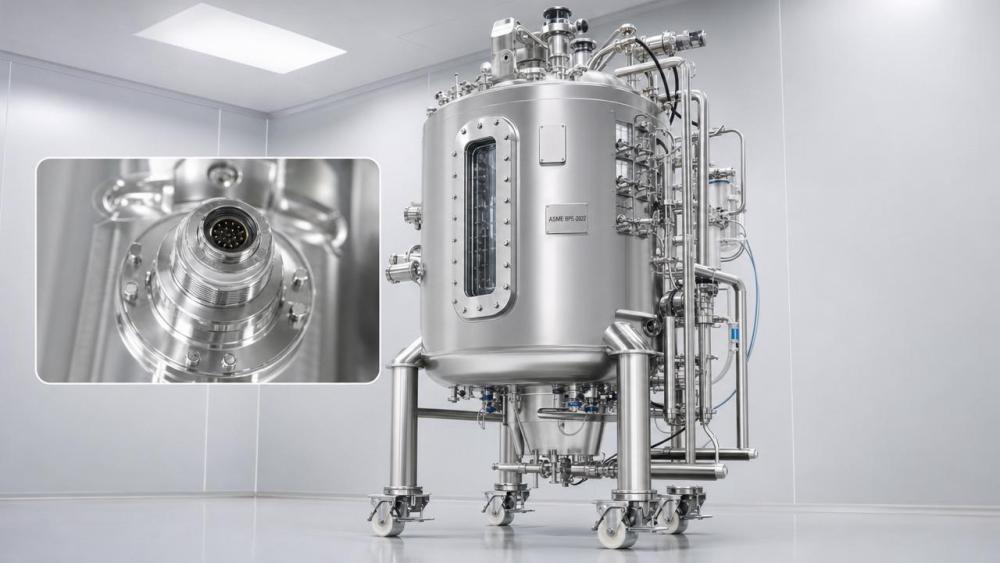
On May 30, 2026, China’s General Administration of Customs released the Statistical Bulletin on Biopharmaceutical Equipment Exports – Q1 2026, revealing a sharp rise in exports of single-use bioreactors (SU-Bioreactors), driven by expanding global demand from emerging contract development and manufacturing organization (CDMO) hubs and tightening technical compliance expectations.
Confirmed Export Performance Data
According to the bulletin, SU-bioreactor exports reached USD 382 million in Q1 2026 — a 62% year-on-year increase. Key destination markets showed even steeper growth: India (+91%), Mexico (+76%), and Saudi Arabia (+144%). Units in the 200–2000 L capacity range accounted for 68% of total export volume. Buyers consistently emphasized compliance with ASME BPE-2022 standards and integration readiness for digital twin–enabled remote operations and maintenance.
Impact Across Supply Chain Roles
Export-oriented equipment manufacturers
These firms face rising order volumes but must rapidly scale production capacity while ensuring traceable ASME BPE-2022 conformance across batches — especially for mid-scale (200–2000 L) units favored by new CDMO clients.
Raw material and component suppliers
Suppliers of single-use bags, fluid path connectors, and sensor-integrated manifolds are seeing tighter delivery windows and increased requests for material certification packages aligned with ASME BPE-2022 Annex A and Annex D requirements.
Contract manufacturing and system integrators
Integrators supplying turnkey bioprocessing lines must now validate digital twin interoperability protocols (e.g., OPC UA compatibility, secure remote access architecture) early in design — not as post-delivery add-ons.
Logistics and regulatory compliance service providers
Freight forwarders and customs consultants report heightened scrutiny on technical documentation packages — including ASME BPE-2022 compliance declarations, sterilization validation summaries, and cybersecurity attestations for connected devices.
Key Priorities for Exporting Enterprises
ASME BPE-2022 certification readiness
Manufacturers must verify that all wetted components — from tubing welds to vessel ports — meet ASME BPE-2022 surface finish, material traceability, and non-destructive testing criteria. Third-party audit reports and calibration records for fabrication tools are increasingly requested pre-shipment.
Digital twin interface standardization
Buyers in India, Mexico, and Saudi Arabia routinely require documented support for remote diagnostics, predictive maintenance triggers, and secure data handover via standardized APIs. Pre-validation of these interfaces against client-defined operational technology (OT) environments is now a de facto bidding requirement.
Mid-capacity unit supply chain alignment
With 200–2000 L units representing nearly 70% of export value, enterprises must prioritize inventory planning and sub-tier supplier qualification specifically for this segment — including flexible film sourcing, gamma-irradiation logistics, and accelerated leak-test throughput.
Industry Observation: Beyond Volume Growth
Analysis shows this export surge reflects more than cyclical demand — it signals a structural shift in global biomanufacturing capacity decentralization. Observably, emerging CDMO hubs are no longer accepting legacy infrastructure compromises; instead, they are specifying next-generation compliance (ASME BPE-2022) and operability (digital twin readiness) as non-negotiable entry requirements. It is more appropriate to understand this as a tightening of technical thresholds — where export competitiveness now hinges less on price and more on verifiable, auditable, and interoperable engineering execution.
Strategic Implication for the Sector
This trend underscores a maturing phase in China’s bioprocess equipment industry: from cost-driven supplier to specification-compliant, digitally enabled partner. Sustained growth will depend not on scaling output alone, but on deepening integration with international quality systems, regulatory expectations, and operational technology ecosystems — turning export momentum into long-term technical credibility.
Source Information and Verification Notes
This article is generated exclusively from the user-provided title, event date (May 30, 2026), and summary text. No external data, enterprise names, policy documents, or hyperlinks were introduced. Specific official source links were not provided in the input and should be verified continuously. Stakeholders are advised to monitor upcoming clarifications on ASME BPE-2022 interpretation by national accreditation bodies, evolving tender specifications from Gulf and Latin American CDMOs, and feedback from end-user commissioning reports.
Related News
- What CSV documentation should a laboratory systems supplier provide?Oct 26, 2026Dr. Elara Sterling
- SCIEX Begins Construction of High-End Mass Spectrometer Plant in BeijingOct 26, 2026Analytical Metrology Expert
- Which design features make cleanroom benches easier to clean?Oct 25, 2026Bio-containment Strategist
- IndexBox Forecasts 12% CAGR for Global Microbioreactor Market Through 2035Oct 25, 2026Bioprocess Scientist
Related News
- 00
0000-00
What CSV documentation should a laboratory systems supplier provide? - 00
0000-00
SCIEX Begins Construction of High-End Mass Spectrometer Plant in Beijing - 00
0000-00
Which design features make cleanroom benches easier to clean? - 00
0000-00
IndexBox Forecasts 12% CAGR for Global Microbioreactor Market Through 2035 - 00
0000-00
When do hazardous compound labs need isolators for containment?
Industry Global
Weekly Insights
Stay ahead with our curated technology reports delivered every Monday.