





Bioprocessing intelligence helps operators spot batch deviations before they escalate into yield loss, compliance risk, or delayed release. In today’s fast-moving biopharma environment, real-time insight across bioreactors, downstream purification, analytical systems, and automated liquid handling is no longer optional. This article explores how smarter process visibility supports consistent quality, faster decisions, and more reliable scale-up under demanding GMP expectations.
For operators, the challenge is rarely a single alarm. It is the accumulation of small shifts: a 0.2 pH drift, unstable dissolved oxygen, delayed harvest timing, inconsistent centrifuge loading, or a subtle LC-MS signal change that only becomes obvious after product quality moves out of trend.
This is where bioprocessing intelligence becomes practical rather than theoretical. It connects equipment data, sampling results, workflow events, and compliance records into a usable decision layer, helping teams act within minutes instead of reacting days later during deviation review.
Why Early Batch Deviation Detection Matters on the Shop Floor
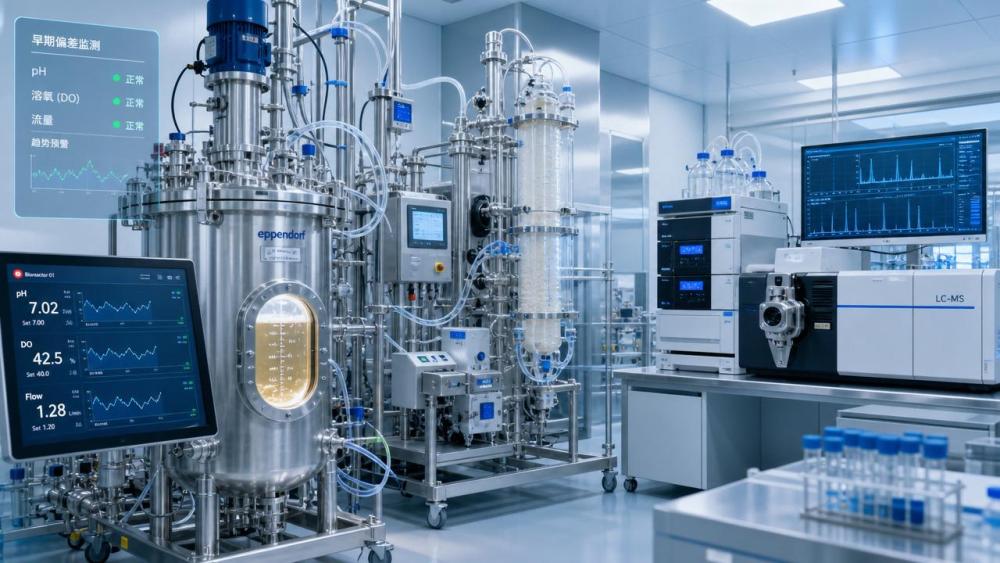
In upstream and downstream operations, most costly failures do not begin as catastrophic events. They usually start as manageable process variation inside a 2-hour to 12-hour window. If operators can see these changes early, they can intervene before the batch crosses a critical quality threshold.
For mammalian cell culture, a small deviation in temperature, agitation, feed timing, or gas transfer can affect viability, metabolite buildup, and titer. In microbial fermentation, oxygen limitation or foaming can shift growth kinetics rapidly, especially during high-density phases where conditions can change in less than 30 minutes.
What operators are really trying to prevent
Operators are not only trying to avoid failed batches. They are also trying to reduce repeat interventions, unplanned holds, extra sampling rounds, and investigation workloads. A deviation caught at the first trend break may take 10 minutes to assess. The same issue found after release testing may require 2 to 5 days of review.
- Yield loss caused by delayed response to process drift
- Extended batch cycle time due to manual checks and resampling
- Out-of-spec or out-of-trend results in purification or analytics
- Higher documentation burden during GMP deviation and CAPA review
- Scale-up inconsistency between pilot, clinical, and commercial runs
Common deviation signals across core bioprocess equipment
The table below shows how bioprocessing intelligence helps operators read early warning signs across BLES priority systems. In practice, the value comes from correlating 3 to 6 variables, not from monitoring each instrument in isolation.
The key lesson is simple: early signals are often weak but measurable. Bioprocessing intelligence gives operators a way to turn weak signals into timely action, especially when multiple systems must stay synchronized under GMP control.
Why manual review alone is no longer enough
A typical batch may involve 50 to 200 tracked parameters, depending on process maturity and instrumentation depth. Manual log review can work for isolated unit operations, but it becomes inefficient once data comes from SCADA, historians, chromatography software, balances, environmental monitoring, and automated workstations at the same time.
When operators must switch between 4 or 5 software environments, deviation recognition slows down. The result is not always bad data. More often, it is delayed interpretation. In commercial or late-stage clinical production, even a 6-hour delay can affect harvest scheduling, buffer preparation, and release planning.
What Bioprocessing Intelligence Looks Like in Daily Operations
Effective bioprocessing intelligence is not just a dashboard. For operators, it should function as a practical decision system with 4 core layers: live data capture, contextual trending, alarm prioritization, and traceable action guidance. Each layer reduces ambiguity during execution.
Four capabilities that create usable process visibility
- Real-time parameter acquisition from bioreactors, filtration skids, analyzers, and robotics
- Context linking between setpoints, actual values, batch stage, and operator interventions
- Risk-based alerts that distinguish critical drift from routine fluctuation
- Electronic records that support investigation, training, and GMP review
For example, a dissolved oxygen dip by itself may not justify escalation. But if it appears together with an agitation increase, foam event, and delayed nutrient feed within the same 45-minute period, the risk profile changes significantly. This is where contextual analytics outperforms isolated alarms.
Operational priorities by process stage
Operators need different intelligence at different stages. Seed train expansion, production bioreactor control, clarification, ultrafiltration, and analytical confirmation each have their own deviation patterns, response windows, and documentation needs.
This stage-based view matters because not all deviations have the same urgency. A 5% flux decline over 2 minutes may be acceptable in one filtration step, while the same trend during a critical concentration phase may require immediate intervention.
The role of BLES in intelligence stitching
BLES is positioned around a valuable gap in the market: many teams have advanced instruments, but fragmented process understanding. By connecting bioreactor dynamics, downstream purification logic, high-molecular analytical metrology, and automated liquid handling, BLES supports a more complete operational picture.
For operators, that means less time translating between equipment silos and more time making controlled decisions. For management and quality teams, it means stronger data integrity, cleaner audit trails, and more predictable scale-up behavior from 20 L to 2000 L and beyond.
How to Build a Practical Deviation Prevention Workflow
Bioprocessing intelligence delivers value only when it is embedded into routine work. The most effective implementation model is a 5-step workflow that helps operators move from data collection to verified action without adding unnecessary system complexity.
A 5-step implementation model for operators
- Define the 10 to 20 parameters that most often predict deviation in each unit operation.
- Set normal operating ranges, alert limits, and escalation thresholds for each batch stage.
- Link instrument outputs with operator actions, sample timestamps, and material movement records.
- Review trend exceptions at fixed intervals, such as every 30 minutes upstream and every batch step downstream.
- Document responses in a way that supports both immediate correction and later GMP investigation.
This workflow prevents a common failure mode: collecting large amounts of process data without clear response rules. Intelligence should reduce decision time, not create more screens and more noise.
Parameters worth prioritizing first
If a facility is starting from a limited digital baseline, it is usually better to begin with a narrow set of high-impact signals. In many bioprocess environments, the first 8 to 12 variables generate most of the useful early-warning value.
- Bioreactor pH, DO, temperature, agitation, gas flow, and feed timestamps
- Centrifuge throughput, filtration pressure, flux, conductivity, and hold time
- LC-MS sequence integrity, peak shape, retention time shift, and system suitability flags
- Liquid handler dispense precision, tip pickup success, deck verification, and exception logs
Common implementation mistakes
One frequent mistake is setting alert thresholds too tightly in the first phase. That often creates alarm fatigue within 1 to 2 weeks. Another is ignoring batch context. A parameter value that is normal during inoculation may indicate risk during late-stage production or concentration.
A third mistake is separating intelligence from compliance documentation. Under GMP expectations, a response is only useful if it is traceable. Systems should support review, acknowledgment, and investigation readiness, especially where CSV and electronic records are involved.
What Operators Should Ask When Evaluating Intelligence Solutions
Not every monitoring platform delivers meaningful bioprocessing intelligence. Some provide basic visualization but limited actionability. Others handle analytics well but do not fit GMP workflows or mixed equipment environments. Operators should assess solutions against practical use, not feature volume alone.
Five evaluation criteria that matter in real production
- Can it integrate upstream, downstream, analytical, and liquid handling data in one review flow?
- Can alerts be tuned by batch phase, product type, or unit operation?
- Does it preserve audit-ready traceability for actions, overrides, and acknowledgments?
- Can operators learn routine use in less than 2 to 4 weeks?
- Does it support scale-up continuity from development runs to GMP manufacturing?
These questions are especially relevant for organizations handling monoclonal antibodies, recombinant proteins, and CGT workflows, where process sensitivity and release pressure are both high. In such settings, faster visibility can influence not only quality but also manufacturing slot utilization.
Why intelligence is also a procurement and scale-up issue
Process intelligence is often treated as an operational add-on, but it should be considered during equipment planning and procurement. A bioreactor, separation skid, LC-MS platform, or liquid handling workstation that cannot share usable data will limit process learning over the next 3 to 5 years.
This is one reason BLES emphasizes both absolute data integrity and seamless process scale-up. Operators need tools that make today’s batch easier to control, while engineering and quality teams need systems that support future validation, tech transfer, and commercial readiness.
A practical operator checklist
Before adopting a new solution, teams should run a 6-point review: signal coverage, integration method, alert logic, training burden, GMP alignment, and investigation support. If one of these six areas is weak, the system may produce data without producing control.
Bioprocessing intelligence is most valuable when it helps operators recognize weak deviation signals early, connect them to real process context, and respond in a way that protects yield, quality, and release timelines. In modern biopharma operations, that means linking bioreactors, purification systems, analytical metrology, biosafety workflows, and automated liquid handling into one practical intelligence framework.
BLES supports this need by focusing on the process, compliance, and scale-up realities that determine whether advanced equipment performs as expected under daily GMP pressure. If you are evaluating smarter monitoring, more reliable batch control, or a stronger data foundation for scale-up, now is the right time to refine your process visibility strategy.
Contact us to discuss your workflow, request a tailored solution, or learn more about bioprocessing intelligence for high-end biopharma and laboratory equipment environments.
Related News
- What CSV documentation should a laboratory systems supplier provide?Oct 26, 2026Dr. Elara Sterling
- GenScript ProBio’s Nanjing Biologics Facility Passes NMPA Pre-Approval InspectionOct 22, 2026Dr. Elara Sterling
- How to assess audit trails in analytical data integrity solutionsOct 16, 2026Dr. Elara Sterling
- How user licensing affects laboratory validation system pricingOct 14, 2026Dr. Elara Sterling
Related News
- 00
0000-00
What CSV documentation should a laboratory systems supplier provide? - 00
0000-00
SCIEX Begins Construction of High-End Mass Spectrometer Plant in Beijing - 00
0000-00
Which design features make cleanroom benches easier to clean? - 00
0000-00
IndexBox Forecasts 12% CAGR for Global Microbioreactor Market Through 2035 - 00
0000-00
When do hazardous compound labs need isolators for containment?
Dr. Elara Sterling
Weekly Insights
Stay ahead with our curated technology reports delivered every Monday.