





High-Molecular Metrology Becomes a Profit Variable Long Before Commercial Launch
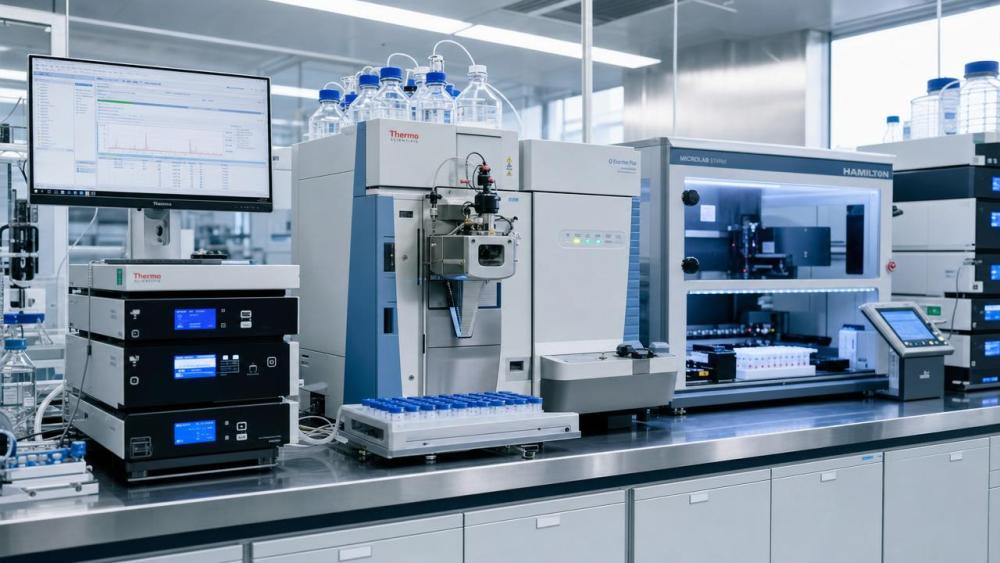
In biopharma, high-molecular analytical metrology now sits at the intersection of science, compliance, and capital efficiency.
A result that looks slightly off is rarely just a lab issue.
It can delay release, trigger deviation review, reshape comparability work, or weaken confidence in process scale-up.
That is why accuracy affects ROI more directly than many teams expect.
For BLES, this is not an isolated analytical topic.
It connects with upstream cell culture control, downstream purification stability, LC-MS interpretation, and automated liquid handling discipline.
When every chromatographic peak, molecular weight signal, or aggregation profile informs GMP readiness, precision becomes a business safeguard.
Why the Same Measurement Standard Does Not Fit Every Workflow
Different workflows ask different questions from high-molecular analytical metrology.
Discovery teams often need speed with enough confidence to rank candidates.
Late-stage development needs tighter reproducibility, audit trails, and method transfer discipline.
Commercial operations care even more about batch-to-batch comparability and release risk.
The analytical question also changes with molecule class.
Monoclonal antibodies, recombinant proteins, viral vectors, and CGT-related materials do not fail in the same way.
Some projects are sensitive to aggregates.
Others depend on charge variants, glycan distribution, fragment detection, or low-level impurities.
In actual use, the better judgment is not asking which platform is most advanced.
It is asking which measurement uncertainty creates the highest downstream cost.
In Early Discovery, the Real Need Is Fast Confidence Rather Than Maximum Complexity
During candidate screening, high-molecular analytical metrology supports go or no-go decisions under time pressure.
At this stage, the risk is not only false data.
It is slow data that arrives after the project window has moved.
Workflows tied to automated liquid handling and high-throughput preparation usually value throughput, method robustness, and clean data handoff.
A technically brilliant method can still fail commercially if it bottlenecks screening cycles.
More common success comes from combining selective characterization with standardized sample preparation.
That reduces operator variability before the molecule even reaches LC-MS or other analytical systems.
Here, high-molecular analytical metrology should help teams discard weak candidates earlier, not simply generate more data points.
Process Development Needs Measurement That Can Explain Change, Not Just Detect It
Once a molecule moves into process development, the analytical burden changes.
Now the question is whether upstream and downstream adjustments alter critical quality attributes.
A shift in bioreactor gas transfer, pH control, or feed strategy may create subtle structural differences.
Likewise, centrifugation, filtration, or polishing choices can reshape impurity profiles.
This is where high-molecular analytical metrology becomes a process interpretation tool.
Useful methods in this setting must be stable enough to compare process conditions over time.
They also need enough sensitivity to distinguish true process effects from normal assay noise.
BLES often frames this as a stitching problem.
Microscopic cell behavior, purification stress, and analytical evidence must align before scale-up decisions are trusted.
Where judgment points usually differ
Closer to GMP, Traceability Often Matters as Much as Raw Accuracy
Many organizations assume better analytical performance alone protects compliance.
In regulated environments, that view is incomplete.
High-molecular analytical metrology must also survive review, transfer, and system validation expectations.
That includes audit trails, method version control, user permissions, electronic records, and repeatable workflows.
This is where BLES places strong emphasis on CSV logic and data integrity.
A measurement system that cannot document how a result was produced creates hidden cost.
That cost appears later through investigations, retraining, delayed submissions, or duplicated studies.
The more mature the program, the less room there is for manually dependent interpretation.
CGT and Complex Biologics Usually Expose Weak Metrology Faster
Cell and gene therapy programs often make analytical weaknesses visible earlier.
Materials are variable, sample volumes may be limited, and process windows can be narrow.
In those conditions, high-molecular analytical metrology cannot rely on ideal sample behavior.
It must work with constrained inputs while still supporting comparability logic.
A method acceptable for conventional proteins may prove fragile for viral vectors or highly sensitive biologics.
This is why scenario matching matters.
The decision should reflect sample stability, matrix complexity, handling time, and the need for orthogonal confirmation.
More instrumentation does not automatically mean better control.
Better control comes from methods that remain interpretable under real process stress.
Common Misreads That Reduce ROI Even When the Instrument Looks Impressive
One frequent mistake is choosing by headline specification alone.
Resolution, sensitivity, or speed matter, but only inside a usable workflow.
Another mistake is treating similar molecules as analytically interchangeable.
Small differences in formulation, impurity burden, or handling stress can change the right metrology strategy.
A third issue is underestimating maintenance and method lifecycle cost.
High-molecular analytical metrology affects ROI over years, not just at installation.
- Ignoring sample preparation variation before blaming the detector.
- Overlooking software governance while focusing only on hardware capability.
- Assuming pilot-scale methods will transfer unchanged into GMP routines.
- Calculating capital expense without counting rework, downtime, and retraining.
A Practical Way to Match High-Molecular Analytical Metrology to the Right Use Case
A useful starting point is mapping the decision impact of each analytical result.
If the result drives candidate ranking, speed and standardization matter most.
If it drives process change, trend sensitivity and cross-run comparability matter more.
If it supports release or filing, traceability and validation discipline become non-negotiable.
In practice, adaptation usually improves when these points are reviewed together:
- Critical quality attributes most likely to drift.
- Sample throughput and acceptable turnaround windows.
- Integration needs with LC-MS, automation, and electronic records.
- Method transfer difficulty across sites or development stages.
- Expected support burden for calibration, qualification, and data review.
This approach reflects the broader BLES view.
Analytical precision creates value when it links seamlessly with process scale-up and absolute data integrity.
What to Clarify Before the Next Investment Decision
High-molecular analytical metrology pays back when it is chosen for the real operating context, not the most attractive brochure metric.
The strongest decisions usually begin with a clear map of use scenarios, failure risks, and compliance obligations.
From there, it becomes easier to compare workflow fit, implementation effort, lifecycle cost, and scale-up relevance.
A sensible next step is to review where measurement uncertainty currently creates the greatest financial exposure.
Then define which parameters, records, and process links must stay consistent from R&D through GMP execution.
That is where high-molecular analytical metrology stops being a laboratory expense and starts acting as a strategic ROI control point.
Related News
- What CSV documentation should a laboratory systems supplier provide?Oct 26, 2026Dr. Elara Sterling
- GenScript ProBio’s Nanjing Biologics Facility Passes NMPA Pre-Approval InspectionOct 22, 2026Dr. Elara Sterling
- How to assess audit trails in analytical data integrity solutionsOct 16, 2026Dr. Elara Sterling
- How user licensing affects laboratory validation system pricingOct 14, 2026Dr. Elara Sterling
Related News
- 00
0000-00
What CSV documentation should a laboratory systems supplier provide? - 00
0000-00
SCIEX Begins Construction of High-End Mass Spectrometer Plant in Beijing - 00
0000-00
Which design features make cleanroom benches easier to clean? - 00
0000-00
IndexBox Forecasts 12% CAGR for Global Microbioreactor Market Through 2035 - 00
0000-00
When do hazardous compound labs need isolators for containment?
Dr. Elara Sterling
Weekly Insights
Stay ahead with our curated technology reports delivered every Monday.