





Why do data integrity compliance systems matter long before an inspection?
In GMP operations, weak records rarely fail all at once. They fail quietly, through missing context, shared logins, overwritten values, and audit trails nobody reviews.
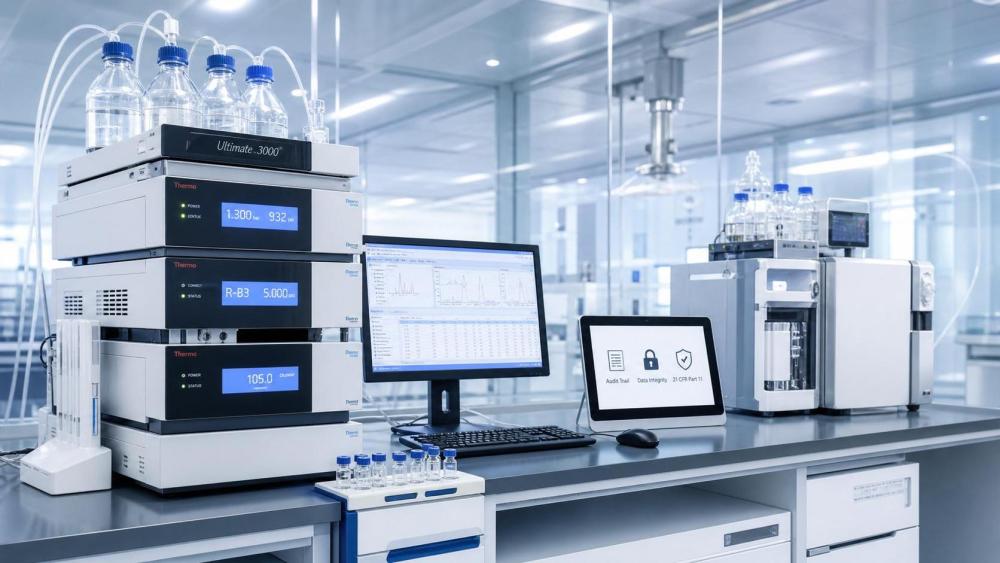
That is why data integrity compliance systems have moved from a documentation topic to an operational control topic.
The real issue is traceability. Every sample transfer, chromatogram, incubation result, and batch-linked decision must remain attributable, legible, contemporaneous, original, accurate, and complete.
In practice, ALCOA+ is not just a training slide. It shapes how laboratories run bioreactors, LC-MS systems, liquid handlers, clean benches, and downstream purification records.
BLES often frames this challenge in a useful way. Advanced instruments create high-value scientific data, but only controlled workflows turn that data into inspection-ready evidence.
That matters across biopharma scale-up. Cell culture monitoring, centrifuge parameters, analytical metrology, and robotic dispensing all depend on data that can be trusted months later.
So when people search for data integrity compliance systems, they are usually asking a deeper question: where do GMP gaps actually start, and what is realistic to fix first?
Which GMP gaps show up most often in routine laboratory and production workflows?
The most common gaps are rarely dramatic. They are ordinary habits that survived because the process still appeared to work.
A shared analyst account is one example. It saves time at shift change, yet it destroys attribution and makes deviation review harder.
Another weak point is disabled or ignored audit trails. If changes are captured but never reviewed, the control exists only on paper.
Hybrid workflows are also risky. Data may begin in an instrument, move into spreadsheets, and end in a PDF without a clear chain of custody.
More subtle problems appear in metadata. Time synchronization errors, incomplete reason-for-change fields, and missing sample identifiers can undermine otherwise valid results.
The table below helps separate frequent GMP findings from the controls that data integrity compliance systems should enforce.
A useful pattern emerges here. Most failures are not scientific failures. They are governance failures around people, permissions, sequence, and review.
How can you tell whether a system is truly protecting ALCOA+ or only appearing to?
A system may generate secure-looking files and still leave critical gaps. The better question is whether it preserves evidence through the full data lifecycle.
For example, a chromatography platform may store raw files well, but the approval logic may still happen outside the controlled environment.
The same happens with automated liquid handling. Dispense logs can be complete, while plate map edits are passed through email or manual re-entry.
A stronger assessment uses several checkpoints:
- Can each action be linked to one person, one time, and one reason?
- Are original records preserved before reprocessing or reinterpretation?
- Does the workflow prevent silent deletion, backdating, or local file substitution?
- Are review steps embedded in the system instead of handled informally?
- Can the system support validation evidence, change control, and periodic review?
This is where data integrity compliance systems differ from ordinary digital tools. They do not simply collect data; they preserve trust in that data.
Within the BLES view of bioprocessing and analytical operations, that trust has to survive scale-up, technology transfer, and cross-site review.
Where do computerized workflows usually break, especially around CSV and connected instruments?
Breaks usually happen at the edges. Individual systems may be validated, yet the handoff between them remains weak.
A bioreactor controller may feed process values into a historian. The historian may then feed reports into a quality review package. Each step adds risk.
The same applies to LC-MS, centrifuge monitoring, environmental records, and sample management tools. Integration often expands faster than governance.
CSV is therefore not just a validation milestone. It is an ongoing discipline for intended use, access boundaries, data flow mapping, and change impact review.
Several warning signs deserve attention:
- Interfaces lack clear ownership after go-live.
- Software patches are applied without risk assessment.
- Instrument vendors control admin settings without formal oversight.
- Backup and restore are tested for IT continuity, but not for record integrity.
- Retired systems leave archived data hard to retrieve or interpret.
In practical terms, data integrity compliance systems should be evaluated as connected ecosystems, not isolated software purchases.
That is especially relevant in advanced laboratories using robotics, high-resolution analytics, and mixed fleets of legacy and modern platforms.
What fixes usually deliver the fastest compliance improvement without disrupting operations?
The fastest wins are often procedural and architectural, not expensive replacements.
Start with user access. Unique credentials, least-privilege roles, and inactive account cleanup remove a large portion of avoidable exposure.
Next, tighten audit trail review around high-risk events. Focus on deleted runs, repeated injections, parameter changes, reprocessing, and result overrides.
Then map hybrid records. If a result moves between instrument software, spreadsheet, and report template, document each transformation and approval point.
Another quick improvement is time control. Clock drift sounds minor, but inconsistent timestamps can damage reconstruction during deviations or inspections.
Training should also change. Generic GMP refreshers help less than scenario-based exercises using actual workflow failures.
A focused remediation sequence often looks like this:
- Identify systems creating GMP-critical decisions.
- Rank them by data risk, not only by business importance.
- Fix access, audit trail review, and backup verification first.
- Close spreadsheet and manual transfer gaps.
- Revalidate affected workflows after major control changes.
This order tends to improve inspection readiness without freezing scientific throughput.
How should implementation value be judged when budget, scale-up pressure, and risk all compete?
The value of data integrity compliance systems should not be judged only by software cost. The better measure is avoided disruption.
A weak system can trigger batch delays, repeated testing, inspection observations, export barriers, and credibility loss during partner audits.
That cost becomes sharper in CGT, biologics, and fast-moving analytical environments, where data density is high and timelines are compressed.
BLES highlights this tension well. Advanced scale-up tools create value only when the underlying evidence remains consistent from development through commercial operations.
When evaluating implementation, it helps to compare three dimensions together:
This keeps the discussion grounded. The goal is not perfect digitization. The goal is defensible control that survives real operations.
What should be reviewed next if gaps already exist?
Begin with the workflows that influence release, deviation closure, stability interpretation, environmental monitoring, or critical process decisions.
Then review where original data lives, who can change it, how changes are justified, and whether audit trails are routinely examined.
It is also worth checking whether connected platforms behave consistently across the process chain, from upstream control to downstream analytics and final reporting.
For organizations working with sophisticated instrumentation, the lesson is straightforward. Scientific precision and GMP traceability have to mature together.
That is the practical role of data integrity compliance systems: reducing ambiguity before it becomes a regulatory finding.
A sensible next step is to build a gap map by system, rank findings by record criticality, and confirm which fixes require procedural updates, validation work, or architecture changes.
Once that map exists, decisions on cost, timing, and implementation become far more precise.
Related News
- What CSV documentation should a laboratory systems supplier provide?Oct 26, 2026Dr. Elara Sterling
- GenScript ProBio’s Nanjing Biologics Facility Passes NMPA Pre-Approval InspectionOct 22, 2026Dr. Elara Sterling
- How to assess audit trails in analytical data integrity solutionsOct 16, 2026Dr. Elara Sterling
- How user licensing affects laboratory validation system pricingOct 14, 2026Dr. Elara Sterling
Related News
- 00
0000-00
What CSV documentation should a laboratory systems supplier provide? - 00
0000-00
SCIEX Begins Construction of High-End Mass Spectrometer Plant in Beijing - 00
0000-00
Which design features make cleanroom benches easier to clean? - 00
0000-00
IndexBox Forecasts 12% CAGR for Global Microbioreactor Market Through 2035 - 00
0000-00
When do hazardous compound labs need isolators for containment?
Dr. Elara Sterling
Weekly Insights
Stay ahead with our curated technology reports delivered every Monday.