





In regulated biopharma operations, secure electronic signatures compliance is not a narrow IT issue. It sits at the intersection of GMP, data integrity, and operational trust.
A valid signature must prove who acted, what changed, when it happened, and why the record can still be trusted later. When that chain breaks, audit exposure grows quickly.
This matters across the environments BLES follows closely, from bioreactors and centrifuges to LC-MS, biosafety systems, and automated liquid handling. Every one of these platforms generates records that may require review, approval, or release decisions.
Why electronic signatures remain a GMP pressure point
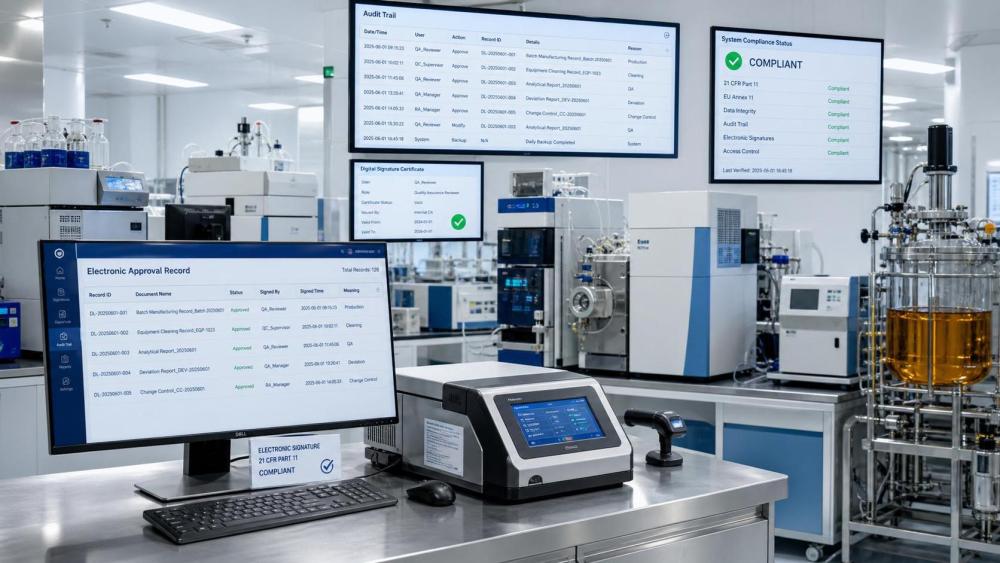
Electronic signatures were meant to reduce paper dependence and improve traceability. In practice, many sites digitized approval steps without fully securing identity, intent, and record linkage.
That gap becomes serious during inspections. Auditors rarely look only at the signature screen. They follow the whole record lifecycle, including access rights, audit trails, exception handling, and system validation.
Secure electronic signatures compliance therefore depends on more than a software feature. It depends on governance, technical controls, documented procedures, and evidence that the controls actually work under routine use.
In fast-moving Cell & Gene Therapy workflows, the pressure is even higher. Short timelines, small batches, and high-value materials leave little room for undocumented rework or weak approval logic.
What secure electronic signatures compliance really means
At a basic level, an electronic signature is acceptable when it is unique to one person, properly controlled, and permanently linked to the associated electronic record.
But GMP expectations go further. The signature must reflect a defined meaning, such as review, approval, verification, or release. It must also resist reuse by unauthorized individuals.
In practical terms, secure electronic signatures compliance usually involves these elements:
- controlled unique user identities
- strong authentication at signing
- clear signature meaning in context
- tamper-evident audit trails
- validated system behavior
- procedures for periodic review and incident response
Without those controls, a signature can look compliant on screen while failing under regulatory scrutiny.
Common GMP gaps worth checking first
The most frequent problems are rarely dramatic. They tend to be ordinary process shortcuts that became normalized over time.
Shared or loosely managed accounts
If multiple people can access the same account, signature ownership becomes unclear. That alone can undermine secure electronic signatures compliance.
This issue still appears in legacy laboratory software, integrated instrument workstations, and production support systems that were configured for convenience during commissioning.
Weak binding between signature and record
Some systems store approval status separately from the full record. Others allow export, overwrite, or reprocessing without preserving the exact signed version.
That creates a traceability break. A signature is meaningful only when the signed content remains fixed, reviewable, and historically reconstructable.
Incomplete audit trails
An audit trail should capture creation, modification, deletion attempts, reprocessing events, and signature actions. Missing metadata can hide the true sequence of decisions.
This is especially relevant for LC-MS result processing and liquid handling methods, where method edits and reintegration decisions can directly affect reported conclusions.
Signature meaning is undefined
A system may record that a user clicked approve, yet the SOP may never define what approval confirms. That ambiguity weakens accountability.
Review, verification, technical completion, and product disposition are not interchangeable. Secure electronic signatures compliance requires that distinction to be explicit.
Re-authentication is missing at the point of signing
Long open sessions create avoidable risk. If a user can sign critical records without re-entering credentials, the control may be too weak for the intended GMP use.
Validation scope is too narrow
Many validation packages confirm that the feature works. Fewer demonstrate that it remains compliant across role changes, network interruptions, time sync issues, and exception workflows.
That is where inspection questions usually become sharper.
Where these gaps show up across biopharma systems
BLES tracks equipment categories where signature controls often intersect with high-risk decisions. The pattern is broad, even when the systems differ technically.
The details vary, but the core question stays the same: can the organization prove that each electronic approval is attributable, intentional, and durable?
How to assess the control environment
A useful review starts with process reality, not vendor claims. Secure electronic signatures compliance should be tested where decisions actually happen.
That usually means walking through one full record path, from data generation to final approval, and checking each control point.
Focus on evidence, not policy statements
- Review user provisioning and deprovisioning records.
- Confirm time synchronization across connected systems.
- Test whether signed records can be altered, exported, or replaced.
- Check whether signature meaning appears clearly in the record.
- Verify that exceptions trigger documented review steps.
Include interfaces and hybrid workflows
Many weak points sit between systems. A compliant signature inside one application may lose context when data moves into LIMS, MES, ELN, or archive platforms.
Hybrid processes can be just as risky. Printing a record for manual annotation, then rescanning it into a repository, often creates version uncertainty.
Why this topic matters for scale-up and inspection readiness
Secure electronic signatures compliance affects more than inspection outcomes. It also shapes how confidently teams can scale methods, transfer processes, and defend comparability.
When facilities expand from development into commercial or multi-site operations, signature models often become inconsistent. Local practices multiply faster than governance can catch up.
That creates friction during technology transfer, batch release, and cross-site investigations. The problem is not only technical. It becomes procedural, quality-related, and economic.
This is one reason BLES places data integrity and GMP intelligence beside process equipment insight. Reliable science and reliable records have to mature together.
A practical next step before the next audit
Start with a ranked inventory of systems that use signatures in GMP-relevant decisions. Then map each one against identity control, record linkage, audit trail depth, validation evidence, and procedural clarity.
That exercise often reveals whether secure electronic signatures compliance is genuinely established or only assumed. The highest value comes from checking real workflows, not just approved documents.
For organizations managing complex bioprocessing, analytical, and automation platforms, the next useful move is to compare signature controls across systems rather than reviewing them in isolation.
A narrower, evidence-based review today is usually easier than explaining a fragmented signature trail during an inspection tomorrow.
Related News
- What CSV documentation should a laboratory systems supplier provide?Oct 26, 2026Dr. Elara Sterling
- GenScript ProBio’s Nanjing Biologics Facility Passes NMPA Pre-Approval InspectionOct 22, 2026Dr. Elara Sterling
- How to assess audit trails in analytical data integrity solutionsOct 16, 2026Dr. Elara Sterling
- How user licensing affects laboratory validation system pricingOct 14, 2026Dr. Elara Sterling
Related News
- 00
0000-00
What CSV documentation should a laboratory systems supplier provide? - 00
0000-00
SCIEX Begins Construction of High-End Mass Spectrometer Plant in Beijing - 00
0000-00
Which design features make cleanroom benches easier to clean? - 00
0000-00
IndexBox Forecasts 12% CAGR for Global Microbioreactor Market Through 2035 - 00
0000-00
When do hazardous compound labs need isolators for containment?
Dr. Elara Sterling
Weekly Insights
Stay ahead with our curated technology reports delivered every Monday.