





In recombinant protein production downstream, the real pressure point is rarely expression alone. Purification bottlenecks decide whether yield, impurity control, and GMP readiness can move forward together.
That is why recombinant protein production downstream remains a central topic across bioprocessing, analytical control, and equipment selection. A process may look efficient upstream, yet fail commercially when clarification, filtration, or polishing become unstable.
For BLES, this topic sits at the intersection of cell culture dynamics, downstream purification, metrology, and audit discipline. It is also where scale-up ambition meets the hard limits of membranes, resins, hold times, and data integrity.
Why downstream bottlenecks matter now
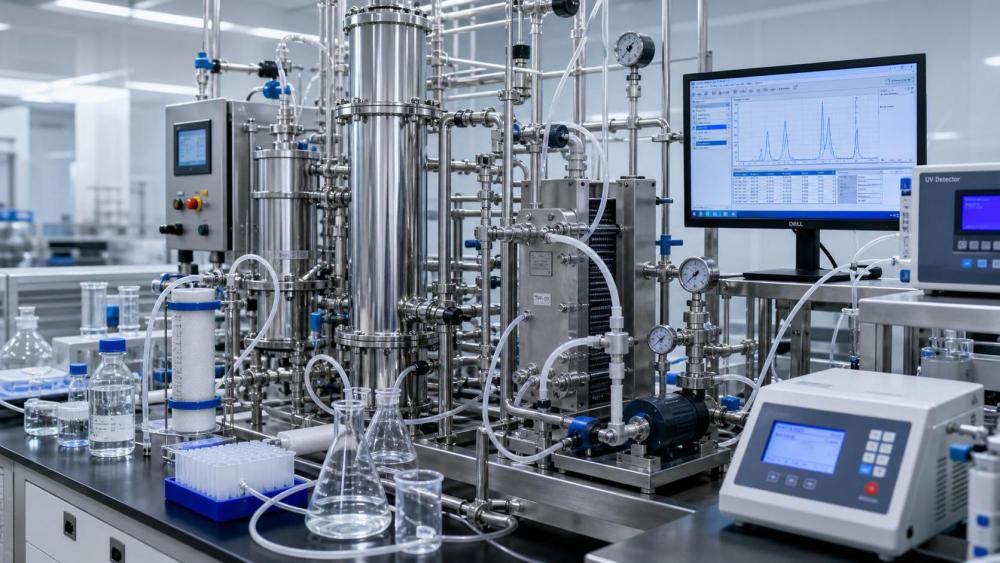
Biologics pipelines are broader than before. Recombinant enzymes, cytokines, growth factors, vaccine antigens, and therapeutic proteins all bring different impurity profiles and stability risks.
At the same time, development timelines are tighter. Facilities need processes that transfer from lab scale to pilot and commercial scale without hidden recovery loss or compliance surprises.
In recombinant protein production downstream, purification is not a single step. It is a sequence of tradeoffs involving centrifugation, depth filtration, ultrafiltration, chromatography, viral clearance, and final formulation handling.
A weak link early in the train can multiply cost later. Poor harvest clarification can overload filters, shorten resin life, increase aggregate burden, and create analytical ambiguity during release testing.
What the bottleneck usually looks like
The bottleneck is not always the slowest unit operation. More often, it is the step where performance becomes unpredictable under realistic feed variability.
In microbial expression systems, endotoxin and host cell debris can dominate the challenge. In mammalian systems, host cell proteins, DNA, and aggregates often shape the purification strategy.
Some proteins bind strongly and purify cleanly. Others are shear sensitive, sticky, or structurally heterogeneous. Those differences determine whether standard platform methods still hold at scale.
In practice, recombinant protein production downstream becomes fragile when one or more variables drift together: feed turbidity, viscosity, bioburden, conductivity, residence time, or cleaning reproducibility.
Typical pressure points
- Harvest clarification loses efficiency because solids loading exceeds the design window.
- Tangential flow filtration fouls early, reducing flux and extending processing time.
- Capture chromatography reaches capacity too soon due to variable feed composition.
- Polishing steps remove impurities but cut recovery below commercial targets.
- Analytical methods detect inconsistency late, after material and time are already lost.
Where equipment choices shape process reality
Downstream performance depends on equipment behavior as much as on process chemistry. This is why the BLES view connects purification with centrifuges, separation systems, LC-MS, and automated handling.
Industrial centrifuges and separation systems often define the first recovery ceiling. If solids are not removed consistently, every later step pays the penalty.
Ultrafiltration and diafiltration systems then shape concentration control, buffer exchange, and hold time risk. Membrane selection affects flux decline, protein retention, and cleaning validation burden.
Chromatography remains the core of selectivity, yet resin economics are increasingly scrutinized. Dynamic binding capacity on paper means little if pressure, fouling, or cycle variability cut usable performance in half.
LC-MS and related analytical metrology matter because downstream decisions are only as good as the data behind them. Subtle variants, clipped forms, or oxidation events can redirect an entire purification train.
A practical view of common bottlenecks
The table below is useful when evaluating recombinant protein production downstream across different process stages.
This view helps separate theoretical process design from actual manufacturing robustness. In recombinant protein production downstream, those are often very different things.
Scale-up is where many assumptions break
Lab success can hide downstream risk because small batches tolerate manual adjustments and wide timing flexibility. Commercial operation does not.
Residence time distribution changes with equipment size. Pump shear changes. Mixing behavior changes. Filter loading becomes less forgiving. Even buffer logistics can become a major constraint.
For this reason, recombinant protein production downstream should be evaluated as a connected system, not as isolated unit operations. One oversized bioreactor can expose weaknesses in clarification and purification architecture overnight.
BLES often frames this through seamless process scale-up. The phrase is useful because it links engineering transfer, analytical confidence, and GMP discipline into one operational target.
Signals that scale-up risk is rising
- Pilot data depends on operator intervention that is hard to standardize.
- Resin lifetime assumptions come from clean feeds rather than production feeds.
- Cleaning or single-use changeover timing is excluded from cycle calculations.
- Critical quality attributes are measured offline with long analytical delay.
- CSV, audit trail, or data integrity needs are considered late.
How to assess downstream options with more discipline
A useful evaluation starts with the impurity burden, not the equipment brochure. The process must match the actual feed stream, target molecule, and required quality profile.
Then compare technologies by process window, not by peak performance. A narrower but stable operating range may be more valuable than a higher nominal capacity.
This is especially true in recombinant protein production downstream, where consistency often creates more value than isolated yield gains.
Useful criteria for comparison
- Impurity removal under worst-case feed variability
- Mass balance across the full purification train
- Hold time tolerance and bioburden exposure
- Cleaning validation or single-use implementation burden
- Compatibility with LC-MS, in-process analytics, and release methods
- Data traceability for GMP review and tech transfer
These criteria also make cross-functional discussions sharper. Process science, quality, automation, and capital planning can then work from the same decision frame.
Where the business value becomes visible
Better recombinant protein production downstream does more than improve purity. It shortens troubleshooting cycles, lowers batch failure risk, and protects the economics of expensive upstream material.
It also supports faster platform transfer across products and sites. That matters in a market shaped by CDMO pressure, funding constraints, and the need for flexible manufacturing assets.
Single-use technology can help in some settings, especially where rapid changeover matters. Still, it should be judged against extractables, throughput, waste strategy, and long-run cost, not convenience alone.
The broader point is simple. Downstream purification quality is now a business issue, an engineering issue, and a compliance issue at the same time.
A sensible next step
When purification bottlenecks appear, the next move is rarely to add another polishing step immediately. It is better to map the full downstream train against feed variability, analytical evidence, and scale assumptions.
For recombinant protein production downstream, that usually means checking clarification limits, membrane behavior, resin utilization, and release analytics as one connected system.
A grounded review should also include GMP data flow, automation readiness, and the cost of inconsistency. That is where more durable decisions emerge.
From there, downstream strategy becomes easier to judge: which bottleneck is fundamental, which is operational, and which can be removed through better equipment, better analytics, or a cleaner process window.
Related News
- What to compare when sourcing protein purification equipment in the USAOct 01, 2026Downstream Purification Fellow
- How to size downstream purification systems for batch capacitySep 13, 2026Downstream Purification Fellow
- How to Evaluate GMP Protein Purification Systems for Scale and ComplianceJul 19, 2026Downstream Purification Fellow
- Protein Polishing Systems: How to Compare Yield, Purity, and ThroughputJul 13, 2026Downstream Purification Fellow
Related News
- 00
0000-00
What CSV documentation should a laboratory systems supplier provide? - 00
0000-00
SCIEX Begins Construction of High-End Mass Spectrometer Plant in Beijing - 00
0000-00
Which design features make cleanroom benches easier to clean? - 00
0000-00
IndexBox Forecasts 12% CAGR for Global Microbioreactor Market Through 2035 - 00
0000-00
When do hazardous compound labs need isolators for containment?
Downstream Purification Fellow
Weekly Insights
Stay ahead with our curated technology reports delivered every Monday.