





When performance matters most, separation systems stop being background equipment and become a decisive part of process strategy. In biopharma and laboratory environments, they shape purity, recovery, throughput, and compliance confidence at the same time.
That matters because downstream pressure is rising. Drug pipelines are more complex, Cell & Gene Therapies demand tighter control, and scale-up decisions now affect both technical success and commercial timing.
Within that context, separation systems deserve closer attention. They sit between productive upstream work and usable product, translating fermentation output into material that can move toward analysis, purification, and release.
Why separation systems matter beyond simple solids removal
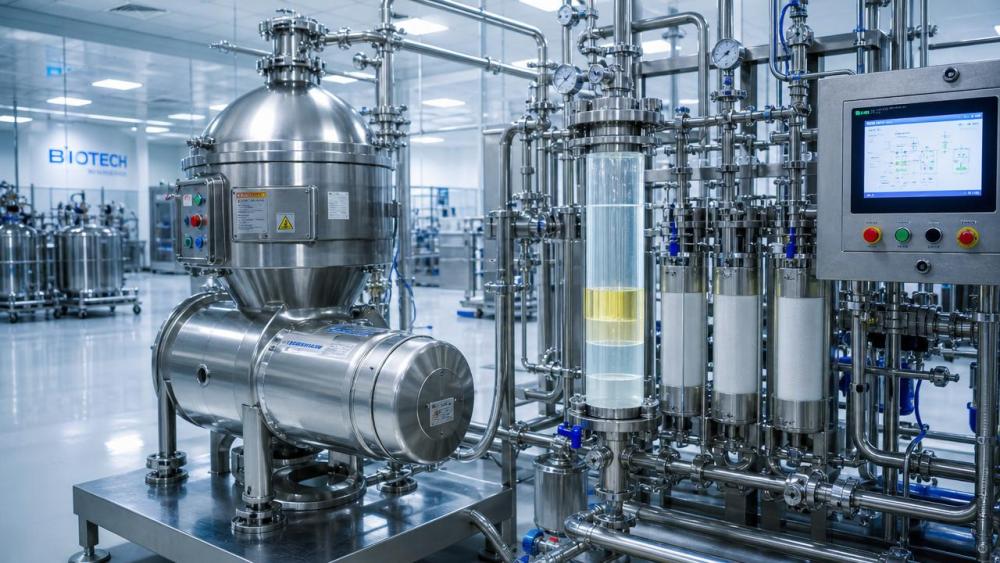
In many facilities, the first instinct is to view separation systems as utility assets. That view misses their real influence on yield protection, impurity control, and process consistency under pressure.
A high-performing separation step does more than clarify broth. It protects sensitive molecules, reduces downstream burden, and creates a more stable feed for filtration, chromatography, or analytical review.
This is especially visible in modern biologics production. When cell density rises and feed strategies become more aggressive, the physical properties of the harvest also become harder to manage.
That is why BLES places industrial centrifuges and separation systems among the core pillars of life science equipment intelligence. Their performance often determines whether upstream productivity can actually convert into downstream value.
What the term really includes
Separation systems are not one machine type. They describe a working family of technologies used to isolate, clarify, concentrate, fractionate, or polish materials within a defined process objective.
In biopharma and advanced laboratory operations, that usually includes centrifugation, membrane-based filtration, tangential flow filtration, depth filtration, and hybrid system configurations.
Each option answers a different process question. One technology may remove cells efficiently, while another improves concentration control, and another protects product integrity during final polishing.
The important point is functional fit. Performance is judged by what the system achieves under real feed conditions, not by equipment category alone.
A practical way to read performance
When comparing separation systems, four questions usually reveal more than a generic specification sheet:
- How much target material is recovered after the step?
- How effectively are cells, debris, or unwanted fractions removed?
- How stable is the result across batch variation?
- How easily can the process be documented for GMP and data integrity needs?
Where current industry attention is shifting
Performance expectations have changed. The market no longer values throughput alone. It increasingly values throughput that remains reliable across changing scales, tighter timelines, and stricter audit environments.
This shift is visible across the BLES coverage landscape. Upstream bioreactors push higher titers, LC-MS systems demand cleaner and more consistent samples, and automated liquid handling depends on predictable material quality.
As a result, separation systems now sit at the intersection of several strategic concerns:
More worth noting is the growing connection between process equipment and intelligence systems. Decision quality improves when equipment data, validation expectations, and scale-up science are reviewed together rather than in isolation.
How separation systems create business value in practice
The value of separation systems is easiest to understand when viewed through process consequences. A weak separation step usually creates hidden costs before it creates visible failure.
For example, incomplete clarification may overload membranes later. Product shear may lower recovery without obvious alarms. Inconsistent concentration profiles may complicate method transfer or release testing.
By contrast, strong separation systems reduce friction across the workflow. They support more stable downstream purification, cleaner analytical inputs, and more predictable scheduling during scale transitions.
That is why performance should be judged as an operational multiplier. Good separation improves more than one step, while poor separation usually weakens several steps at once.
Typical value outcomes
- Higher usable recovery from valuable batches
- Lower impurity burden entering downstream purification
- Better fit for automated and data-driven workflows
- More defensible process records during quality review
- Stronger scale-up confidence from pilot to commercial production
Common scenarios where performance matters most
Not every process places the same demand on separation systems. The highest-risk situations usually combine fragile product behavior, difficult feed properties, and limited tolerance for batch deviation.
Harvesting monoclonal antibody culture is a familiar example. The volume is large, the solids load is significant, and downstream steps depend on controlled feed quality.
Viral vector and CGT workflows create a different challenge. The molecules or particles may be more sensitive, and process economics may leave less room for avoidable loss.
Analytical and laboratory settings also matter. Sample preparation for LC-MS, high-molecular characterization, or automated liquid handling often depends on consistent fractionation and contaminant removal before the instrument stage.
In these cases, separation systems are not isolated assets. They influence whether later platforms can operate at their designed precision.
What to examine before comparing options
A useful evaluation starts with the process, not the brochure. Equipment should be read against the material reality of the workflow it must support.
Several factors usually deserve early attention:
- Feed characteristics, including viscosity, particle load, and shear sensitivity
- Target throughput at current scale and next scale
- Cleaning, single-use, or turnaround expectations
- Integration with automation, sensors, and batch records
- Validation burden under FDA, EMA, and CSV-related expectations
This is where BLES-style intelligence becomes especially useful. Scale-up science, compliance interpretation, and equipment economics often need to be considered together, not as separate conversations.
A system that performs well in a pilot suite may still struggle in commercial timing, digital traceability, or cost-to-changeover. Real comparison depends on the whole operating context.
A simple comparison frame
When reviewing separation systems, it helps to rank each option across three dimensions: process fit, compliance fit, and scale-up fit.
If one dimension is weak, the apparent technical advantage can fade quickly during implementation.
Reading the next move more clearly
Separation systems matter most when process stakes are high, timelines are compressed, and quality cannot be negotiated. Their real value appears in how well they protect product, simplify downstream work, and support auditable scale-up.
A useful next step is to map the separation step against actual bottlenecks. Look at recovery loss, impurity carryover, batch variability, cleaning constraints, and digital documentation together.
From there, compare separation systems by operational evidence rather than headline capacity alone. That approach usually produces better decisions, especially in fast-moving biopharma and laboratory environments where one weak transfer point can affect the entire process chain.
Related News
- What to compare when sourcing protein purification equipment in the USAOct 01, 2026Downstream Purification Fellow
- How to size downstream purification systems for batch capacitySep 13, 2026Downstream Purification Fellow
- How to Evaluate GMP Protein Purification Systems for Scale and ComplianceJul 19, 2026Downstream Purification Fellow
- Protein Polishing Systems: How to Compare Yield, Purity, and ThroughputJul 13, 2026Downstream Purification Fellow
Related News
- 00
0000-00
What CSV documentation should a laboratory systems supplier provide? - 00
0000-00
SCIEX Begins Construction of High-End Mass Spectrometer Plant in Beijing - 00
0000-00
Which design features make cleanroom benches easier to clean? - 00
0000-00
IndexBox Forecasts 12% CAGR for Global Microbioreactor Market Through 2035 - 00
0000-00
When do hazardous compound labs need isolators for containment?
Downstream Purification Fellow
Weekly Insights
Stay ahead with our curated technology reports delivered every Monday.