





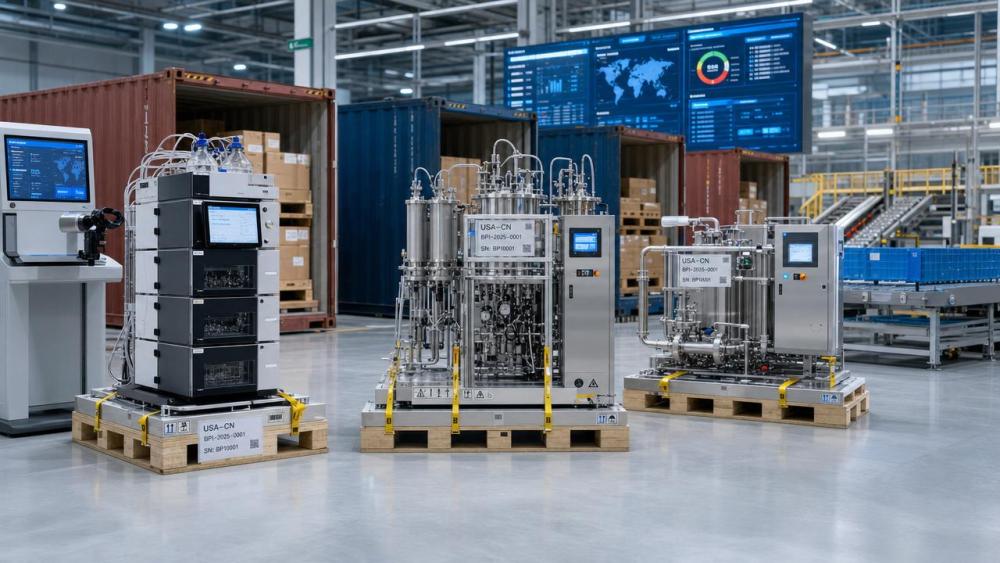
On June 3, 2026, Chinese customs authorities and U.S. CBP formally launched a nationwide smart clearance channel for bioprocess equipment, creating a new trade-handling framework for high-value systems such as UHPLC platforms, chromatography purification systems, and TFF ultrafiltration systems. For manufacturers, importers, procurement teams, logistics providers, and after-sales service operations, the development matters not simply because transit is faster, but because customs handling is now more closely tied to pre-declaration review and original manufacturer digital certificate matching.
What the rollout confirms at this stage
The confirmed information is limited but clear. From June 3, 2026, the General Administration of Customs of China, together with U.S. CBP, put the “smart clearance channel” for bioprocess equipment into use across ports nationwide. The scope covers high-value equipment including UHPLC systems, chromatography purification systems, and TFF ultrafiltration systems. According to the provided event summary, the mechanism relies on AI-based pre-declaration verification combined with original manufacturer digital certificate binding, and average customs clearance time has been reduced from 7–12 days to within 48 hours. The first batch of coverage includes Shanghai, Shenzhen, Tianjin, Los Angeles, and Chicago.
Why this matters across the transaction chain
For equipment traders and exporters, document readiness becomes more operational
Analysis shows that the most immediate effect for trading companies and export-facing suppliers is not only shorter waiting time, but a tighter link between shipment progress and document consistency. Because the channel is described as using AI pre-declaration verification and manufacturer certificate binding, these participants will likely need to pay closer attention to whether product identity, declaration materials, and manufacturer-issued digital records align cleanly before shipment.
For buyers and procurement teams, delivery assumptions may need updating
From an industry perspective, procurement functions in biopharma, laboratory, and process-related projects may see this as a change in delivery planning logic rather than a simple logistics improvement. If covered equipment can move through customs materially faster, purchase scheduling, installation sequencing, and acceptance planning may shift. What deserves closer attention is whether procurement documents, technical files, and supplier qualification materials are prepared in a way that supports this faster customs path without creating later compliance gaps.
For supply chain and service providers, execution accuracy may matter more than buffer time
Observably, customs brokers, logistics coordinators, and after-sales support teams may be affected because a shorter customs window leaves less room to correct inconsistent records late in the process. In practical terms, the value of accurate pre-shipment data, certificate linkage, and traceable equipment documentation may increase. For service providers handling delivery and commissioning coordination, the key issue is whether internal workflows can keep pace if equipment arrives much sooner than under the previous 7–12 day pattern.
Where companies should focus now
Check whether certificate-linked documentation is complete
Because the disclosed mechanism includes original manufacturer digital certificate binding, companies involved in shipment preparation should review whether manufacturer-issued records, product descriptions, and declaration materials are internally consistent. The event summary does not provide detailed execution standards, so this remains an area for close monitoring rather than a fixed checklist.
Track changes in tender, purchasing, and delivery language
Analysis shows that faster customs handling can affect commercial terms even before any broader market effect becomes visible. Buyers and suppliers may need to watch for changes in delivery commitments, technical specification alignment, and handover schedules in purchasing documents or tender files, especially where imported bioprocess systems are time-sensitive.
Watch how covered categories are applied in practice
The confirmed scope includes UHPLC systems, chromatography purification systems, and TFF ultrafiltration systems, but the summary does not define how product boundaries will be interpreted in every operational scenario. It is more appropriate to understand this as a concrete implementation signal with practical questions still worth monitoring, particularly for mixed-system shipments or equipment packages with multiple subsystems.
Prepare for tighter traceability expectations after arrival
From an industry perspective, a faster customs route does not remove the need for post-arrival verification, service coordination, or quality traceability. Companies should therefore pay attention to whether delivery, installation, and after-sales records remain aligned with the same product identity and source documentation used at customs.
How this development is best understood
Observably, this is more than a general statement of support for trade facilitation because it describes an already launched clearance arrangement, named equipment categories, and a defined handling method tied to AI verification and digital certificate binding. At the same time, it should not yet be treated as a fully transparent and settled operating regime in every detail. Analysis shows that the market still needs to observe how customs interpretation, documentation thresholds, and operational consistency develop in day-to-day execution.
A practical reading for the market
At this stage, the development is best understood as an implemented rule change with direct implications for customs processing, delivery planning, and compliance preparation in high-value bioprocess equipment trade. It signals that clearance speed can improve where pre-declaration data and manufacturer-linked documentation are in order, but it also suggests that companies should remain cautious about assuming identical execution outcomes across all transactions until more operating feedback becomes visible.
Basis of this article and what still needs verification
This article is generated from the user-provided news title, event date, and event summary. For events of this type, market participants would usually continue checking official notices, customs or trade authority releases, regulator updates, industry association information, standard-setting documents, and reporting by established professional media. A specific official source link was not provided in the input, so further verification is still needed. What remains worth tracking includes later policy detail, practical certification and documentation requirements, changes in tender or procurement wording, operational feedback from the covered ports, and how companies implement the process in actual shipments.
Related News
- What to compare when sourcing protein purification equipment in the USAOct 01, 2026Downstream Purification Fellow
- How to size downstream purification systems for batch capacitySep 13, 2026Downstream Purification Fellow
- How to Evaluate GMP Protein Purification Systems for Scale and ComplianceJul 19, 2026Downstream Purification Fellow
- Protein Polishing Systems: How to Compare Yield, Purity, and ThroughputJul 13, 2026Downstream Purification Fellow
Related News
- 00
0000-00
What CSV documentation should a laboratory systems supplier provide? - 00
0000-00
SCIEX Begins Construction of High-End Mass Spectrometer Plant in Beijing - 00
0000-00
Which design features make cleanroom benches easier to clean? - 00
0000-00
IndexBox Forecasts 12% CAGR for Global Microbioreactor Market Through 2035 - 00
0000-00
When do hazardous compound labs need isolators for containment?
Downstream Purification Fellow
Weekly Insights
Stay ahead with our curated technology reports delivered every Monday.