





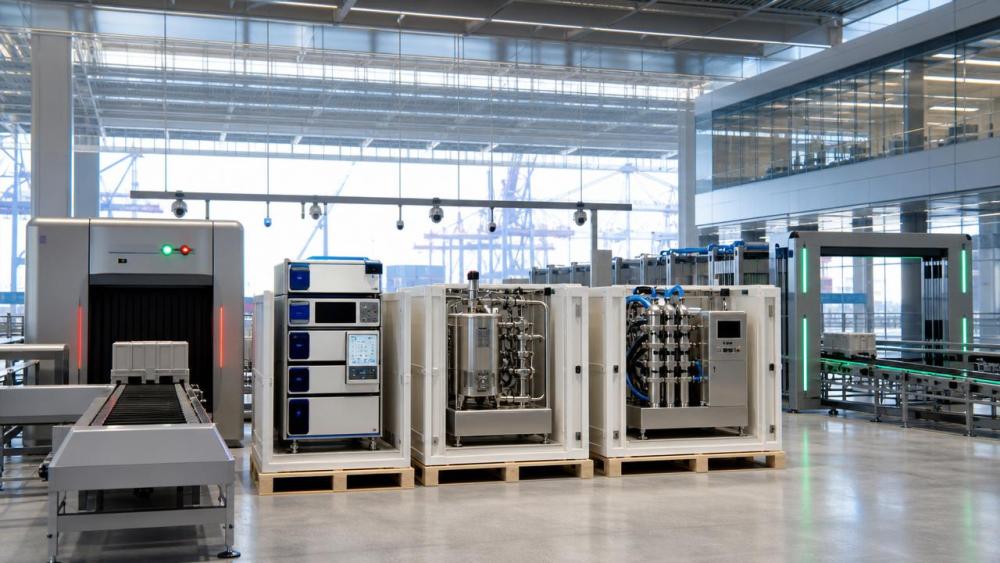
On June 5, 2026, China Customs and U.S. CBP expanded a smart customs clearance channel for bioprocess equipment to nationwide use, signaling a concrete change in how certain GMP-critical systems are processed at the border. The measure applies to 17 categories of equipment, including UHPLC systems, monoclonal antibody purification chromatography systems, and TFF ultrafiltration systems. For companies involved in cross-border procurement, equipment delivery, project installation, and regulated production planning, the development is worth attention because it links customs handling efficiency directly with lead times and handover schedules.
What has been confirmed in the nationwide rollout
According to the provided event information, the nationwide rollout was formally launched on June 5, 2026 by the General Administration of Customs of China together with U.S. CBP. The program is described as a smart customs clearance channel for bioprocess equipment.
The scope covers 17 categories of GMP key equipment. The examples explicitly provided include UHPLC systems, monoclonal antibody purification chromatography systems, and TFF ultrafiltration systems.
The reported operating features of the channel are pre-declaration AI verification and infrared penetration inspection without crate opening. Based on the provided summary, the average customs clearance time has been reduced from 5-7 days to within 48 hours. The first group of pilot companies reportedly saw order delivery cycles shortened by 32%.
Where the operational impact is likely to appear first
Cross-border equipment suppliers and exporters
From an industry perspective, the first visible effect is likely to fall on suppliers and exporters shipping covered equipment categories. A shorter customs cycle can change delivery commitments, shipment scheduling, and coordination with end users. What deserves closer attention is whether internal export documentation, packing records, and technical descriptions are prepared in a way that supports pre-declaration review under the new channel.
Biopharma buyers and project procurement teams
For buyers of GMP-critical systems, the practical impact is likely to be felt in procurement timing and installation planning. If customs handling for eligible equipment becomes more predictable, procurement teams may reassess buffer time built into project schedules. Analysis shows that buyers should pay close attention to whether bid documents, purchase contracts, and delivery clauses need to reflect the possibility of shorter import lead times while still preserving room for compliance review and acceptance procedures.
Supply chain and delivery coordination providers
Logistics coordinators, customs service providers, and delivery management teams may also be affected because the new channel appears to shift emphasis toward pre-arrival data preparation and non-intrusive inspection methods. In practice, this may increase the importance of data accuracy, cargo classification consistency, and document readiness before arrival, rather than relying on extra time after the shipment reaches port.
Installation, validation, and after-sales service teams
For service teams working downstream from customs clearance, faster release may compress handoff windows between arrival, site delivery, installation, and customer acceptance. Observably, this does not automatically remove compliance obligations at the user site, but it may change sequencing and resource allocation for commissioning and post-delivery support.
What companies should review now
Document readiness for pre-declaration review
Analysis shows that companies dealing in covered equipment should review whether product descriptions, model identification, shipment documentation, and technical files are complete and internally consistent. Because the provided summary mentions AI-based pre-declaration verification, any mismatch between commercial and technical records may become more important in practice, even though the detailed execution standard was not provided in the input.
Whether target products clearly fall within the covered categories
Businesses should closely track how their own equipment portfolios map to the 17 covered GMP key equipment categories. The event summary names only several examples, so companies should avoid assuming that adjacent products, accessories, or bundled systems are automatically treated the same way until execution language or transaction-level handling becomes clearer.
Delivery promises and procurement calendars
The reported reduction in average clearance time and the pilot-stage shortening of order delivery cycles suggest that commercial timelines may be adjusted. What deserves closer attention is how quickly procurement teams, suppliers, and logistics providers begin reflecting this in delivery commitments, project milestones, and inventory planning. Companies should be careful not to treat the reported efficiency gain as a universal result for every shipment without checking actual execution conditions.
Compliance traceability after faster border release
Faster customs release does not eliminate the need for quality traceability, equipment records, or downstream compliance checks. For regulated users, it remains important to align customs documents, technical documentation, and internal acceptance records so that shorter border handling does not create gaps in audit trails or after-sales accountability.
Why this looks like an execution signal, not just a procedural update
Observably, this development is more than a generic efficiency statement because it identifies named customs authorities, a defined implementation date, covered equipment categories, and specific operating methods such as AI pre-verification and non-opening infrared inspection. That makes it more appropriate to understand the event as an implemented execution signal rather than a purely tentative policy direction.
At the same time, analysis shows that the market should still watch how the channel is applied shipment by shipment. The input does not provide detailed criteria for eligibility, documentation thresholds, exception handling, or treatment of mixed consignments. For that reason, the current significance lies in the operational direction and the customs-side handling model, while some business implications still require observation through actual use.
How the market may reasonably interpret this development
In practical terms, the nationwide launch points to a customs-processing change with direct relevance for bioprocess equipment trade, delivery coordination, and procurement execution. It should not be overstated as a complete rewrite of compliance or supply chain risk, but it does indicate that border processing for certain GMP-critical equipment may become faster and more data-driven. At this stage, it is more appropriate to understand the news as a landed operational change with meaningful execution value, while continuing to monitor how consistently it is implemented and how market participants adapt their documentation and delivery practices.
Basis of this article and what still needs verification
This article is based on the user-provided news title, event date, and event summary. For events of this type, relevant source categories usually include official announcements, releases from customs or trade authorities, regulatory communications, industry association updates, standard-setting materials, and reporting by authoritative media. A specific official source link was not provided in the input, so further verification is still needed.
What still deserves ongoing attention includes detailed implementation language, customs execution practice, eligibility interpretation for covered equipment categories, changes in procurement or tender documents, and feedback from companies using the channel in real transactions.
Related News
- What to compare when sourcing protein purification equipment in the USAOct 01, 2026Downstream Purification Fellow
- How to size downstream purification systems for batch capacitySep 13, 2026Downstream Purification Fellow
- How to Evaluate GMP Protein Purification Systems for Scale and ComplianceJul 19, 2026Downstream Purification Fellow
- Protein Polishing Systems: How to Compare Yield, Purity, and ThroughputJul 13, 2026Downstream Purification Fellow
Related News
- 00
0000-00
What CSV documentation should a laboratory systems supplier provide? - 00
0000-00
SCIEX Begins Construction of High-End Mass Spectrometer Plant in Beijing - 00
0000-00
Which design features make cleanroom benches easier to clean? - 00
0000-00
IndexBox Forecasts 12% CAGR for Global Microbioreactor Market Through 2035 - 00
0000-00
When do hazardous compound labs need isolators for containment?
Downstream Purification Fellow
Weekly Insights
Stay ahead with our curated technology reports delivered every Monday.