





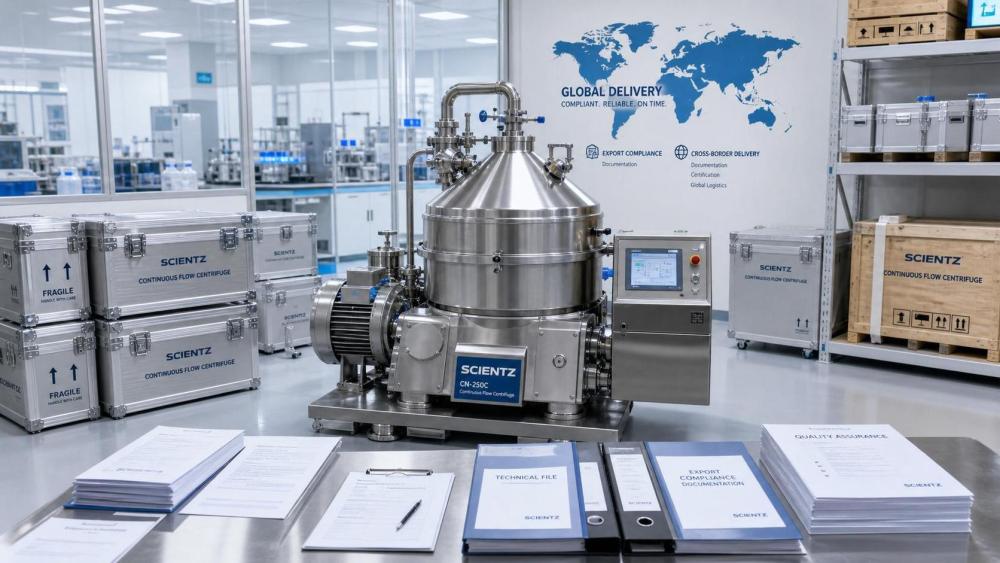
On June 24, 2026, the U.S. Bureau of Industry and Security (BIS) updated a supplementary list under the Export Administration Regulations (EAR), explicitly placing Continuous Flow Centrifuges within the scope of key bioprocessing equipment for exports to Russia and Belarus. For companies involved in exporting, procurement, compliance review, technical documentation, and delivery planning, the immediate significance lies not only in the rule change itself, but in the fact that end-use documentation and case-by-case licensing now become part of the transaction path for covered models.
What the June 24 update specifically changes
According to the provided event information, BIS updated the EAR supplementary list on June 24, 2026. The update explicitly identifies Continuous Flow Centrifuges as critical equipment for bioprocessing.
The new requirement applies to exports to Russia and Belarus. For such exports, an additional end-use statement must be submitted, and a case-by-case BIS license must be obtained.
The rule took effect immediately on the same day. The scope covers continuous flow models with functions involving cell harvesting, virus purification, and mRNA liposome separation.
Where the practical pressure is likely to appear first
Export transactions may face a tighter document threshold
From an industry perspective, exporters are the most directly affected because the change adds two concrete compliance elements: an end-use statement and an individual BIS licensing step for covered shipments to Russia and Belarus. The impact is likely to appear first in pre-shipment review, internal export screening, contract confirmation, and handover timing.
What deserves closer attention is whether product descriptions, application notes, and commercial documents clearly indicate functions such as cell harvesting, virus purification, or mRNA liposome separation, since these functional attributes are explicitly named in the provided rule summary.
Procurement and project teams may need to revisit model selection
For procurement-side participants, the main issue is not only supply availability but whether a selected continuous flow centrifuge falls within the newly clarified functional scope. In practical terms, purchasing teams, project owners, and technical buyers may need to recheck model specifications, intended use descriptions, and supplier-provided compliance materials before confirming orders tied to the affected destinations.
Analysis shows that this can influence procurement sequencing, document collection, and acceptance planning, especially where delivery expectations were based on a standard export process rather than a license-based review path.
Supply chain and delivery coordination may become more documentation-driven
Supply chain service providers, distributors, and after-sales coordinators may also feel the impact because the new rule is effective immediately. That means shipment preparation, documentation handoff, customs-facing file readiness, and service commitments linked to covered equipment may all require closer alignment with exporter compliance checks.
Observably, the practical challenge is less about broad market interpretation and more about whether each transaction file is prepared in a way that supports the new licensing and end-use requirements.
What companies should review now
Check whether product functions trigger the new scope
Companies should first identify whether any continuous flow centrifuge in their portfolio includes cell harvesting, virus purification, or mRNA liposome separation functions, because those are the functional markers explicitly named in the event summary.
Reassess end-use files and supporting technical materials
Where affected destinations are involved, businesses should closely review the completeness and consistency of end-use statements, technical descriptions, product literature, and transaction documents. The provided information does not include detailed filing standards, so this is best treated as a compliance review priority rather than an already settled execution template.
Recalculate delivery assumptions for affected business
Because the rule is effective immediately and requires case-by-case BIS licensing, companies should pay attention to whether delivery schedules, purchase commitments, and cross-border execution plans still match current regulatory conditions. Analysis shows that timelines may become more dependent on document readiness and licensing progress than before, although no specific processing duration is provided in the input.
Watch for later wording, implementation signals, and market response
What deserves closer attention is the follow-up interpretation around filing practice, documentation expectations, and how the covered functions are described in technical or commercial records. Companies involved in bids, procurement files, and after-sales commitments should also watch for any resulting changes in tender wording, supplier qualification checks, or internal compliance procedures.
Why this reads as an execution signal, not only a policy note
As an observation, this update is more appropriately understood as a rule already in force rather than a distant policy direction, because the provided information states that it took effect immediately. At the same time, it is not yet possible, based on the supplied facts alone, to conclude how consistently the market will interpret product scope, documentation thresholds, or licensing expectations in day-to-day transactions.
From an industry perspective, the most important takeaway is that functional classification now matters more visibly in export compliance for these centrifuge models. That places greater weight on technical descriptions, end-use representations, and transaction-level review rather than on product naming alone.
How the market may best read the current stage
The immediate industry meaning of this development is not simply that a list was updated, but that exports of covered continuous flow centrifuges to Russia and Belarus now face a more explicit compliance gate tied to bioprocessing use. A neutral reading is that this is an implemented rule change with direct operational consequences for affected trade flows.
At the same time, it is more appropriate to understand the event as a confirmed compliance change whose detailed execution effects still require observation. The next practical questions are likely to center on documentation standards, review consistency, delivery adjustments, and how market participants adapt their internal controls.
Basis of this article and points that still need verification
This article is generated from the user-provided news title, event date, and event summary. For developments of this kind, relevant source types often include official notices, releases from regulatory authorities, trade administration information, industry association updates, standards-related documents, and reporting by established professional media.
No specific official source link was provided in the input, so the exact official publication path still needs to be verified on an ongoing basis. Continued observation is also needed regarding detailed implementation language, compliance interpretation, tender document changes, industry feedback, and how companies carry the requirement into actual export execution.
Related News
- When Does Centrifugal Separation for Cell Harvest Outperform TFF?Aug 12, 2026Downstream Purification Fellow
- Industrial Centrifuges for Continuous Operation: What Impacts Uptime MostJul 13, 2026Downstream Purification Fellow
- TUV Rheinland Updates BSL-3 Rules for Flow CentrifugesJul 07, 2026Downstream Purification Fellow
- CBP Reclassifies Continuous Flow Centrifuges, Adds 25% DutyJul 03, 2026Downstream Purification Fellow
Related News
- 00
0000-00
What drives laboratory system validation cost in GMP environments? - 00
0000-00
How analytical metrology systems support data integrity in QC labs - 00
0000-00
How to evaluate a process technology equipment manufacturer for GMP readiness - 00
0000-00
When does a single use manufacturing platform reduce scale-up risk? - 00
0000-00
When digital laboratory workflow solutions reduce GMP data integrity risk
Downstream Purification Fellow
Weekly Insights
Stay ahead with our curated technology reports delivered every Monday.