





Why Continuous Flow Matters in Modern Separation
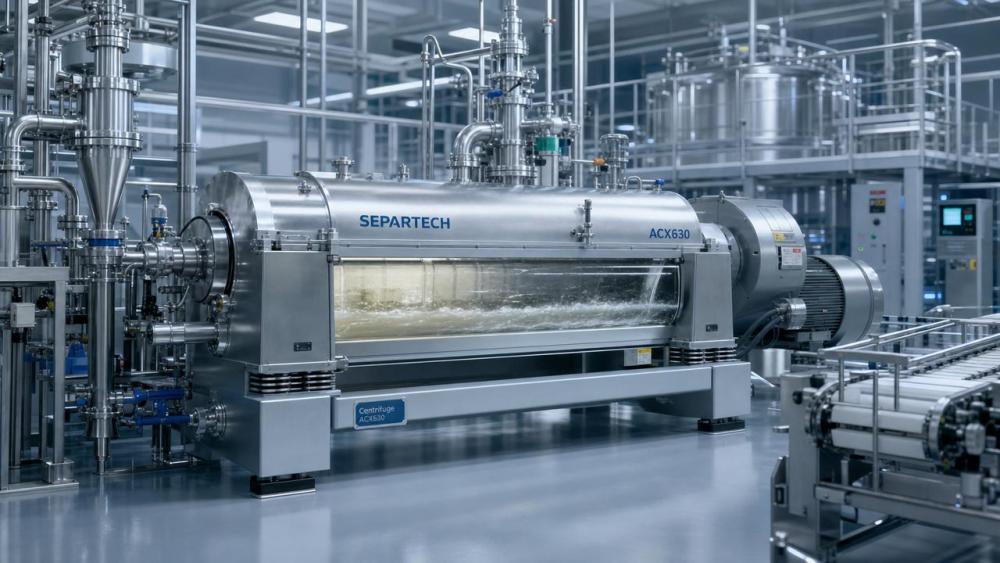
Industrial centrifuges sit at a critical point between upstream production and downstream purification.
When fermentation volume rises, separation speed becomes more than a productivity issue.
It affects product hold time, impurity burden, cleaning schedules, and the stability of the next process step.
That is why continuous-flow operation often gains attention before capacity expansion, especially in bioprocessing, pharmaceutical recovery, food ingredients, and fine chemicals.
In high-throughput environments, batch separation can create pauses between filling, spinning, discharge, and restart.
Continuous-flow industrial centrifuges reduce those interruptions and keep material moving at a steadier pace.
For BLES, this topic is especially relevant because separation is not an isolated utility.
It is one of the five equipment pillars that shape scale-up efficiency, data integrity, and compliance readiness across life science operations.
In other words, better throughput is valuable only when it also supports cleaner product transfer, traceable control, and reliable process behavior.
What Continuous-Flow Industrial Centrifuges Actually Do
At the basic level, industrial centrifuges use centrifugal force to separate solids from liquids, or liquids of different densities.
The difference with continuous flow is operational rhythm.
Material enters the system while separation is already underway, rather than waiting for a full batch cycle to finish.
This approach is common in disc-stack centrifuges and decanter centrifuges, though their fit depends on solids content, shear sensitivity, and target recovery.
In biopharma, the typical stream may include fermentation broth, cell debris, precipitates, or biomass.
The centrifuge becomes the “gold panning sieve” of downstream purification, clearing bulk impurities before filtration, chromatography, or concentration.
The goal is not simply to spin faster.
The goal is to maintain a stable separation zone, predictable discharge behavior, and consistent clarified output under changing feed conditions.
Where Better Throughput Becomes Real Business Value
Throughput is often discussed as volume per hour, but the practical value is broader.
A faster separator only helps if the rest of the line can absorb that speed without quality loss.
Continuous-flow industrial centrifuges can create value in several connected ways:
- They shorten residence time for unstable intermediates.
- They reduce queueing between harvest and purification.
- They lower the solids load reaching depth filters or membranes.
- They improve campaign planning by smoothing equipment utilization.
- They support more repeatable scale-up when feed rates are well characterized.
For facilities handling monoclonal antibodies, recombinant proteins, or CGT-adjacent process streams, these gains can be significant.
A cleaner handoff from centrifugation can reduce pressure on downstream polishing and improve overall process economics.
This is also where BLES brings a useful perspective.
Separation performance should be judged alongside bioreactor output, analytical verification, biosafety controls, and automation strategy, not in isolation.
When Continuous Flow Outperforms Batch Operation
Continuous flow is not automatically superior.
It performs best when process conditions reward steady handling more than stop-start flexibility.
Several situations usually point toward continuous-flow industrial centrifuges.
By contrast, batch centrifugation may remain practical for small volumes, irregular feed composition, or highly specialized campaigns.
The real decision depends on feed behavior, not just nameplate capacity.
Key Factors That Influence Separation Performance
Throughput claims can be misleading if operating variables are not understood.
In actual use, industrial centrifuges respond strongly to feed consistency and control discipline.
Feed characteristics
Solids concentration, particle size, viscosity, and density difference all affect separation efficiency.
A broth rich in fragile mammalian cells behaves very differently from a tougher microbial slurry.
Shear sensitivity
Some targets tolerate aggressive acceleration.
Others may fragment, release impurities, or lose viability under excessive shear.
Discharge and solids handling
A centrifuge that clarifies well but struggles with solids discharge can still become the plant bottleneck.
Stable discharge intervals and manageable waste streams matter as much as bowl speed.
Instrumentation and compliance
In regulated environments, alarms, recipe control, electronic records, and validated software architecture are not optional extras.
They support the same GMP logic that governs upstream control and analytical release.
This is where BLES intelligence is particularly useful, connecting equipment decisions with CSV expectations, traceability, and audit readiness.
Typical Use Cases Across Process Environments
Although biopharma is a strong fit, industrial centrifuges serve many process industries where solids-liquid separation shapes yield and uptime.
- Cell culture harvest before depth filtration and chromatography.
- Microbial fermentation clarification in enzyme and protein production.
- Recovery of fine chemical intermediates from reaction mixtures.
- Food and nutraceutical processing where phase purity affects consistency.
- Waste minimization loops that reclaim usable liquid from solids-heavy streams.
The common thread is not the industry label.
It is the need for reliable separation under production pressure, while keeping quality outcomes measurable and repeatable.
How to Judge Whether the Upgrade Makes Sense
A useful evaluation starts with process mapping rather than equipment brochures.
If industrial centrifuges are under review, a few questions usually expose the real opportunity.
- Is the current bottleneck caused by separation time, manual handling, or downstream fouling?
- Does the feed stream stay reasonably stable across the campaign?
- Will faster clarification improve the next unit operation in a measurable way?
- Are cleaning, validation, and electronic records aligned with site requirements?
- Can automation and monitoring support tighter control rather than just higher speed?
These questions help avoid a common mistake.
Many sites buy for peak capacity, then discover the real gains depend on integration with filtration, analytics, and changeover strategy.
That broader view matches the BLES approach: connect microscopic process behavior with scale-up logic and compliance discipline.
A Practical Next Step for Process Review
Continuous-flow industrial centrifuges deliver better throughput when the process needs steady movement, cleaner clarification, and fewer interruptions between unit operations.
Their value becomes clearer when throughput is measured alongside recovery, filter life, automation fit, and GMP documentation.
A practical next step is to compare current separation performance against three points: feed variability, downstream burden, and control requirements.
If those factors already limit output, continuous-flow industrial centrifuges deserve a closer technical review.
From there, the most useful path is not chasing the highest G-force.
It is building a separation strategy that fits product sensitivity, process scale, and the quality expectations of the full manufacturing chain.
Related News
- When Does Centrifugal Separation for Cell Harvest Outperform TFF?Aug 12, 2026Downstream Purification Fellow
- Industrial Centrifuges for Continuous Operation: What Impacts Uptime MostJul 13, 2026Downstream Purification Fellow
- TUV Rheinland Updates BSL-3 Rules for Flow CentrifugesJul 07, 2026Downstream Purification Fellow
- CBP Reclassifies Continuous Flow Centrifuges, Adds 25% DutyJul 03, 2026Downstream Purification Fellow
Related News
- 00
0000-00
How to assess GMP audit readiness in Europe before an inspection - 00
0000-00
How to size downstream purification systems for batch capacity - 00
0000-00
When does a Class II biosafety cabinet provide adequate protection? - 00
0000-00
Selecting sterile bioprocess equipment solutions for GMP compliance - 00
0000-00
How to maintain GMP compliance documentation that stands up to audits
Downstream Purification Fellow
Weekly Insights
Stay ahead with our curated technology reports delivered every Monday.