





Biopharma equipment is moving from support function to capacity strategy core
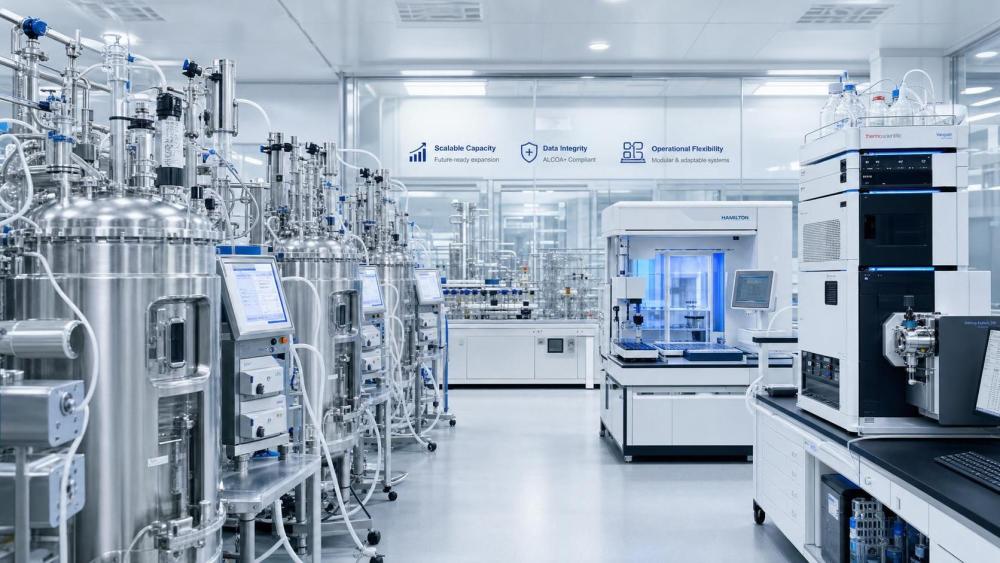
In 2026, capacity planning is no longer shaped only by molecule pipelines or facility size.
The bigger shift is that biopharma equipment now determines how quickly capacity can be added, switched, validated, and defended under audit.
That matters across the broader industrial landscape, because life sciences investment is under pressure to produce faster proof, cleaner data, and lower operational drag.
Recent signals point in the same direction.
Commercial teams want scale-up paths with fewer surprises.
R&D groups want analytical confidence earlier.
Operations want flexible lines that can absorb demand swings without rebuilding entire workflows.
This is why biopharma equipment is becoming a board-level conversation rather than a technical purchasing topic.
Platforms such as BLES have helped make that shift visible by connecting microscopic process behavior with GMP reality, export compliance, and commercialization timing.
Why the change is becoming more visible now
The market is not simply buying more tools.
It is rethinking which biopharma equipment creates usable capacity, and which only adds fixed cost.
One driver is the mix of therapies moving forward.
Cell and gene therapies, biologics, and precision pipelines demand smaller batches, tighter controls, and faster process adjustments.
Another driver is funding discipline.
Capital is still available, but it increasingly favors capacity models with measurable utilization, data integrity, and shorter payback periods.
A third driver is compliance complexity.
CSV expectations, traceability demands, and cross-region audit scrutiny now influence equipment architecture from day one.
The result is a more selective market.
Biopharma equipment must prove that it supports both process science and regulatory endurance.
The strongest demand signals behind 2026 planning
- Single-use systems are favored where product mix changes quickly and downtime is expensive.
- Automated liquid handling is expanding beyond screening into routine quality and development workflows.
- LC-MS and advanced analytical metrology are moving earlier in process decisions, not only later in release testing.
- Bioreactors are being evaluated for scale transfer predictability, not only vessel volume.
- Separation systems are under pressure to improve yield without creating cleaning or validation bottlenecks.
The equipment conversation is shifting from ownership to readiness
In earlier cycles, capacity often meant physical expansion.
In 2026, it increasingly means readiness to run the next program with fewer delays.
That distinction changes how biopharma equipment is valued.
For bioreactors and fermenters, the question is no longer only scale.
It is whether gas transfer, control logic, and sensor integration support stable movement from pilot to commercial batches.
For industrial centrifuges and separation systems, speed alone is not enough.
Teams are comparing impurity clearance, product recovery, filter burden, and how each step affects downstream scheduling.
For biosafety cabinets and clean benches, attention is widening from basic containment to workflow ergonomics, operator consistency, and contamination event prevention.
The same pattern appears in automated liquid handling.
Precision, deck flexibility, software traceability, and method portability now carry more weight than throughput headlines alone.
Where readiness creates measurable advantage
Automation is broadening, but the real story is data trust
Automation remains central, yet the 2026 version is less about replacing hands and more about protecting decisions.
Biopharma equipment now sits inside a chain of digital evidence.
If data capture, audit trails, and software validation are weak, extra capacity can quickly become unusable capacity.
That is why the BLES perspective on absolute data integrity is increasingly relevant.
When CSV requirements are addressed early, equipment deployment becomes faster and less disruptive later.
More importantly, automated systems become easier to scale across sites, partners, and regulated workflows.
This applies strongly to LC-MS systems.
They are no longer viewed as isolated analytical assets.
They increasingly act as decision engines for comparability, impurity profiling, and process adjustment.
The same logic extends to robotic liquid handling.
High throughput matters, but trusted repeatability matters more.
Single-use and modular design are changing scale-up economics
One of the clearest shifts in biopharma equipment is the stronger role of modular capacity.
Single-use technology is not replacing every stainless setup, but it is reshaping where flexibility creates the most value.
In volatile demand environments, line switch speed can matter more than peak installed output.
That is especially true for CXO networks, regional manufacturing hubs, and facilities supporting mixed portfolios.
The economic case is also becoming more precise.
Decision makers are looking beyond disposable cost.
They are modeling cleaning validation hours, changeover losses, water and utility loads, operator allocation, and time-to-batch.
That broader view often changes the answer.
Biopharma equipment that appears more expensive upfront may create better annual capacity economics if it reduces idle time and compliance burden.
Questions that now matter more than list price
- How fast can a process switch from one molecule or campaign to another?
- How much engineering support is required for requalification?
- Which consumables expose the operation to supply concentration risk?
- Can the equipment standardize methods across internal and external sites?
- Does the platform support future automation layers without redesign?
The impact is spreading across the full process chain
What makes 2026 different is that equipment shifts no longer stay in one department.
A change in upstream bioreactor strategy affects downstream purification timing.
A change in analytical metrology influences release confidence and process development speed.
A change in liquid handling architecture alters staffing, scheduling, and method reproducibility.
This is where integrated intelligence becomes valuable.
BLES reflects a market need for stitched insight rather than isolated device comparison.
In practice, capacity planning now depends on how well equipment choices connect process physics, compliance logic, and commercial urgency.
That integrated view helps explain why some facilities scale smoothly while others accumulate hidden bottlenecks despite large capital spend.
What deserves closer attention over the next planning cycle
The next phase will likely reward selective investment rather than broad expansion.
Biopharma equipment should be reviewed as a capacity architecture, not as a collection of standalone assets.
The most useful starting point is to map where current bottlenecks actually form.
In some organizations, the limit is upstream control.
In others, it is analytical turnaround, cleaning validation, or method transfer reliability.
From there, compare equipment options against three tests.
- Does it expand real throughput, not just nominal throughput?
- Does it strengthen compliance resilience under FDA and EMA scrutiny?
- Does it preserve flexibility for future modality or demand shifts?
That approach keeps the discussion grounded.
It also turns biopharma equipment planning into a clearer sequence of operational choices.
The best next step is to track process bottlenecks, compare automation and single-use fit by scenario, and build a phased readiness plan around scale-up, data integrity, and audit durability.
Related News
- When does a single use manufacturing platform reduce scale-up risk?Sep 20, 2026Prof. Alistair Thorne
- How to evaluate a bioprocessing intelligence platform for scale-upSep 07, 2026Prof. Alistair Thorne
- How can a cell therapy bioprocessing manufacturer support GMP scale-up?Sep 07, 2026Prof. Alistair Thorne
- What drives CGT bioprocessing cost at commercial scale?Aug 31, 2026Prof. Alistair Thorne
Related News
- 00
0000-00
When does a single use manufacturing platform reduce scale-up risk? - 00
0000-00
When digital laboratory workflow solutions reduce GMP data integrity risk - 00
0000-00
How biopharma teams can prepare audit trails for GMP inspections - 00
0000-00
How electronic analytical data integrity supports GMP audit readiness - 00
0000-00
How to build a system lifecycle validation strategy for GMP compliance
Prof. Alistair Thorne
Weekly Insights
Stay ahead with our curated technology reports delivered every Monday.