





As Cell & Gene Therapies move from promising pipelines to repeatable commercialization, 2026 capacity planning has become a strategic test of timing, infrastructure, and execution.
For BLES, this topic sits at the intersection of bioprocess systems, analytical control, GMP compliance, and flexible laboratory automation.
Cell & Gene Therapies no longer depend only on scientific success. They also depend on whether production, testing, containment, and data integrity can scale together.
In 2026, the central question is practical: which capacity model matches the therapy, the region, and the approval path without locking enterprises into costly rigidity?
Why 2026 changes the capacity planning scenario for Cell & Gene Therapies
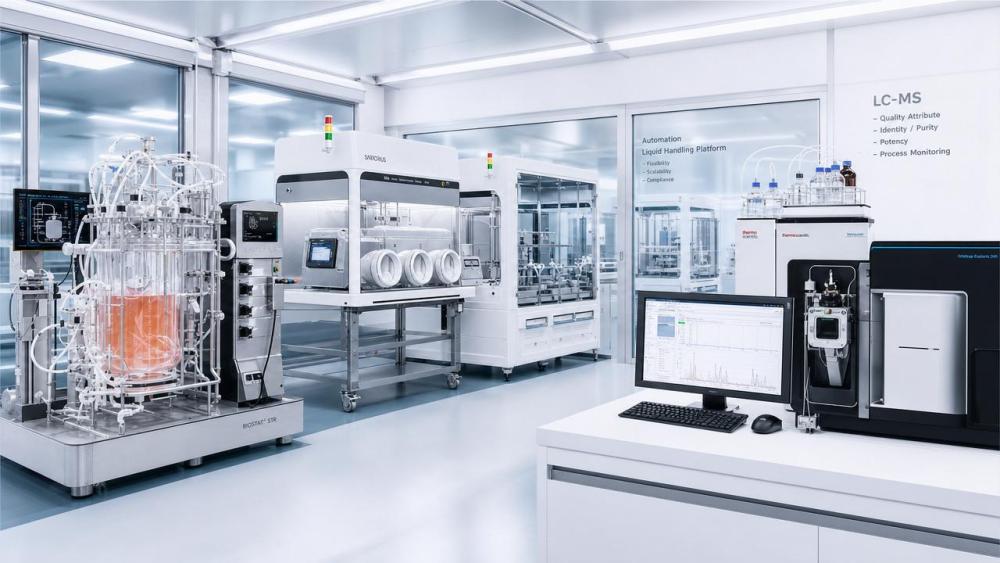
The planning environment for Cell & Gene Therapies is changing because demand growth is uneven, while technical constraints remain highly specific.
Autologous programs require patient-linked scheduling. Allogeneic programs demand larger batch economics. Viral vector platforms add pressure on cleanroom utilization and release analytics.
These differences make generic expansion plans risky. Capacity must be shaped by scenario, not by simple square footage or installed bioreactor volume.
Cell & Gene Therapies also face faster regulatory scrutiny around comparability, traceability, computerized systems, and contamination control.
That means a new suite, isolator, centrifuge, LC-MS workflow, or liquid handling platform can become a bottleneck if validation planning starts too late.
Scenario one: autologous Cell & Gene Therapies need scheduling capacity, not only physical capacity
Autologous Cell & Gene Therapies operate under chain-of-identity pressure. Each patient batch carries strict timing, transport, processing, and release dependencies.
In this scenario, adding more equipment does not automatically increase throughput. The real limit often appears in handoffs between collection, processing, testing, and shipment.
Key judgment points
- Can cleanroom slots match patient intake variability?
- Is biosafety cabinet availability aligned with staffing and shift design?
- Do release assays create hidden queue time?
- Can electronic records preserve identity without manual reconciliation?
For autologous operations, BLES often sees planning errors in underestimating analytical turnaround and overestimating operator productivity.
The better approach is to model each patient lot as a time-sensitive workflow, then identify the longest and least flexible step.
Scenario two: allogeneic Cell & Gene Therapies need scalable upstream and downstream balance
Allogeneic Cell & Gene Therapies promise broader patient reach, but their capacity planning challenge is different.
Here, the risk is imbalance. Upstream expansion may outpace clarification, concentration, fill-finish, or cold chain capability.
Single-use bioreactors offer flexibility, especially when portfolios are still shifting. Yet scale-up success depends on oxygen transfer, mixing performance, and reproducibility.
Industrial centrifuges and separation systems then become crucial. They determine whether larger harvest volumes can move downstream without yield loss or contamination risk.
Core planning signals
- Stable cell expansion under expected batch sizes
- Adequate harvest and clarification windows
- Vector or payload recovery consistency
- Sufficient buffer preparation and storage planning
For Cell & Gene Therapies, the winning site design is usually not the biggest one. It is the one with fewer transition losses between unit operations.
Scenario three: viral vector and analytical workflows often define the real ceiling
Many Cell & Gene Therapies rely on viral vectors, and vector-related operations are notorious for hidden capacity constraints.
Facilities may appear ready on paper, yet release testing, characterization, and environmental controls reduce actual usable output.
LC-MS systems, molecular analytics, and automated liquid handling are not secondary tools. They are capacity infrastructure.
If assay transfer is slow, sample preparation is manual, or instrument qualification lags, Cell & Gene Therapies can miss release targets despite full manufacturing occupancy.
Practical bottlenecks to evaluate
- Assay throughput per batch and per week
- Method validation timelines for new indications
- Sample chain-of-custody integrity
- CSV readiness for software-linked instruments
This is where the BLES perspective matters. Analytical metrology and GMP data integrity must be planned at the same time as production expansion.
How capacity needs differ across Cell & Gene Therapies scenarios
This comparison shows why Cell & Gene Therapies cannot use one investment logic across all assets, geographies, or development stages.
What enterprises should prioritize in 2026 capacity planning
The next step is converting scenario analysis into capacity actions. For Cell & Gene Therapies, five priorities stand out.
- Build flexible suites around platform changes, not fixed campaign assumptions.
- Model analytical capacity with the same rigor as manufacturing capacity.
- Strengthen single-use supply resilience for bags, tubing, connectors, and filters.
- Align CSV, e-records, and audit trail design before scale-up execution.
- Use automation where repetitive handling limits consistency or speed.
For Cell & Gene Therapies, flexibility does not mean vague planning. It means designing controllable optionality into equipment, utilities, and data systems.
That is especially relevant when funding conditions remain selective and capacity bets must show measurable operational return.
Common misjudgments that slow Cell & Gene Therapies scale-up
Several repeated assumptions continue to weaken 2026 plans for Cell & Gene Therapies.
- Assuming cleanroom expansion alone solves throughput limitations
- Treating analytics as a support function instead of a release gate
- Ignoring operator training time for advanced automated systems
- Underplanning for consumables qualification and second sourcing
- Delaying GMP digital compliance until late-stage validation
These errors usually emerge when planning is done by equipment category rather than by end-to-end process scenario.
BLES tracks this across bioreactors, separation systems, biosafety environments, and liquid handling platforms. The pattern is consistent.
A practical next-step framework for Cell & Gene Therapies capacity decisions
A realistic planning cycle for Cell & Gene Therapies should begin with a scenario map covering therapy type, batch logic, release pathway, and regional compliance needs.
Then, link each scenario to equipment loads, staffing assumptions, assay demand, data flow, and failure recovery options.
The most useful output is not a static facility number. It is a capacity model showing where one constraint shifts when another improves.
For organizations evaluating Cell & Gene Therapies expansion, the strongest 2026 position will come from synchronized planning across manufacturing, analytics, automation, and GMP systems.
BLES supports this view through intelligence on single-use scale-up, downstream separation, analytical metrology, biosafety control, and digital compliance readiness.
In a market where speed matters, disciplined capacity design is no longer optional. It is the structure that determines whether Cell & Gene Therapies can scale with confidence.
Related News
- Zylidac Bio and Prolific Machines Partner to Scale Optogenetics for GMP ProductionOct 23, 2026Prof. Alistair Thorne
- How to prevent oxygen limitation in process scale-up for biologicsOct 18, 2026Prof. Alistair Thorne
- How to maintain product quality when scaling up a bioprocessOct 09, 2026Prof. Alistair Thorne
- What should you verify before choosing a bioprocessing equipment exporter?Oct 08, 2026Prof. Alistair Thorne
Related News
- 00
0000-00
What CSV documentation should a laboratory systems supplier provide? - 00
0000-00
SCIEX Begins Construction of High-End Mass Spectrometer Plant in Beijing - 00
0000-00
Which design features make cleanroom benches easier to clean? - 00
0000-00
IndexBox Forecasts 12% CAGR for Global Microbioreactor Market Through 2035 - 00
0000-00
When do hazardous compound labs need isolators for containment?
Prof. Alistair Thorne
Weekly Insights
Stay ahead with our curated technology reports delivered every Monday.