





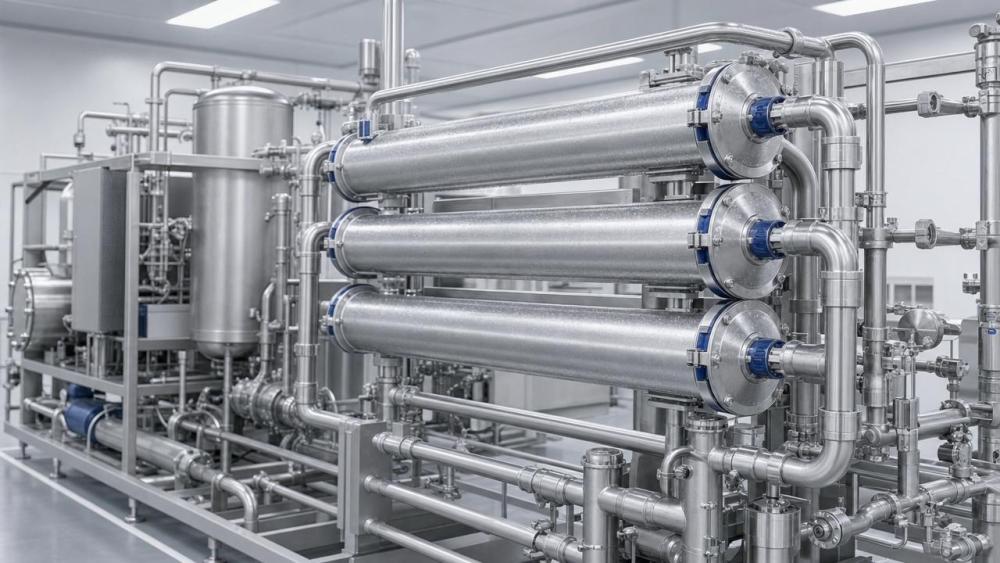
On May 27, 2026, a global shortage emerged for high-rejection composite ultrafiltration membranes (MWCO 10–100 kDa) used in Tangential Flow Filtration (TFF) systems, following export restrictions from Japan and reallocation of South Korean semiconductor-grade PVDF membrane capacity. This disruption directly affects biopharmaceutical manufacturing, CDMO operations, and TFF system integration — making it critical for procurement, supply chain, and process engineering stakeholders to reassess sourcing strategies and lead-time buffers.
Event Overview
Effective May 27, 2026, major Japanese and South Korean suppliers of high-performance composite membranes for TFF ultrafiltration systems implemented a 40% price increase for exports to China and restricted shipment volumes. The shortage stems from tightened Japanese export controls and the diversion of South Korean PVDF membrane production capacity toward semiconductor wafer cleaning applications. Current lead times for these membranes have extended to 22–26 weeks. This has already impacted expansion plans of biopharmaceutical CDMOs in Europe and North America, prompting increased inquiry volumes toward Chinese TFF system integrators.
Impact on Specific Industry Segments
Direct Trade Enterprises
Companies engaged in cross-border distribution of filtration membranes face immediate margin compression and contractual renegotiation pressure. The 40% price hike applies specifically to exports to China, creating asymmetry in regional pricing and complicating inventory valuation and resale agreements.
Raw Material Procurement Teams
Procurement units sourcing MWCO 10–100 kDa composite membranes for internal TFF system assembly or custom module fabrication are encountering extended lead times and reduced order acceptance rates. Availability is no longer guaranteed even for confirmed purchase orders placed under prior contracts.
Equipment Integration & Manufacturing Firms
TFF system integrators — particularly those relying on imported membranes for final assembly — face delays in system delivery schedules and potential non-compliance with customer delivery milestones. Some integrators report rising inbound inquiry volume from Western CDMOs seeking alternative supply routes, but capacity constraints limit rapid scale-up.
Supply Chain Service Providers
Logistics and customs compliance firms supporting membrane imports must now verify updated export license requirements from Japan and monitor regulatory updates from Korea’s Ministry of Trade, Industry and Energy. Documentation scrutiny has intensified, contributing to further delays at port clearance stages.
What Relevant Enterprises or Practitioners Should Monitor and Do Now
Track official policy updates from Japanese METI and Korean MOTIE
Both governments’ formal announcements — especially regarding licensing criteria, product classification changes, or exemptions for life science applications — will determine whether current restrictions are temporary or structural. Monitoring should include English-language summaries issued by national trade promotion agencies.
Validate availability and specifications of domestic membrane alternatives
While Chinese TFF system integrators are receiving more inquiries, their ability to meet performance-critical requirements (e.g., consistent MWCO, low protein binding, sterilization compatibility) depends on underlying membrane supply. Procurement teams should request third-party validation reports — not just supplier declarations — before committing to alternate sources.
Distinguish between short-term allocation shifts and long-term capacity redirection
The Korean PVDF shift toward semiconductor cleaning reflects sustained investment in chip-related infrastructure. Analysis shows this is unlikely to reverse in the next 12–18 months, meaning reliance on Korean-sourced membranes for high-precision bioprocessing may require multi-year contingency planning — not just spot-market workarounds.
Reassess safety stock levels and dual-sourcing feasibility for critical membrane SKUs
With lead times exceeding 5 months, enterprises should audit current buffer stocks against projected production demand through Q4 2026. Where technically feasible, qualifying a second membrane source — even if requiring minor system recalibration — mitigates single-point-of-failure risk without full platform redesign.
Editorial Perspective / Industry Observation
Observably, this event functions less as an isolated supply shock and more as a signal of increasing interdependence between semiconductor policy and biomanufacturing infrastructure. The fact that PVDF membrane capacity — originally developed for battery and filtration markets — is now being prioritized for chip cleaning underscores how export control frameworks increasingly treat advanced materials as strategic assets across sectors. From an industry perspective, this is not yet a systemic failure, but rather an early-stage inflection point where procurement resilience begins to intersect with national technology policy. Continued monitoring is warranted, particularly for any extension of Japanese controls to other polymer-based separation materials.
Concluding, this membrane supply constraint highlights a growing vulnerability in downstream bioprocess equipment: dependence on highly specialized, geopolitically sensitive components with limited qualified alternatives. It is best understood not as a temporary logistics hiccup, but as a structural reminder that material-level supply chains — once considered stable — now require active, policy-aware stewardship.
Source: Publicly reported export regulation updates from Japan’s Ministry of Economy, Trade and Industry (METI), statements from South Korean Ministry of Trade, Industry and Energy (MOTIE), and verified commercial intelligence from multiple biopharma CDMO procurement channels (as of May 27, 2026).
Note: Ongoing observation is required for potential expansion of Japanese export controls to related polymer grades or additional Korean production reallocations.
Related News
- What CSV documentation should a laboratory systems supplier provide?Oct 26, 2026Dr. Elara Sterling
- SCIEX Begins Construction of High-End Mass Spectrometer Plant in BeijingOct 26, 2026Analytical Metrology Expert
- Which design features make cleanroom benches easier to clean?Oct 25, 2026Bio-containment Strategist
- IndexBox Forecasts 12% CAGR for Global Microbioreactor Market Through 2035Oct 25, 2026Bioprocess Scientist
Related News
- 00
0000-00
What CSV documentation should a laboratory systems supplier provide? - 00
0000-00
SCIEX Begins Construction of High-End Mass Spectrometer Plant in Beijing - 00
0000-00
Which design features make cleanroom benches easier to clean? - 00
0000-00
IndexBox Forecasts 12% CAGR for Global Microbioreactor Market Through 2035 - 00
0000-00
When do hazardous compound labs need isolators for containment?
Industry Global
Weekly Insights
Stay ahead with our curated technology reports delivered every Monday.