





Where GMP data integrity risks become operational, pharmaceutical compliance solutions matter most
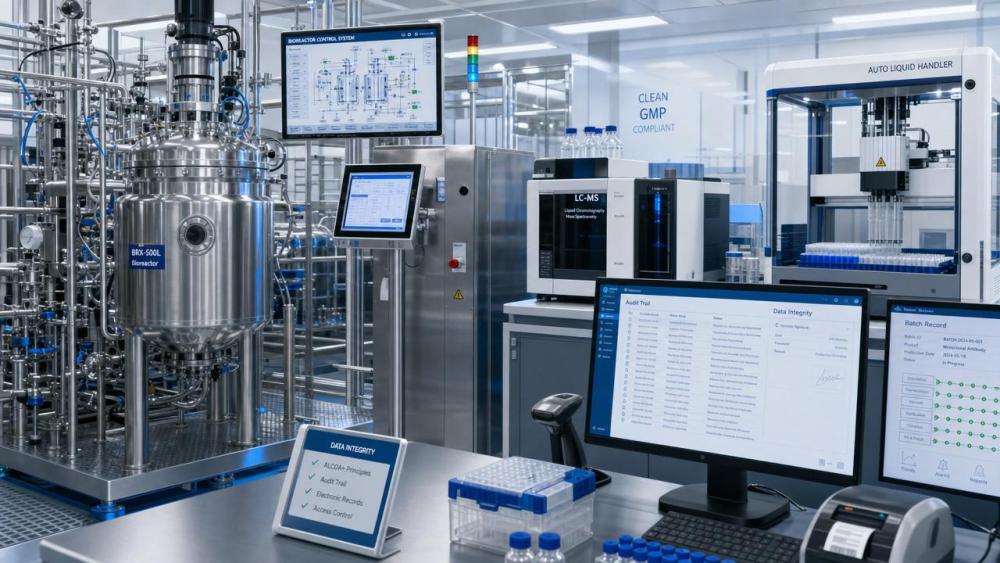
In GMP environments, data integrity rarely fails in dramatic ways. It usually weakens through small gaps, fragmented records, and inconsistent system control.
That is why pharmaceutical compliance solutions are not only about passing inspections. They protect batch release timing, analytical credibility, and trust in every regulated decision.
The challenge is that risk does not look the same everywhere. A bioreactor record, an LC-MS sequence, and a liquid handling audit trail carry different failure modes.
In actual operations, stronger compliance comes from matching controls to the process context. The best pharmaceutical compliance solutions are shaped by where the data is created, reviewed, transferred, and reused.
This matters across the wider BLES landscape, where high-end bioprocessing, downstream purification, analytical metrology, and automated workflows must all support traceable GMP execution.
Actual risk patterns differ across laboratories, pilot lines, and commercial production
A common mistake is treating all GMP data as one governance problem. In reality, each operating environment creates different integrity pressures.
Development laboratories often struggle with method changes, software configuration drift, and manual transcription between instruments and review files.
Pilot facilities face another issue. Processes evolve quickly, but validation, access control, and change documentation do not always keep pace.
Commercial manufacturing is usually more standardized, yet batch-critical data flows are wider. That increases the importance of secure integration, review by exception, and durable archival.
BLES often tracks this intersection closely. The same site may run cell culture systems, purification skids, LC-MS platforms, and robotic liquid handling, each under different control logic.
Good pharmaceutical compliance solutions therefore start with a practical question: where can records be altered, lost, delayed, or misunderstood before quality sees the impact?
Bioprocessing records demand continuity, not only accuracy
In bioreactors and fermenters, data integrity is tied to continuity. Missing trends in pH, DO, agitation, or feed events can distort process interpretation even when single values seem acceptable.
Here, pharmaceutical compliance solutions should emphasize time synchronization, historian integrity, alarm acknowledgment records, and controlled parameter changes.
For cell and gene therapy workflows, the tolerance for ambiguity is even lower. Small-batch variability makes complete electronic traceability more important than broad summary reporting.
Analytical platforms require review discipline and method governance
LC-MS and other high-molecular analytical systems generate complex raw files, processed results, and interpretation layers. Risk often appears during reprocessing, sequence interruption, or unmanaged method versions.
In this setting, pharmaceutical compliance solutions need stronger controls for audit trails, analyst privileges, result invalidation rules, and linkages between raw data and final reports.
High-frequency scenarios reveal what kind of compliance control is really needed
When risk reviews stay too general, control measures become expensive but shallow. A more useful approach is to compare typical operating scenarios and decide where controls must be deepest.
The table shows why one-size-fits-all controls often disappoint. Different assets generate different evidence, so inspection readiness depends on matching the evidence model to the process.
Automated workflows reduce manual error, but they also create hidden validation exposure
Automation is often introduced to remove repetitive pipetting, accelerate screening, and standardize handling. Those gains are real, especially in NGS preparation and high-throughput assay work.
Still, automated systems can create a false sense of control. If scripts, templates, and instrument interfaces are loosely governed, errors scale faster than in manual workflows.
That is why pharmaceutical compliance solutions for liquid handling workstations must go beyond calibration records. They should address software change approval, plate map traceability, exception handling, and user role boundaries.
The same principle applies to connected cleanroom devices and biosafety systems. Environmental monitoring, maintenance events, and operator interventions need records that remain attributable and reviewable.
In practice, CSV and data integrity controls should be planned before workflow expansion. Retrofitting them later usually costs more and leaves legacy risk unresolved.
Before selecting pharmaceutical compliance solutions, check these adaptation conditions
Selection decisions often focus on software features. A stronger judging method is to confirm how the solution behaves under real operating constraints.
- Confirm whether raw data, metadata, and review comments stay linked through the full retention period.
- Check whether instrument integrations preserve original time stamps and user attribution.
- Verify that temporary data caches, local drives, and export folders are still under procedural control.
- Assess whether role-based access reflects actual segregation of duties in the site workflow.
- Review how deviations, retests, and invalidated results are documented without breaking traceability.
- Match archival design to data volume, file complexity, and retrieval speed required during inspections.
These points are especially relevant in mixed environments, where legacy analytical instruments coexist with newer robotic systems and enterprise quality platforms.
BLES-related operations frequently span scale-up science, compliance interpretation, and equipment interoperability. That makes adaptability more valuable than narrow feature abundance.
Where teams often misjudge GMP data integrity risk
One recurring misjudgment is assuming validated equipment automatically produces compliant records. Validation supports control, but daily data integrity still depends on configuration, behavior, and review discipline.
Another weak point is overvaluing purchase cost while underestimating implementation effort. Pharmaceutical compliance solutions can fail if training, SOP revision, and migration planning are treated as side tasks.
Sites also tend to copy one control model across similar-looking operations. Yet a chromatography data system, a bioreactor historian, and a robotic assay platform do not create identical evidence chains.
A subtler issue appears during scale-up. Data structures that work in development may become fragile when batch frequency, user count, and review load increase.
This is where strategic intelligence matters. Compliance decisions should be read alongside process physics, throughput expectations, and the commercial pressure of faster drug development.
A practical path to stronger pharmaceutical compliance solutions
A resilient framework starts with process mapping, not technology shopping. Identify where critical GMP data originates, where it changes form, and where final quality decisions rely on it.
Then rank systems by product impact and evidence complexity. Batch-release analytics, upstream control records, and automated preparation logs usually deserve different review depth.
Next, align pharmaceutical compliance solutions with real execution conditions. That includes CSV scope, interface ownership, audit trail review routines, backup testing, and long-term archival retrieval.
Where operations bridge bioprocessing, purification, metrology, and robotics, the goal is not maximum restriction. The goal is dependable traceability without slowing essential scientific work.
A useful next step is to compare current workflows against scenario-specific failure points, then build an adaptation standard covering access, attribution, review, retention, and change control.
That approach turns pharmaceutical compliance solutions into a business safeguard. It supports inspection readiness, protects scale-up confidence, and preserves the credibility of every regulated result.
Related News
- What CSV documentation should a laboratory systems supplier provide?Oct 26, 2026Dr. Elara Sterling
- GenScript ProBio’s Nanjing Biologics Facility Passes NMPA Pre-Approval InspectionOct 22, 2026Dr. Elara Sterling
- How to assess audit trails in analytical data integrity solutionsOct 16, 2026Dr. Elara Sterling
- How user licensing affects laboratory validation system pricingOct 14, 2026Dr. Elara Sterling
Related News
- 00
0000-00
What CSV documentation should a laboratory systems supplier provide? - 00
0000-00
SCIEX Begins Construction of High-End Mass Spectrometer Plant in Beijing - 00
0000-00
Which design features make cleanroom benches easier to clean? - 00
0000-00
IndexBox Forecasts 12% CAGR for Global Microbioreactor Market Through 2035 - 00
0000-00
When do hazardous compound labs need isolators for containment?
Dr. Elara Sterling
Weekly Insights
Stay ahead with our curated technology reports delivered every Monday.