





In biopharmaceutical quality control and safety management, unreliable polymer data can compromise release decisions, GMP compliance, and patient risk assessments.
High-molecular analytical metrology provides the measurement discipline needed to verify molecular weight distribution, aggregation, purity, and structural consistency across complex biopolymers.
For audit-ready data integrity and process safety, understanding how metrology supports LC-MS, chromatography, and validated workflows is essential.
What quality teams really need from high-molecular analytical metrology
Most searches for high-molecular analytical metrology are not purely academic. QC teams want defensible numbers for complex molecules under regulated pressure.
The practical question is simple: can the reported molecular weight, impurity profile, or aggregation result survive release review and inspection?
For safety managers, the concern extends further. Poorly characterized biopolymers may affect toxicity assumptions, process containment decisions, or deviation severity assessments.
Reliable metrology turns analytical data from an instrument output into controlled evidence, with known uncertainty, traceability, and documented fitness for purpose.
This is especially important for biopolymers because they rarely behave like small molecules. Their size, conformation, charge, and degradation pathways are interconnected.
Why biopolymer data becomes unreliable in real laboratories
Biopolymer measurements fail for predictable reasons. Sample preparation, column interactions, detector calibration, and analyst interpretation can all shift final conclusions.
A protein aggregate may appear differently by SEC, field-flow fractionation, dynamic light scattering, or LC-MS, depending on the stress history.
Polysaccharides, nucleic acids, PEGylated proteins, and viral vector components introduce additional complexity because their distributions are broad rather than single-point values.
For QC staff, the danger is not only an incorrect result. The greater risk is accepting data without understanding measurement limitations.
If a method cannot distinguish degradation from formulation excipients, the laboratory may understate risk or trigger unnecessary batch investigations.
High-molecular analytical metrology addresses these vulnerabilities by defining what is measured, how uncertainty is estimated, and when results are comparable.
The data attributes that matter most for release and safety decisions
QC and safety teams should prioritize measurement attributes linked directly to product quality, patient exposure, and process control.
Molecular weight distribution is often the starting point. It reveals polymer chain length variation, fragmentation, crosslinking, and batch-to-batch consistency.
Aggregation is another critical attribute because high-molecular species may influence immunogenicity, potency, filtration behavior, and formulation stability.
Purity and impurity profiling remain essential, but high-molecular products require special attention to co-eluting species and structurally similar contaminants.
Structural consistency also matters. Changes in glycosylation, charge variants, conjugation ratio, or higher-order structure may alter performance.
The best analytical strategy connects these attributes with predefined acceptance criteria, not retrospective explanations after unexpected chromatograms appear.
How metrology strengthens chromatography, LC-MS, and orthogonal testing
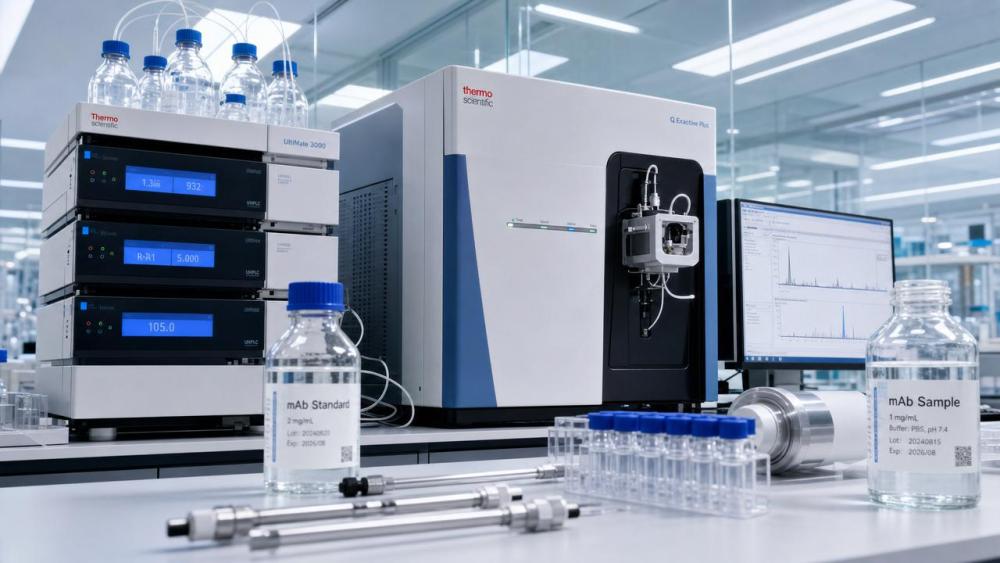
Chromatography remains a core platform for high-molecular analysis, but metrology determines whether chromatographic signals are meaningful and comparable.
Size-exclusion chromatography, ion-exchange chromatography, HIC, and reversed-phase methods each require careful system suitability and reference material selection.
LC-MS adds molecular specificity, especially for intact mass, peptide mapping, degradation identification, and confirmation of subtle structural variants.
However, LC-MS results depend on ionization efficiency, deconvolution settings, mass calibration, and control of matrix effects.
Metrology does not replace analytical expertise. It provides the measurement architecture that prevents expert interpretation from becoming undocumented judgment.
Orthogonal methods are particularly valuable. When SEC suggests aggregation, complementary techniques can confirm whether the signal reflects true species or method artifacts.
Building an audit-ready measurement workflow
An audit-ready workflow begins before sample injection. It starts with intended use, risk ranking, and a clear definition of critical quality attributes.
Method validation should demonstrate specificity, accuracy, precision, linearity, range, robustness, detection capability, and system suitability for the intended matrix.
For high-molecular products, validation must also address sample stability, adsorption, shear sensitivity, freeze-thaw effects, and dilution behavior.
Reference standards should be qualified with documented identity, purity, storage conditions, and expiry controls. Unqualified standards create hidden compliance exposure.
Instrument qualification is equally important. IQ, OQ, and PQ evidence should align with actual analytical risk, not generic vendor templates.
Computerized system validation must confirm secure access, audit trails, data backup, electronic signatures, and controlled processing methods.
When inspectors ask how a result was produced, the laboratory should reconstruct the full path from sample receipt to approved report.
Managing measurement uncertainty without slowing routine QC
Measurement uncertainty is often treated as a statistics burden, but it is actually a decision-support tool for regulated laboratories.
QC teams need to know whether variation comes from the product, the method, the instrument, or normal analyst-to-analyst differences.
A practical uncertainty budget includes calibration, sample preparation, repeatability, intermediate precision, reference standard uncertainty, and data processing effects.
For routine release testing, uncertainty estimates do not need to paralyze operations. They should clarify confidence around specifications and trending limits.
When a result approaches an acceptance limit, uncertainty awareness helps decide whether investigation, retesting, or risk escalation is justified.
This is where high-molecular analytical metrology becomes operationally useful. It improves judgment without turning every batch into a research project.
Common warning signs that your biopolymer data is not trustworthy
Several warning signs indicate that a laboratory should reassess its measurement controls before relying on high-molecular data.
One sign is inconsistent molecular weight distribution between analysts, instruments, or sites without an obvious technical explanation.
Another is recurring integration adjustment. If analysts frequently override automated processing, the method may be insufficiently controlled.
Poor reference standard history is also problematic. Missing qualification records, unexplained lot changes, or unstable standards undermine comparability.
Unexpected sample losses, pressure changes, broad peaks, or non-reproducible aggregates may indicate adsorption, degradation, or unsuitable method conditions.
Safety managers should treat these signs seriously because uncertain data can weaken hazard classification, cleaning validation, and containment rationale.
What QC managers should ask before trusting a method
Before approving a method for routine use, QC managers should ask whether the analytical principle matches the quality question.
If the goal is aggregation control, the method must detect relevant aggregate size ranges under realistic formulation conditions.
If the goal is structural confirmation, mass accuracy, sequence coverage, and variant detection capability must be demonstrated.
Managers should also ask whether method transfer has been proven. A method that works only in one expert laboratory is operationally fragile.
Data integrity controls deserve equal attention. Raw data, processing parameters, audit trails, and report templates must remain traceable.
Finally, acceptance criteria should be justified scientifically. Specifications copied from early development may not remain suitable after scale-up.
How safety management benefits from better high-molecular measurements
Safety managers often view analytical metrology as a QC function, but its impact reaches process safety and biological risk assessment.
Reliable biopolymer data helps evaluate exposure hazards, impurity carryover, cross-contamination potential, and the consequences of process deviations.
In cell and gene therapy environments, high-molecular characterization may support viral vector consistency, residual impurity control, and release risk decisions.
For biologics manufacturing, aggregation or fragmentation trends can reveal stress points in filtration, mixing, pumping, freezing, or hold conditions.
These insights help safety teams distinguish isolated analytical noise from process changes that may require containment or corrective action.
Better measurement confidence also improves communication between QC, QA, manufacturing, validation, and regulatory affairs during investigations.
Connecting metrology with GMP compliance and data integrity
GMP compliance requires more than passing specifications. It requires proof that results were generated by controlled, validated, and reproducible processes.
High-molecular analytical metrology supports this proof by linking methods, instruments, standards, analysts, software, and records into one defensible system.
Data integrity principles such as ALCOA+ should be embedded into routine workflows, not checked only during audit preparation.
Attributable, legible, contemporaneous, original, accurate, complete, consistent, enduring, and available records are essential for biopolymer decisions.
Laboratories should control method versions, processing templates, integration rules, and report approval paths with the same discipline as physical instruments.
When analytical platforms include automated liquid handling or complex LC-MS software, computerized system validation becomes a major compliance pillar.
Practical implementation priorities for laboratories
Laboratories do not need to rebuild every method at once. A risk-based roadmap is usually more realistic and effective.
Start with methods linked to release, stability, deviation closure, or safety-critical decisions. These methods carry the highest regulatory and patient impact.
Next, review reference standards and system suitability criteria. Weak controls here can compromise even sophisticated instrumentation.
Then assess sample handling. Biopolymers may change during thawing, mixing, dilution, filtration, or storage before analysis begins.
After that, examine software workflows. Ensure that data acquisition, processing, review, and approval are secure and version controlled.
Finally, establish periodic method performance review. Trending resolution, retention time, mass accuracy, and impurity response can reveal gradual drift.
Choosing technologies without being distracted by instrument specifications
Instrument specifications matter, but they should not be the only basis for choosing analytical systems or laboratory upgrades.
QC teams should evaluate whether the platform supports validated methods, stable calibration, robust service, secure software, and transferability.
For LC-MS systems, mass accuracy and sensitivity are important, but uptime, method control, and data review efficiency also affect reliability.
For chromatography platforms, pump precision, detector stability, column compatibility, and autosampler temperature control influence high-molecular measurements.
Automated liquid handling may reduce manual variability, but it requires verification of pipetting accuracy for viscous or adsorption-prone samples.
The best technology decision aligns analytical capability with GMP expectations, operator skill level, maintenance capacity, and lifecycle cost.
Conclusion: reliable biopolymer data is a controlled measurement outcome
High-molecular analytical metrology is not an abstract specialty. It is a practical foundation for confident biopolymer release and safety decisions.
For QC personnel, it clarifies whether molecular weight, aggregation, purity, and structural data are accurate enough for regulated use.
For safety managers, it strengthens risk assessment by reducing uncertainty around product consistency, impurity behavior, and process deviations.
The strongest laboratories combine fit-for-purpose methods, qualified standards, validated software, trained analysts, and clear uncertainty understanding.
When these elements work together, analytical results become more than chromatograms or mass spectra. They become reliable evidence for GMP decisions.