





As Cell & Gene Therapies move toward commercial scale in 2026, the biggest threats are no longer scientific promise but scale-up risk, compliance pressure, cost volatility, and process inconsistency. For business leaders, understanding how manufacturing systems, analytical control, and GMP readiness shape CGT outcomes is now essential to protecting investment, accelerating market entry, and building resilient biopharma operations.
For executives evaluating capacity expansion, CDMO partnerships, facility upgrades, or automation investments, Cell & Gene Therapies now require a different operating mindset. A process that performs in a 2 L development run can fail at 50 L, 200 L, or commercial batch cadence if transfer parameters, contamination controls, and data integrity systems are not aligned early.
This is where BLES brings practical value. By connecting bioreactor scale-up logic, downstream separation capability, LC-MS analytical control, biosafety containment, automated liquid handling, and GMP validation readiness, decision-makers can assess Cell & Gene Therapies scale-up risk as a full operating system rather than a single manufacturing task.
Why Cell & Gene Therapies Scale-Up Risk Becomes More Severe in 2026
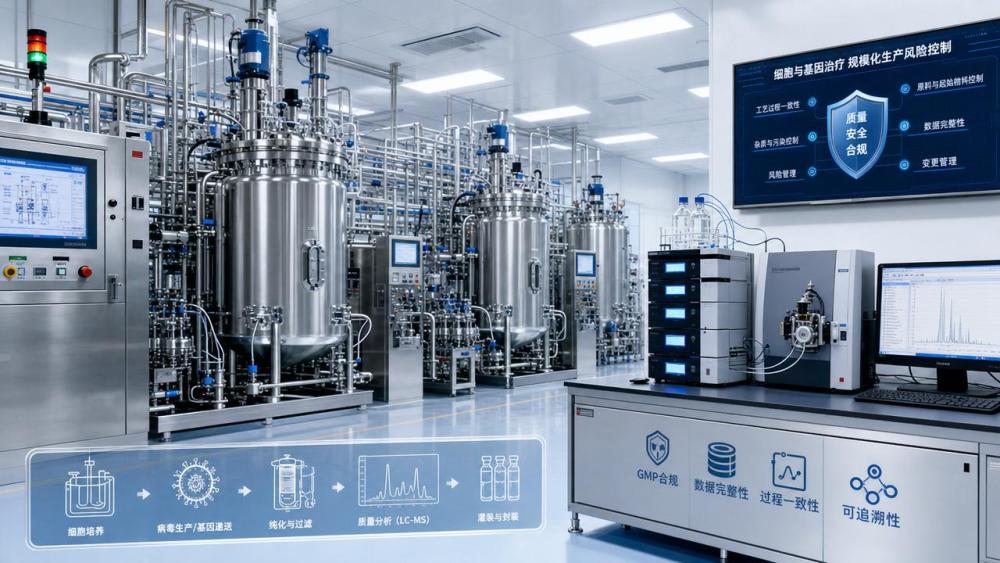
In 2026, commercial pressure is intensifying across autologous, allogeneic, and viral vector-based Cell & Gene Therapies. The challenge is not only technical expansion, but maintaining lot-to-lot consistency while handling low process tolerance, short product hold times, and strict release criteria.
Compared with conventional biologics, many CGT workflows involve 3 to 7 critical handoff points, from cell receipt and activation to transduction, expansion, harvest, fill, and release. Every handoff can introduce deviation risk, scheduling delay, or chain-of-identity exposure.
The main business risks behind scale-up failure
The first risk is process sensitivity. Small changes in dissolved oxygen, pH, agitation, cytokine dosing, or media exchange timing may alter cell phenotype, viability, or potency. In many Cell & Gene Therapies processes, acceptable variation windows are narrower than ±5%, leaving little room for uncontrolled scale transfer.
The second risk is capacity mismatch. A company may increase upstream batch volume by 2x or 4x, yet downstream purification, sterile handling, environmental monitoring, or QC release still operates at pilot speed. This creates hidden bottlenecks that extend cycle time by 24 to 72 hours.
The third risk is regulatory readiness. Cell & Gene Therapies manufacturing requires stronger traceability than many legacy systems can provide. Missing audit trails, incomplete CSV documentation, inconsistent electronic records, and weak deviation management can delay licensure even when science is strong.
Why 2026 raises the stakes
- More programs are shifting from clinical batches to pre-commercial and commercial planning.
- Funding discipline is forcing ROI scrutiny on every facility and equipment decision.
- Regulators expect better digital traceability, contamination control, and validated computerized systems.
- Supply volatility for single-use assemblies, filters, and vector-related materials remains a 6- to 12-month planning issue.
For leadership teams, this means Cell & Gene Therapies scale-up is no longer a science-only conversation. It is a capital allocation, quality governance, and operational resilience decision that affects launch timing, gross margin, and partner credibility.
Where Cell & Gene Therapies Operations Commonly Break Down
Many CGT organizations focus on the most visible process step, such as cell expansion or viral vector production, but scale-up failure usually comes from system misalignment. The table below highlights common breakdown areas that business leaders should review before approving expansion budgets.
The key takeaway is that Cell & Gene Therapies scale-up risk is distributed across equipment, people, digital systems, and quality oversight. A high-performing upstream process alone cannot compensate for weak downstream recovery or underdeveloped analytical release methods.
Upstream scale-up: more than increasing vessel volume
For mammalian and suspension-based workflows, scale-up should be evaluated through gas transfer, mixing time, shear exposure, and temperature uniformity rather than liters alone. A 5 L process that reaches target density in 6 days may not behave the same way at 200 L if sparger design, impeller configuration, and control logic are not matched.
In Cell & Gene Therapies, even a 10% drop in viability at harvest can materially affect final dose availability. This is especially important for autologous processes, where one missed batch often means one missed patient treatment window.
Downstream and analytical bottlenecks are often underestimated
Industrial centrifuges, filtration platforms, and concentration steps must be sized for real throughput, not theoretical throughput. If a harvest volume doubles, hold-time stability, clarification speed, and filter replacement frequency must be reassessed. A delay of 8 to 12 hours can affect viral vector integrity or cell recovery profile.
Analytical readiness is equally critical. LC-MS systems, potency assays, identity testing, and impurity profiling should be developed alongside process scale-up. If release testing remains semi-manual or poorly standardized, manufacturing success may still translate into commercial delay.
How Decision-Makers Should Evaluate Equipment and Platform Readiness
A practical way to assess Cell & Gene Therapies readiness is to evaluate whether equipment choices support consistency, flexibility, and auditability at the same time. Many organizations overemphasize initial purchase price and underweight validation effort, changeover speed, and data integration.
Four equipment questions that affect long-term ROI
- Can the system maintain process control across 3 scale points, such as 2 L, 50 L, and 200 L?
- Does it support single-use or hybrid configurations that reduce cleaning burden and changeover time?
- Can data be exported into validated digital workflows with secure audit trails?
- What is the realistic service response time: 24 hours, 72 hours, or longer across regions?
For Cell & Gene Therapies, these questions directly affect plant utilization and batch economics. A lower-cost unit can become expensive if it requires 2 extra operators, 1 additional manual reconciliation step, or repeated requalification during process changes.
Readiness matrix for procurement planning
The following matrix can help executive teams compare equipment and system priorities before committing to facility expansion or multi-site transfer.
A disciplined procurement framework reduces the chance of buying equipment that is technically advanced but commercially impractical. For Cell & Gene Therapies, fit-for-process matters more than generic performance claims.
Why automation and containment should be reviewed together
Automated liquid handling, biosafety cabinets, and clean benches are often purchased in separate workstreams. In reality, they should be reviewed as one control layer. If an automated workstation reduces manual steps by 30% but creates awkward aseptic transfers, total contamination risk may not improve.
The strongest Cell & Gene Therapies facilities design automation around closed or semi-closed workflows, operator ergonomics, environmental monitoring access, and electronic batch data capture. This integrated view supports both throughput and audit readiness.
GMP, CSV, and Data Integrity Risks That Can Delay Commercialization
For many Cell & Gene Therapies programs, the most expensive delay is not a failed experiment but a preventable quality-system gap discovered late. If digital records, software-controlled instruments, or workflow automation platforms are not validated in step with manufacturing growth, the organization can lose months during remediation.
Three compliance gaps seen during expansion
First, companies often add new instruments faster than they update validation packages. This creates inconsistent user access, unreviewed software changes, and weak electronic record traceability. In a regulated setting, these are not minor issues.
Second, method transfer and instrument qualification are frequently treated as separate projects. In Cell & Gene Therapies, analytical method suitability, instrument performance, and release criteria should be connected from the start to avoid comparability disputes.
Third, cross-functional ownership is often unclear. Manufacturing owns throughput, QA owns compliance, QC owns testing, and engineering owns systems, but no one owns end-to-end digital integrity. That gap becomes visible during inspection preparation.
A practical 5-step readiness sequence
- Map all software-controlled CGT equipment and identify GxP impact.
- Review user roles, audit trails, backup logic, and change control status.
- Align IQ, OQ, PQ, and method qualification timelines.
- Test deviation handling, electronic batch review, and data retrieval workflows.
- Run a mock inspection review 8 to 12 weeks before major filing milestones.
For business leaders, the point is simple: Cell & Gene Therapies scale-up requires compliance architecture just as much as process architecture. Strong documentation and validated systems do not slow growth; they protect it.
How to Build a Lower-Risk Scale-Up Strategy for Cell & Gene Therapies
A resilient Cell & Gene Therapies strategy combines technical discipline with investment sequencing. Organizations that scale well usually do not expand everything at once. Instead, they phase decisions across process definition, equipment selection, digital validation, and network support.
Recommended priorities for 2026 planning
- Standardize critical process parameters before increasing commercial batch cadence.
- Stress-test supply continuity for single-use assemblies, filters, and analytical consumables over a 2- to 4-quarter horizon.
- Invest in LC-MS, potency, and identity methods early enough to support late-stage comparability.
- Use automation where it removes repeatable error, not simply where it adds technical sophistication.
- Select equipment partners able to support process transfer, validation documents, and post-installation service.
Who should use this framework
This approach is especially relevant for biopharma executives, plant leaders, procurement directors, QA heads, technical operations teams, and CDMO decision-makers evaluating new Cell & Gene Therapies capacity. It is also useful for equipment suppliers that want to position their systems around measurable process outcomes rather than isolated specifications.
BLES supports this perspective by translating scale-up science into procurement intelligence, validation logic, and operating strategy. Across bioreactors, separation systems, LC-MS platforms, biosafety infrastructure, and liquid handling automation, the goal is not just better equipment selection, but stronger commercial readiness.
Cell & Gene Therapies will reward companies that can scale with precision, document with discipline, and adapt with speed. In 2026, the winners will be those that reduce process variability, protect GMP integrity, and align equipment choices with real manufacturing economics.
If your organization is planning CGT facility expansion, equipment sourcing, analytical upgrades, or compliance strengthening, now is the time to assess scale-up risk at system level. Contact BLES to get a tailored strategy, discuss product details, or explore more solutions for resilient Cell & Gene Therapies growth.
Related News
- Zylidac Bio and Prolific Machines Partner to Scale Optogenetics for GMP ProductionOct 23, 2026Prof. Alistair Thorne
- How to prevent oxygen limitation in process scale-up for biologicsOct 18, 2026Prof. Alistair Thorne
- How to maintain product quality when scaling up a bioprocessOct 09, 2026Prof. Alistair Thorne
- What should you verify before choosing a bioprocessing equipment exporter?Oct 08, 2026Prof. Alistair Thorne
Related News
- 00
0000-00
What CSV documentation should a laboratory systems supplier provide? - 00
0000-00
SCIEX Begins Construction of High-End Mass Spectrometer Plant in Beijing - 00
0000-00
Which design features make cleanroom benches easier to clean? - 00
0000-00
IndexBox Forecasts 12% CAGR for Global Microbioreactor Market Through 2035 - 00
0000-00
When do hazardous compound labs need isolators for containment?
Prof. Alistair Thorne
Weekly Insights
Stay ahead with our curated technology reports delivered every Monday.