





Biopharma Manufacturing Scale-Up Pitfalls: What Usually Breaks First?
Scaling a promising process into reliable commercial output is where many biopharma manufacturing strategies succeed or fail.
The risks extend beyond vessel size, batch volume, or facility capacity.
They involve comparability, GMP data integrity, automation readiness, equipment fit, and downstream purification resilience.
Understanding these pitfalls early protects product quality, accelerates regulatory confidence, and prevents expensive rework.
1. Why Does Lab Success Often Fail in Biopharma Manufacturing Scale-Up?
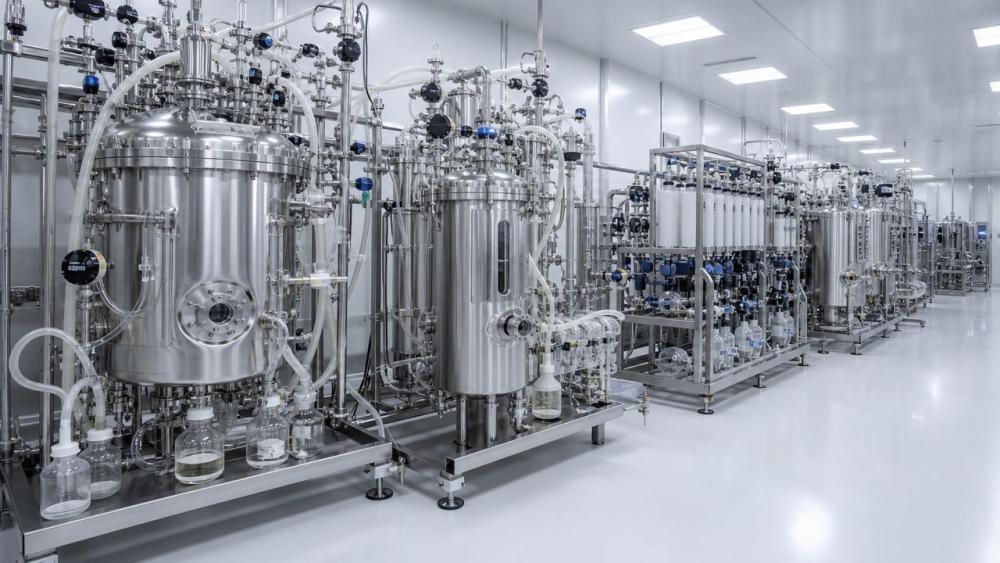
A lab process can look robust while hiding fragile assumptions.
Small vessels provide mixing, oxygen transfer, and heat removal conditions that rarely repeat at production scale.
In biopharma manufacturing, scale changes the physical environment around every cell.
CHO cells, microbial systems, and viral vector processes respond sharply to shear, gradients, and nutrient availability.
A 2 L bioreactor may show stable pH and dissolved oxygen.
A 2000 L system may create local zones with different gas transfer, mixing time, and carbon dioxide stripping.
The first pitfall is treating scale-up as geometric enlargement.
Better biopharma manufacturing scale-up starts with process understanding, not equipment purchasing.
- Map critical quality attributes before increasing batch size.
- Define acceptable ranges for pH, DO, osmolality, and metabolites.
- Compare mixing time, kLa, power input, and shear exposure.
- Run engineering batches before committing to commercial assumptions.
A disciplined model links cell culture behavior with mechanical performance.
That link is essential for predictable biopharma manufacturing and regulatory defensibility.
2. How Can Process Comparability Become a Hidden Regulatory Risk?
Comparability is not a paperwork exercise.
It proves that process changes do not alter safety, identity, purity, or potency.
In biopharma manufacturing, every scale transition may create new comparability questions.
A new bioreactor geometry can shift glycosylation patterns in monoclonal antibody production.
A new filtration area can change impurity clearance or product recovery.
A different chromatography skid can affect residence time and gradient accuracy.
The pitfall is assuming analytical release tests alone will catch every concern.
Modern biopharma manufacturing needs deeper analytical metrology across development and scale-up.
Which evidence matters most?
LC-MS, capillary electrophoresis, bioassays, and impurity profiling should be aligned early.
These methods help detect subtle molecular changes before they become submission delays.
Comparability protocols should include acceptance logic, not only raw data tables.
Each result must explain whether the scaled process remains scientifically equivalent.
- Use side-by-side batches when possible.
- Include orthogonal analytical methods.
- Track trend shifts, not only specification failures.
- Document rationales for every process parameter change.
Strong comparability planning reduces friction between biopharma manufacturing execution and regulatory review.
3. What Equipment Choices Create Downstream Bottlenecks?
Upstream productivity often improves faster than downstream capacity.
This imbalance is a common biopharma manufacturing scale-up trap.
Higher titers increase the load on harvest clarification, centrifugation, filtration, chromatography, and buffer preparation.
A bioreactor may perform well while purification becomes the actual production ceiling.
Industrial centrifuges, depth filters, and ultrafiltration systems must be sized against real impurity burden.
Cell density, debris profile, viscosity, and product stability all influence downstream performance.
In biopharma manufacturing, equipment selection must follow mass balance and process dynamics.
It should not follow catalog capacity claims alone.
Where do bottlenecks usually appear?
- Harvest clarification becomes slow after cell density increases.
- Chromatography columns limit campaign throughput.
- Single-use assemblies constrain pressure, flow, or hold time.
- Buffer preparation becomes a scheduling bottleneck.
- Manual sampling delays real-time process decisions.
Downstream modeling should begin before upstream scale is locked.
This approach keeps biopharma manufacturing capacity realistic from cell expansion to final formulation.
4. Why Is GMP Data Integrity a Scale-Up Pitfall?
Scale-up increases data volume, system interfaces, and audit exposure.
A process that relied on spreadsheets may collapse under GMP scrutiny.
Biopharma manufacturing depends on trusted records from instruments, automation platforms, and laboratory systems.
Incomplete audit trails can undermine an otherwise excellent process.
Computerized System Validation, or CSV, is therefore a scale-up requirement.
It should not be postponed until the validation batch stage.
The pitfall is buying advanced equipment without validating the data pathway.
For compliant biopharma manufacturing, electronic records must remain attributable, legible, contemporaneous, original, and accurate.
What should be checked early?
- User access control and role separation.
- Audit trail review workflows.
- Time synchronization across systems.
- Data export, backup, and restoration procedures.
- Change control for recipes and methods.
Automated liquid handling, LC-MS systems, and bioreactor controllers all generate critical records.
Each record must support traceable biopharma manufacturing decisions.
5. When Should Single-Use Technology Be Selected or Avoided?
Single-use technology can shorten changeover time and reduce cleaning validation burden.
It is valuable for flexible biopharma manufacturing, especially multiproduct facilities and CGT programs.
Yet single-use adoption is not automatically lower risk.
Supply continuity, extractables, leachables, pressure limits, and assembly integrity must be evaluated.
The pitfall is viewing disposable systems only as procurement items.
In biopharma manufacturing, they become part of the validated process boundary.
How does the choice differ from stainless steel?
The right platform depends on product lifecycle, demand volatility, facility strategy, and validation capacity.
Balanced biopharma manufacturing plans often combine both technologies intelligently.
6. How Can Automation Improve Scale-Up Without Creating New Failure Modes?
Automation improves repeatability, sampling discipline, and process response speed.
However, poorly implemented automation can freeze bad assumptions into production routines.
In biopharma manufacturing, automation should be designed around process logic and human oversight.
Liquid handling workstations can reduce pipetting error during assay preparation and NGS workflows.
Automated bioreactor control can stabilize feeding, DO control, and pH adjustment.
Yet recipe errors, sensor drift, and integration gaps can spread quickly at scale.
What implementation sequence is safer?
- Define the manual process and its failure points.
- Automate high-variability steps first.
- Validate sensors, recipes, and exception handling.
- Connect records to GMP data governance.
- Monitor trends after implementation.
Automation is most powerful when it improves scientific visibility.
It should not merely replace manual activity inside biopharma manufacturing operations.
FAQ Summary: Common Biopharma Manufacturing Scale-Up Questions
Final Takeaway: Build Scale-Up Around Evidence, Not Optimism
Successful biopharma manufacturing scale-up requires more than larger vessels and faster timelines.
It requires measurable process understanding, robust equipment fit, validated data flows, and realistic downstream planning.
The strongest programs connect cell culture dynamics with GMP expectations and commercial execution.
Before the next scale transition, review critical parameters, analytical comparability, automation readiness, and purification throughput.
That review can reveal weak links before they become batch failures, audit findings, or delayed launches.
For resilient biopharma manufacturing, the next step is clear: test assumptions early, document decisions rigorously, and scale only what is truly understood.
Related News
- Zylidac Bio and Prolific Machines Partner to Scale Optogenetics for GMP ProductionOct 23, 2026Prof. Alistair Thorne
- How to prevent oxygen limitation in process scale-up for biologicsOct 18, 2026Prof. Alistair Thorne
- How to maintain product quality when scaling up a bioprocessOct 09, 2026Prof. Alistair Thorne
- What should you verify before choosing a bioprocessing equipment exporter?Oct 08, 2026Prof. Alistair Thorne
Related News
- 00
0000-00
What CSV documentation should a laboratory systems supplier provide? - 00
0000-00
SCIEX Begins Construction of High-End Mass Spectrometer Plant in Beijing - 00
0000-00
Which design features make cleanroom benches easier to clean? - 00
0000-00
IndexBox Forecasts 12% CAGR for Global Microbioreactor Market Through 2035 - 00
0000-00
When do hazardous compound labs need isolators for containment?
Prof. Alistair Thorne
Weekly Insights
Stay ahead with our curated technology reports delivered every Monday.