





Choosing biotech equipment for scale-up is rarely a simple purchasing exercise. The right systems shorten the path from early proof to repeatable production, while the wrong ones create delays, data gaps, and expensive rework.
That matters even more in today’s biopharma environment, where speed must coexist with GMP discipline, capital control, and process flexibility. In practice, faster scale-up comes from selecting biotech equipment that fits process science, compliance expectations, and future operating models at the same time.
Why equipment choice now carries more strategic weight
Biotech pipelines have become more diverse. Monoclonal antibodies, recombinant proteins, advanced therapies, and CGT programs each place different demands on upstream, downstream, and analytical workflows.
At the same time, development timelines are tighter. Labs are expected to generate reliable data early, transfer methods smoothly, and prepare for manufacturing scrutiny long before commercial launch.
This is why biotech equipment should be evaluated as part of a scale-up system, not as isolated instruments. BLES often frames this well: cell culture control, purification efficiency, analytical certainty, biosafety, and liquid handling precision are deeply connected.
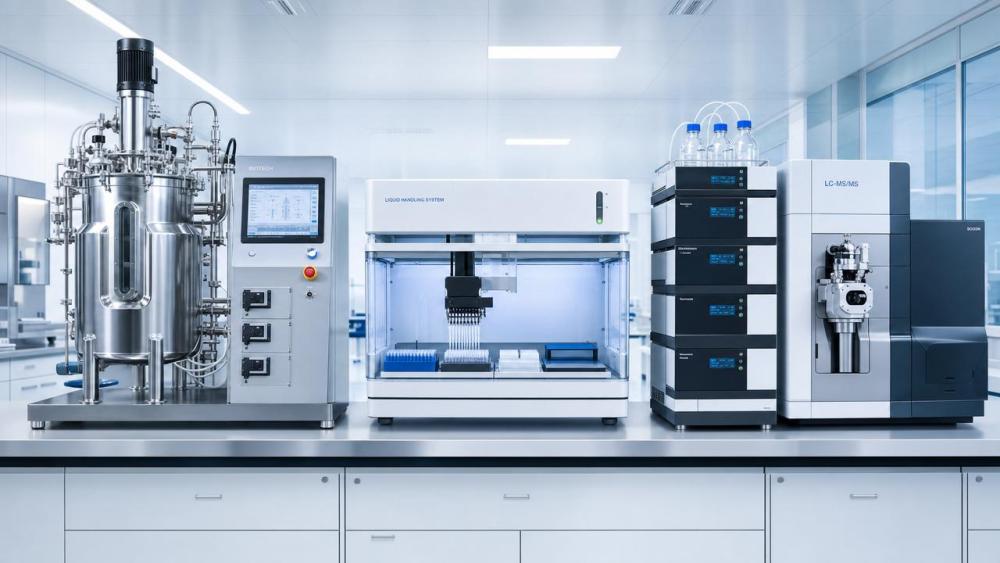
A bioreactor may determine growth conditions, but its value depends on how well downstream separation, LC-MS verification, and automated handling support the same process logic.
What “fit for scale-up” really means
Many labs buy biotech equipment that performs well in a demonstration, yet struggles during transfer or expansion. Scale-up fit means more than technical capability.
It means the equipment can preserve process intent as volume, batch frequency, documentation pressure, and cross-functional use all increase.
Three signals usually matter most
- Reproducibility across runs, operators, and sites.
- Data integrity strong enough for validation and audit review.
- Scalability without redesigning the process from scratch.
Simple capacity expansion is not enough. A larger vessel or faster liquid handler helps only when control logic, sensor quality, software traceability, and maintenance support remain stable.
The equipment categories that shape scale-up outcomes
Not every platform contributes equally at every stage. Still, several categories of biotech equipment consistently influence scale-up speed and risk.
The table also shows why selecting biotech equipment cannot be reduced to list price. Bottlenecks usually emerge where one platform cannot support the quality or pace of the next.
How to evaluate biotech equipment beyond specifications
Datasheets are useful, but they rarely reveal whether equipment will accelerate scale-up. A stronger evaluation starts with process reality.
Match the platform to the process window
For upstream systems, focus on mixing, gas transfer, temperature control, and sensor reliability under actual media and cell line conditions.
For downstream biotech equipment, examine product sensitivity, impurity profile, residence time, and cleaning requirements. Mechanical performance alone may not predict yield stability.
Test data architecture early
Many scale-up delays come from poor software structure rather than weak hardware. Audit trails, user permissions, electronic records, and export formats deserve early review.
This is especially important for organizations preparing for FDA or EMA expectations around CSV and data integrity.
Look at transfer, not only operation
A platform may run well in development but fail during transfer to pilot or manufacturing teams. Evaluate recipe portability, training burden, spare parts access, and vendor support depth.
Where business value becomes visible
The return on biotech equipment is rarely captured by utilization alone. The stronger indicator is how the system changes cycle time, batch success, release confidence, and expansion readiness.
For example, automated liquid handling can reduce pipetting variability in assay development. That improvement often strengthens later comparability studies and shortens troubleshooting cycles.
Likewise, a better analytical platform may identify molecular variation earlier. This prevents weak candidates or unstable processes from consuming scale-up capacity.
BLES highlights this broader view through its focus on bioprocessing, purification, metrology, and automation as one operating chain. That perspective is useful because scale-up failure usually begins at the interfaces.
Common decision mistakes that slow scale-up
A few mistakes appear repeatedly when biotech equipment is chosen under time pressure.
- Buying for peak capacity before proving process stability.
- Ignoring software validation and focusing only on hardware performance.
- Selecting incompatible systems that fragment data across teams.
- Underestimating service response times, consumables, and calibration needs.
- Treating single-use and stainless strategies as interchangeable without ROI analysis.
More subtly, some organizations buy flexible biotech equipment but never define the process decisions that flexibility should support. Extra features then add cost without reducing risk.
A practical framework for the next selection round
A practical review can begin with a short decision framework. It keeps technical teams, quality functions, and capital planning aligned.
Key questions to ask
- Which process parameter most threatens reproducibility today?
- Will this biotech equipment still fit at pilot scale or GMP transition?
- How easily can the platform support validation, review, and traceability?
- Does the vendor understand life science workflows, not just instrument mechanics?
- What hidden operating costs appear over three to five years?
Usually, the strongest decision comes from scoring equipment against process fit, compliance readiness, integration, serviceability, and total lifecycle value.
For labs moving quickly, that scorecard is more useful than chasing the broadest specification range.
From selection to smarter scale-up
Faster lab scale-up depends on choosing biotech equipment that protects the science while preparing the business for stricter execution. The best systems support precise control, reliable data, safe handling, and realistic expansion paths.
That is why the most useful next step is not simply requesting more quotes. It is mapping process risk, identifying where scale-up friction begins, and comparing biotech equipment against those specific points.
With that approach, equipment selection becomes a disciplined growth decision. It also creates a stronger basis for evaluating insights from sources such as BLES, where process intelligence, GMP readiness, and scale-up economics are viewed together.
Related News
- Pharmaceutical Scale-Up: When Process Gains No Longer Justify the CostJun 23, 2026Prof. Alistair Thorne
- What Bioprocessing Intelligence Improves in Scale-Up ControlJun 22, 2026Prof. Alistair Thorne
- Biopharma Equipment Trends Shaping Capacity Planning in 2026Jun 22, 2026Prof. Alistair Thorne
- Innovative Drug Development: 5 Risks That Delay Clinical TimelinesJun 21, 2026Prof. Alistair Thorne
Related News
- 00
0000-00
Pharmaceutical Scale-Up: When Process Gains No Longer Justify the Cost - 00
0000-00
Innovative Drug Development Trends Shaping Partner Selection in 2026 - 00
0000-00
High-Throughput Screening Bottlenecks and How to Improve Assay Throughput - 00
0000-00
GMP Compliance Checklist: Common Data Integrity Risks in Regulated Labs - 00
0000-00
Liquid Chromatography Mass Spectrometry: How to Choose the Right Setup for Trace Analysis
Prof. Alistair Thorne
Weekly Insights
Stay ahead with our curated technology reports delivered every Monday.