





High-Throughput Screening: When Nanoliter Dispensing Pays Off
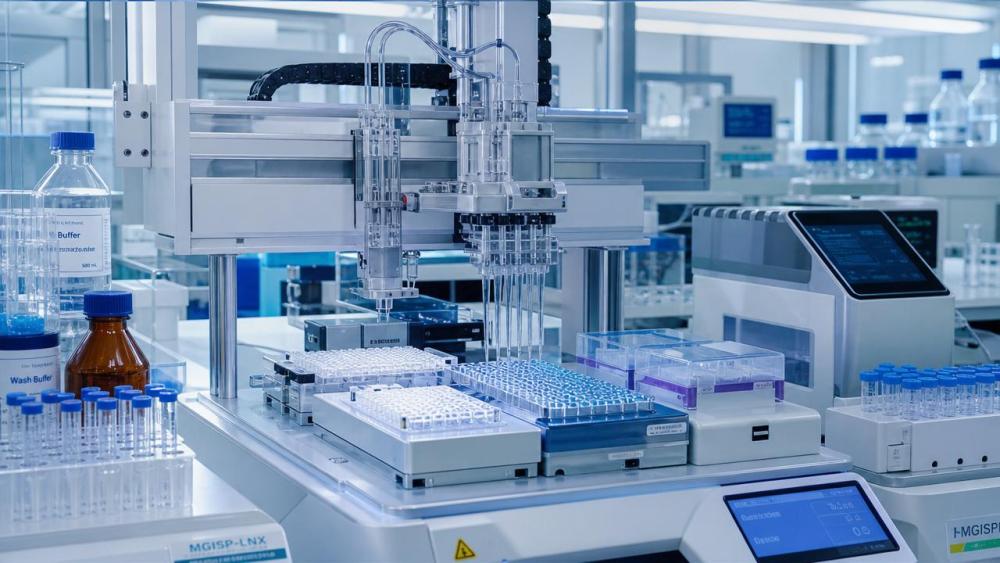
For capital approval, high-throughput screening is no longer just a scientific throughput metric. It is a capital efficiency decision.
As assay volumes shrink from microliters to nanoliters, laboratories can reduce reagent spend and conserve scarce biologics.
The stronger promise is faster hit identification without expanding headcount, bench space, or downstream analytical burden.
Yet nanoliter dispensing only pays off when accuracy, validation, data integrity, and scalability are evaluated together.
The Shift From More Wells to Smarter Volume Economics
The older logic of high-throughput screening focused on plate count, robot speed, and daily compound capacity.
That logic is changing as biologics, cell models, CRISPR libraries, and phenotypic assays become more expensive.
In many programs, the limiting resource is not the instrument queue. It is the sample, reagent, or validated assay window.
Nanoliter liquid handling changes the cost equation of high-throughput screening by attacking variable cost at the source.
A tenfold volume reduction can reshape consumable demand, storage needs, compound usage, and waste treatment exposure.
However, smaller volumes also make evaporation, adsorption, meniscus effects, and dispensing drift more consequential.
Trend Signals Showing Nanoliter Dispensing Is Moving Mainstream
High-throughput screening is becoming more integrated with automated sample preparation, AI-assisted analysis, and cloud-based laboratory informatics.
The shift is visible in 384-well, 1536-well, and acoustic dispensing workflows entering broader discovery operations.
Miniaturized assays are no longer restricted to elite screening centers with custom engineering support.
Vendors now combine nanoliter dispensing with barcode tracking, audit trails, environmental monitoring, and automated calibration routines.
This matters because high-throughput screening increasingly sits inside regulated, traceable, and globally distributed R&D environments.
Why the Payoff Is Rising Across Discovery Workflows
Several forces are pushing high-throughput screening toward nanoliter dispensing and smaller reaction formats.
- Reagents for complex biology are costlier than traditional biochemical substrates.
- Cell and gene therapy research often depends on limited donor material.
- Screening libraries are expanding faster than laboratory floor space.
- Integrated analytics reward consistent volume control and metadata quality.
- Sustainability goals are increasing scrutiny on solvent and plastic waste.
These drivers do not make every high-throughput screening program a candidate for nanoliter conversion.
They do make the old assumption of microliter formats look increasingly expensive in sensitive assays.
The economic benefit appears when miniaturization preserves assay quality while reducing the cost per valid datapoint.
Where Nanoliter Dispensing Creates Measurable Advantage
Nanoliter dispensing is strongest when high-throughput screening relies on expensive inputs and repeated dose-response exploration.
It also helps when assay development must test many conditions before a robust screening window emerges.
High-value reagents and limited samples
Antibodies, enzymes, viral vectors, cytokines, and patient-derived materials can dominate total assay cost.
In these cases, high-throughput screening gains value by extending each batch across more experimental conditions.
Large compound libraries and matrix designs
Combination screens, toxicity panels, and formulation matrices multiply the number of required dispense events.
Nanoliter dispensing can reduce the penalty of broader exploration while keeping replicate strategy intact.
Early programs with uncertain biology
Early discovery often needs fast learning more than perfect final process mimicry.
Miniaturized high-throughput screening supports rapid hypothesis testing before more material-intensive confirmation steps begin.
Where Conventional Liquid Handling May Still Win
Nanoliter systems are not automatically superior to microliter liquid handling workstations.
Some assays need mixing energy, incubation volume, or surface area that does not scale cleanly.
Other workflows require simple, robust, GMP-aligned transfers where validation overhead outweighs reagent savings.
- Use microliter dispensing when assay tolerance is wide and reagents are inexpensive.
- Avoid over-miniaturization when evaporation changes biological response.
- Retain conventional formats when downstream confirmation uses larger volumes anyway.
- Question nanoliter adoption if calibration resources are consistently unavailable.
The smarter investment is the one that improves validated decisions, not just theoretical plate throughput.
The Hidden Variables Behind Total Cost of Ownership
The business case for high-throughput screening should include more than purchase price and claimed dispense speed.
Total cost of ownership includes method development, qualification, maintenance, consumables, software, and failed-run exposure.
Data integrity also has financial value because weak records can slow decisions or force repeat studies.
Impact on Laboratory Operations and Business Decisions
When high-throughput screening is miniaturized well, discovery teams can test broader biology earlier.
Operations can reduce repetitive manual handling while improving scheduling consistency across automated liquid handling platforms.
Analytical teams also benefit when dispensing records align with LC-MS, imaging, plate reader, and LIMS datasets.
For enterprise planning, the effect is portfolio-level. More reliable early data can reduce late-stage waste.
The downside is organizational complexity. Nanoliter workflows demand stronger coordination between assay biology, automation, informatics, and quality systems.
- Assay development must define acceptable miniaturization limits.
- Automation teams must monitor dispense performance continuously.
- Quality functions must confirm traceability and change control.
- Data teams must preserve metadata for later modeling.
Key Points to Watch Before Funding a Nanoliter Platform
A strong high-throughput screening investment case should connect technical performance to economic outcomes.
The strongest cases usually show both reagent savings and faster decision cycles.
- Estimate cost per valid datapoint, not cost per plate.
- Compare reagent savings against validation and maintenance costs.
- Run pilot plates with real samples, not only vendor demos.
- Measure Z-factor, CV, edge effects, and hit confirmation rates.
- Check whether software supports audit trails and role permissions.
- Confirm service response for critical high-throughput screening periods.
These checks prevent a common mistake: buying speed while inheriting fragility.
A Practical Decision Framework for ROI
Nanoliter dispensing pays when reduced volume produces more reliable decisions at lower total program cost.
The following framework helps compare high-throughput screening options without relying on headline throughput alone.
How BLES Reads the Next Phase of Screening Automation
The next phase of high-throughput screening will be defined by precision, traceability, and scale-up intelligence.
Liquid handling workstations will increasingly connect with biosafety cabinets, analytical systems, and GMP-ready data environments.
For biopharmaceutical research, this connection is essential. Screening hits must eventually survive purification, characterization, and manufacturing translation.
BLES tracks these links across automated liquid handling, LC-MS analytics, clean processing, and bioprocess scale-up.
That perspective helps separate attractive automation claims from platforms that support durable scientific and operational advantage.
Action Steps for the Next Evaluation Cycle
Start with a quantified map of current high-throughput screening cost drivers.
Then identify assays where volume reduction would change decision economics, not merely reduce liquid consumption.
Run a controlled pilot comparing microliter and nanoliter formats using the same biology, controls, and analysis rules.
Track reagent usage, valid datapoints, repeat rates, hit confirmation, downtime, and documentation effort.
If nanoliter dispensing improves both cost per decision and data confidence, the investment case becomes compelling.
If it only improves theoretical throughput, conventional liquid handling may remain the better choice.
High-throughput screening pays off when automation, biology, analytics, and compliance move together with measurable discipline.
Related News
- How to prevent carryover in automated low-volume liquid handlingSep 28, 2026Lab Automation Architect
- TUV Validation Marks First Scaled Nanoliter Dispensing DeliveryJul 14, 2026Lab Automation Architect
- EMA-Qualified Nanoliter Platform Enters Volume DeliveryJul 13, 2026Lab Automation Architect
- NanoPipette Pro Moves to Volume Delivery After EMA Pre-CertificationJul 10, 2026Lab Automation Architect
Related News
- 00
0000-00
What CSV documentation should a laboratory systems supplier provide? - 00
0000-00
SCIEX Begins Construction of High-End Mass Spectrometer Plant in Beijing - 00
0000-00
Which design features make cleanroom benches easier to clean? - 00
0000-00
IndexBox Forecasts 12% CAGR for Global Microbioreactor Market Through 2035 - 00
0000-00
When do hazardous compound labs need isolators for containment?
Lab Automation Architect
Weekly Insights
Stay ahead with our curated technology reports delivered every Monday.